
A weekend campsite doesn't need a miniature power grid. It needs enough energy to get through the night without losing the things you actually rely on. A lamp and a couple of phones are a very different problem from a compressor fridge running for two days. Write down your loads before you look at the battery aisle.
Start with watt-hours, not the number of outlets
A watt measures power at an instant; a watt-hour measures energy over time. Multiply the average draw in watts by hours of use. A 10 W light running for four hours takes 40 Wh. A 60 W appliance for ten minutes takes 10 Wh, not 60 Wh. USB adapters, AC inverters and battery management all use some energy, so energy delivered at the socket isn't necessarily the capacity printed on the box.
A compressor refrigerator complicates the estimate because it cycles. A 45 W compressor running for 40% of a 24-hour day uses about 432 Wh. That is a hypothetical duty cycle, not a fridge specification. Pre-chilling, ambient heat, ventilation and how often the lid opens can alter it considerably. Measure the average with an appropriate meter if possible; if you already know the measured daily Wh, divide by 24 and enter that as the average wattage for a full day.
Three worked camping examples
| Load | Average W | Hours/day | Wh/day |
|---|---|---|---|
| Phone charging, combined | 10 | 3 | 30 |
| LED lantern | 5 | 4 | 20 |
| Fan | 12 | 8 | 96 |
| Compressor fridge (illustrative average) | 18 | 24 | 432 |
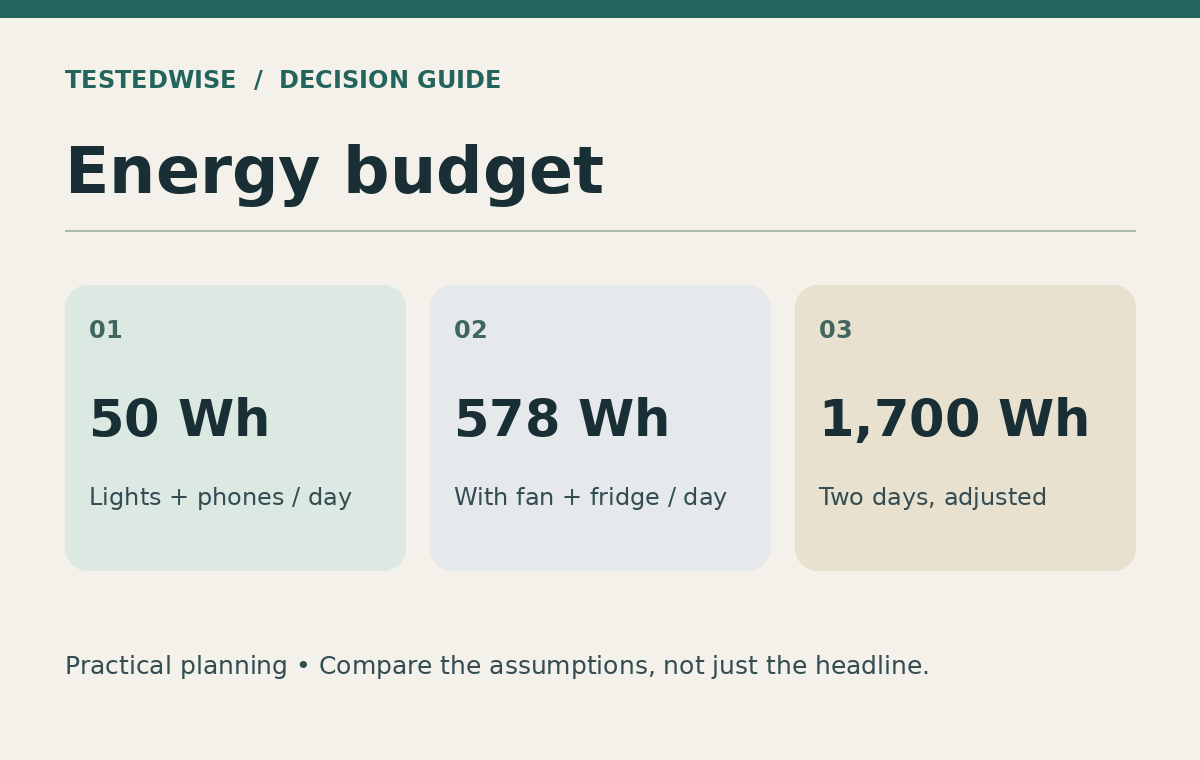
For lighting and phones alone the total is 50 Wh/day. Adding the fan gives 146 Wh/day. Adding the fridge takes the total to 578 Wh/day. These are deliberately transparent assumptions, not measured consumption. A two-night trip might involve more than 48 hours away from charging, so use the actual hours between reliable charging opportunities rather than counting nights alone.
If the full 578 Wh/day load must run for two days, that's 1,156 Wh at the devices. With an assumed 85% delivery efficiency and a 20% capacity reserve, the nominal battery estimate is 1,156 ÷ (0.85 × 0.80), or 1,700 Wh. Do not add a second reserve if the usable battery figure you entered already includes one. A 1,024 Wh unit could still work with confirmed charging, fewer loads or a smaller measured fridge draw, but cannot deliver 1,156 Wh from a single charge under those assumptions.
Check the power limit separately
Energy is the overnight budget; watts determine which appliances can start and run. A 1,500 W kettle operating for six minutes uses 150 Wh, but still needs an outlet rated for that load. If another device shares the inverter, add its simultaneous running watts. Compare startup requirements in the appliance instructions with the power station's documented surge duration and port limits. Don't use the advertised surge figure as a continuous rating.
A DC fridge may avoid some AC conversion losses if its voltage, connector and current match the power station. Check that the DC socket stays on when the compressor is idle; some power-saving modes shut off light loads. Test that behavior at home rather than discovering it when the food warms up.
Make a charging plan that survives bad weather
If you're driving between campsites, consult the vehicle and power station manuals for permitted charging current and whether the socket is switched with ignition. A socket that remains energized can drain a starter battery. A solar panel's nameplate power is not its all-day output. Shade, clouds, direction, heat and the station's input limits matter. Never count on solar to supply an essential overnight load before you've established a fallback.
For a weekend, a simple option is to size for the trip without recharge. For a longer trip, record each reliable opportunity separately and reduce the storage interval only when it is realistic. A fuel generator has exhaust, noise and campsite restrictions; use it outdoors away from people and openings as directed by CPSC and the manufacturer. Keep the power station dry, ventilated and within its stated temperature limits.
Pack a fallback before leaving
Prioritize a thermometer and dependable cold storage over decorative lighting. Keep a separate flashlight and a way to navigate even if the shared battery runs down. If food storage depends on power, have a backup plan using ice or shelf-stable meals. A medical device needs a manufacturer-approved power arrangement and a reliable contingency; a generic camping estimate is not enough.
Try our Camping Power Planner with your own numbers. Use the fridge runtime calculator if the fridge is your only concern; use the generator calculator for startup watts rather than energy capacity.
To decide whether stored battery energy or a fuel-powered generator fits your campsite, see Portable Power Station vs. Inverter Generator for Camping.
To compare ice storage with powered refrigeration before buying, see 12V Car Fridge vs. Traditional Cooler: Which Makes Sense?.
Frequently asked questions
Is a 500 Wh power station enough for a weekend?
It can be enough for light electronics, but the actual answer depends on hours, load and losses. A continuous 18 W average fridge alone uses 432 Wh per day before delivery losses.
Can I use the battery percentage to estimate tomorrow's power?
Only approximately. Measure consumption under representative conditions, and check actual usable capacity and the power station's cutoff. Reserve more energy if temperature or consumption is unpredictable.
What if my device only lists amps?
At a known DC voltage, volts times amps gives watts. A maximum input label is an upper bound, not a measured average. AC loads may also have power-factor and startup considerations; use real watt measurements or manufacturer guidance.
Related buying and setup guides
- Car Camping Essentials: A Beginner's Weekend Checklist
- Camp Kitchen Essentials: Build a Simple Outdoor Cooking Setup
- Best Portable Power Stations for Camping & Home Backup: 5 Models Compared
- Best 12V Car Refrigerators for Road Trips and Camping: 5 Models Compared
- Best Camping Generators: 5 Quiet Inverter Models Compared for Car Camping & RVs