
Best Portable Power Stations for Camping & Home Backup: 5 Models Compared
A portable power station can make a campsite more comfortable, keep a router and a few lights running during a short outage, or give you a practical way to charge gear away from a wall outlet. The hard part is choosing a size that fits the job. A unit with a large battery can still have a modest AC output, while a smaller model may run a surprisingly powerful appliance for a short time.
Affiliate disclosure: This article contains affiliate links. TestedWise may earn a commission if you purchase through them, at no additional cost to you. Read the full disclosure.
We compared five current Amazon US listings from BLUETTI, Jackery, EcoFlow, and Anker. The selection spans compact 300Wh-class stations, two popular 1kWh models, and a 2kWh option. This is a research-led comparison based on retailer listings, manufacturer specifications, and published independent testing; we did not conduct hands-on runtime tests on these five units.
Quick answer: The BLUETTI Elite 30 V2 offers unusually high rated output for a compact 288Wh station. The Jackery Explorer 300 is lighter and better suited to phones, laptops, and lights. Choose the EcoFlow DELTA 3 for a balanced 1kWh setup with expansion support, the Anker SOLIX C1000 Gen 2 for higher continuous AC output and fast recharging, or the Anker SOLIX S2000 when longer runtime is the priority.
Portable power station comparison
| Model | Battery capacity | Continuous AC output | Approx. weight | Best fit |
|---|---|---|---|---|
| BLUETTI Elite 30 V2 | 288Wh | 600W | 9.4 lb | Compact station with a stronger inverter |
| Jackery Explorer 300 | 292Wh | 300W | About 7–7.5 lb* | Phones, laptops, lights, and cameras |
| EcoFlow DELTA 3 | 1,024Wh | 1,800W | About 27.6 lb | Balanced camping and outage use |
| Anker SOLIX C1000 Gen 2 | 1,024Wh | 2,000W | 24.9 lb | Higher AC loads and fast recharging |
| Anker SOLIX S2000 | 2,010Wh | 1,500W | 35.7 lb | Longer runtime for moderate loads |
*The Jackery listing has a small discrepancy between its item-weight field and feature copy; the range is approximate.
Capacity and output are different measurements. Watt-hours (Wh) describe how much energy the battery stores; watts (W) describe how much power the inverter can supply at one time. A 2,010Wh station with a 1,500W inverter can run a modest load for longer than a 1,024Wh unit, but it cannot necessarily run a higher-wattage appliance. Surge ratings and special modes are separate from continuous output.
The five portable power stations worth comparing

Best compact station when 600W output matters more than a tiny battery
1. BLUETTI Elite 30 V2
The Elite 30 V2 is a small-format station with a more useful inverter rating than many products in the same 300Wh class. BLUETTI lists 288Wh of LiFePO₄ capacity and 600W of continuous AC output, with a separate Power Lifting mode rated up to 1,500W for compatible resistive loads. That last figure is not a 1,500W continuous rating, so it should not be treated as permission to run any appliance with a 1,500W label.
At about 9.4 lb, it is still manageable for car camping, a desk setup, or short power interruptions. The manufacturer lists a 10ms UPS switchover and fast AC charging, but the 288Wh battery is best for electronics, lights, routers, and other modest loads rather than long-running kitchen appliances.
- 288Wh LiFePO₄ battery and 600W rated AC output.
- Power Lifting mode is a separate 1,500W claim; check appliance compatibility and the manual.
- About 9.4 lb, with 10ms UPS and manufacturer-listed 45-minute 0–80% charging.

Best lightweight option for phones, laptops, cameras, and campsite lighting
2. Jackery Explorer 300
The Explorer 300 is the simplest carry-friendly choice in this comparison. Its Amazon listing describes 292Wh of capacity, 300W of rated output, and a 600W peak, with two AC outlets, a 100W USB-C port, two USB-A ports, and a 120W car outlet. The Amazon page shows slightly different weights in its item-details field and feature copy, so treat it as roughly 7–7.5 lb. It is still much easier to move between a vehicle, picnic table, and tent than a 1kWh station.
Think of it as a device-and-lighting station, not a small home generator. It is a practical match for charging a laptop, camera batteries, phones, a small fan, or LED lights. It is not the right tool for a kettle, toaster, microwave, or other high-wattage appliance.
- 292Wh capacity, 300W rated output, and 600W peak surge.
- New-version LFP battery with 4,000+ cycles to 70% capacity and a five-year warranty, according to Jackery.
- About 7–7.5 lb (Amazon listing fields differ), with 2 AC outlets, 100W USB-C, USB-A, and a 12V car outlet; solar panel is not included with this listing.

Best balanced 1kWh option for camping and moderate home backup
3. EcoFlow DELTA 3
The DELTA 3 moves into the class that can run more than small electronics. EcoFlow lists 1,024Wh of capacity and 1,800W of AC output, with a 3,600W surge rating and a 10ms UPS function. Its LFP battery, five-year warranty, and expansion options make it a flexible middle ground for people who want one unit for weekend trips and occasional outages.
EcoFlow advertises a 56-minute full recharge under its specified AC charging conditions and says the system can expand to as much as 5kWh with compatible extra batteries. The real value is the combination of a useful inverter, expansion path, and several charging methods. Check the exact solar input and accessory compatibility for the configuration you are buying.
- 1,024Wh LFP battery; 1,800W AC output and 3,600W surge.
- 10ms UPS, five-year warranty, and expansion support with compatible batteries.
- Manufacturer advertises a 56-minute full AC recharge under specified charging conditions.

Best 1kWh pick when higher continuous AC output is the priority
4. Anker SOLIX C1000 Gen 2
The C1000 Gen 2 has a similar battery size to the DELTA 3 but a higher stated continuous inverter output. Anker lists 1,024Wh and 2,000W continuous AC output, with a 3,000W peak. That difference matters when you are comparing appliances: the C1000 can support a higher running load on paper, even though its stored energy is in the same general class as the EcoFlow.
Anker advertises 49-minute HyperFlash charging at up to 1,600W when the mode is enabled in the app, 600W maximum solar input, and a 10ms UPS switchover. It weighs about 24.9 lb. One trade-off is that the Gen 2 model is not expandable with extra batteries, so choose it for its output and charging speed rather than a future capacity-growth plan.
- 1,024Wh capacity, 2,000W continuous output, and 3,000W peak.
- About 24.9 lb; 600W maximum solar input and 10ms UPS.
- 49-minute charging is an Anker claim tied to HyperFlash mode and the specified input conditions; no expansion battery support.
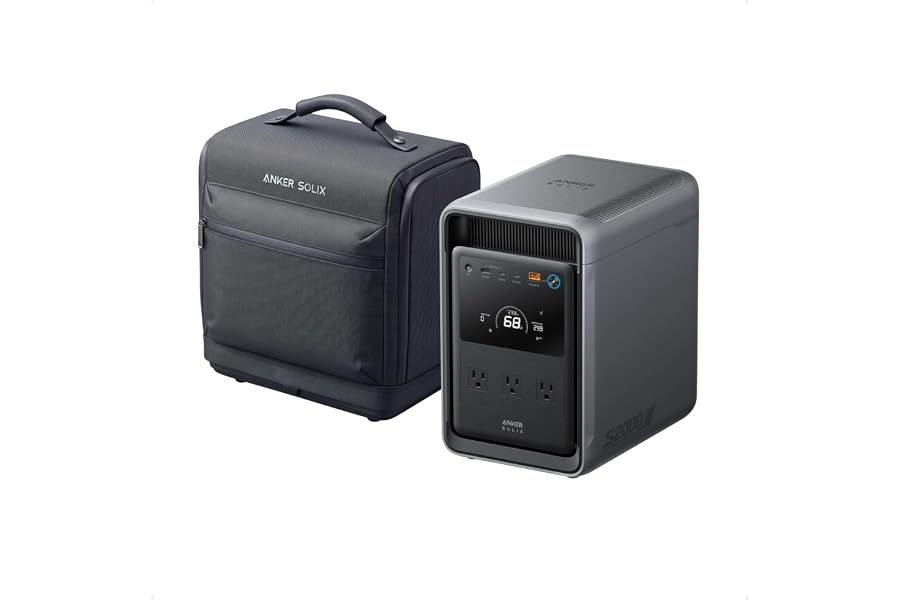
Best for longer runtime when battery capacity matters more than inverter wattage
5. Anker SOLIX S2000
The S2000 doubles the stored energy of a typical 1kWh station, but its continuous AC output is lower than the C1000 Gen 2. Anker lists 2,010Wh, 1,500W rated output, and 3,000W peak. That makes it a useful example of why battery capacity and inverter output must be considered separately: it can run a modest load for longer, but it is not the better choice for an appliance that needs more than 1,500W continuously.
At about 35.7 lb, it is still portable but is more naturally a car-camping or home-backup unit than a station you want to carry far. Anker claims up to 35 hours of refrigerator backup under its own test conditions. The official specifications also list a 10ms UPS and five-year warranty. One notable omission is a 12V DC car outlet, so check the port list if you use a 12V fridge or other vehicle accessories.
- 2,010Wh LFP capacity; 1,500W continuous and 3,000W peak AC output.
- About 35.7 lb, with 10ms UPS and five-year warranty.
- No 12V DC car port; Anker’s 35-hour refrigerator figure is a manufacturer test claim, not a universal runtime promise.
How to size a portable power station for your actual gear
1. Start with the appliance label, not the battery headline
Make a short list of the devices you want to run. Record each device’s running wattage, how many hours you expect to use it, and whether it has a motor or compressor that draws extra power when it starts. A laptop, phone charger, LED lantern, and camera battery charger are modest loads. A kettle, toaster, microwave, hair dryer, or space heater can draw well over 1,000W and may overwhelm a small station even if its battery capacity looks generous.
For a rough runtime estimate, divide the station’s usable energy by the load in watts. A planning shortcut is rated Wh × 0.8 ÷ device watts for an AC load, but the 0.8 factor is only an estimate for inverter losses and reserve. Real results depend on the device, temperature, battery condition, inverter efficiency, and the station’s own standby draw. A 1,024Wh unit might deliver around eight hours to a steady 100W load under that rough assumption, not a guaranteed eight-hour runtime.
2. Check continuous output and surge separately
Continuous output is the rating that matters for an appliance while it is running. Surge output is a short-duration allowance for startup loads, and the duration and supported load types vary by model. Do not size a station around a surge number. If your refrigerator, pump, or compressor has a high startup draw, check the appliance manual and the power station’s detailed specifications rather than assuming the headline peak number will cover it.
3. Treat special power modes as compatibility features
BLUETTI’s Power Lifting mode and EcoFlow’s X-Boost are not the same thing as a higher continuous inverter rating. These modes can support certain resistive loads by changing the way output is delivered, but they are not suitable for every appliance or electronic device. Read the product manual and use the manufacturer’s compatibility guidance. A device that relies on precise voltage or has a motor may not behave as expected in a special mode.
4. Choose battery chemistry and cycle-life claims with context
All five models in this comparison use lithium iron phosphate (LiFePO₄ or LFP) batteries, which are commonly selected for portable power stations because of their cycle-life and thermal-stability characteristics. Cycle-life numbers are measured under defined conditions and often refer to the point at which a battery retains a stated percentage of its original capacity. A 4,000-cycle claim to 70% capacity is not the same as 4,000 cycles to 80%, and neither is a promise that every user will get the same number of years.
5. Compare ports, not just the number of outlets
Look at the actual ports your gear uses. A 12V fridge may need a regulated DC car outlet; a laptop may need USB-C Power Delivery; a household appliance may need a grounded 120V AC outlet. The Anker SOLIX S2000 is a useful example: it has a large battery but no 12V DC car port. That can be a deal-breaker for a camper who expects to connect a 12V cooler directly.
If a 12V compressor refrigerator is part of your camping setup, choose the fridge and power station as a system. Check the fridge's average draw, DC input requirements, and low-voltage cutoff rather than estimating runtime from its maximum wattage alone. Our portable 12V car refrigerator comparison covers battery-equipped and conventional models, plus the practical differences between single-zone and dual-zone designs.
Solar charging and home backup: what to check
A solar panel’s advertised wattage is a laboratory maximum, not the output you should expect all day. Angle, cloud cover, shade, temperature, cable losses, and the station’s maximum solar input all affect charging. Check the voltage and connector compatibility as well as the maximum input watts. A 400W panel cannot force 400W into a station that accepts only 200W, and a panel that exceeds the station’s voltage limit may be unsafe.
For home backup, decide which circuits or appliances matter most before buying. A portable station is useful for a fridge, modem, lights, and small electronics only if its continuous output and runtime match those loads. Do not plug a power station into a wall outlet to energize house wiring. If you want to connect backup power to household circuits, use a properly rated transfer switch or approved inlet installed by a qualified electrician. A portable battery station also does not produce the same kind of unlimited fuel supply as a gas generator.
For camping, the simplest setup is often a station sized for electronics and lighting, with a separate plan for cooking. A 300Wh model can be enough for a phone, camera, laptop, and lantern; it is not designed to run an electric hot plate for a weekend. If you are building a first trip kit, our car-camping essentials checklist and camp kitchen guide help separate electrical needs from cooking gear.
Buying mistakes that are easy to avoid
- Choosing by Wh alone. Battery capacity does not tell you whether the inverter can run the appliance you have in mind.
- Assuming a solar panel is included. Many Amazon listings are station-only; check the selected bundle and what is in the box.
- Confusing surge with continuous watts. A peak rating is not a safe continuous operating target.
- Ignoring the port layout. Check for 12V DC, USB-C PD, and the number of AC outlets you actually need.
- Expecting a UPS label to guarantee every device. Check transfer time, waveform, device requirements, and the manufacturer’s instructions for sensitive equipment.
- Planning home backup without a load list. A station that can run a router and lights may not run a microwave or electric heater.
For a related project, see when an inverter generator may be a better fit.
Frequently asked questions
What size portable power station do I need for camping?
For phones, cameras, lights, and a laptop, a compact 250–300Wh unit may be enough for a short trip. Add a 1kWh-class station if you want more runtime, a 12V fridge, or several devices at once. Estimate your daily watt-hours before choosing rather than relying on a generic campsite size recommendation.
Is a 1,000Wh power station enough to run a refrigerator?
It can run some refrigerators for a period of time, but runtime varies widely with compressor cycles, ambient temperature, door openings, fridge size, and inverter losses. Check the refrigerator’s running and startup requirements, then use a conservative runtime estimate. A manufacturer’s fridge-runtime claim is tied to its own test conditions.
Is a 2,000Wh power station automatically more powerful than a 1,000Wh model?
No. Wh describes stored energy, while W describes output power. The Anker SOLIX S2000 stores 2,010Wh but is rated for 1,500W continuous output; the C1000 Gen 2 stores 1,024Wh and is rated for 2,000W continuous output. The larger battery can run a moderate load longer, but the smaller station can support a higher continuous load.
Can I use a portable power station indoors?
Battery power stations do not burn fuel and do not produce the carbon monoxide exhaust associated with gas generators. Still, follow the manufacturer’s ventilation, temperature, clearance, and charging instructions. Do not use a fuel-powered generator indoors or in an attached garage.
Can I leave a power station plugged in all the time?
Some models support UPS or pass-through operation, but charging behavior, bypass limits, battery-management settings, and long-term storage instructions differ. Check the manual for the exact model and avoid assuming that every station is designed for permanent 24/7 use.
Bottom line
For a compact station, choose between the Jackery Explorer 300’s lower weight and the BLUETTI Elite 30 V2’s higher rated output. In the 1kWh class, the EcoFlow DELTA 3 offers expansion flexibility, while the Anker C1000 Gen 2 has the higher continuous AC rating and fast recharge feature. The Anker S2000 is the capacity choice for longer moderate loads, but its 1,500W inverter and lack of a 12V car port matter as much as its 2kWh battery.
Before ordering, confirm the exact model, AC output, port list, solar-panel compatibility, and whether the current Amazon offer includes the accessories shown in the product photos.