
Most first-time campers need fewer camp kitchen essentials than long gear checklists make it sound. For a first drive-up campsite, you can cook plenty of good meals with a stove, one pot, one pan, a few utensils, a cooler, clean water, and a simple way to wash up. What matters is how those pieces work together—not how many gadgets you can fit in the car.
Affiliate disclosure: This article contains affiliate links. TestedWise may earn a commission if you purchase through them, at no additional cost to you. Read the full disclosure.
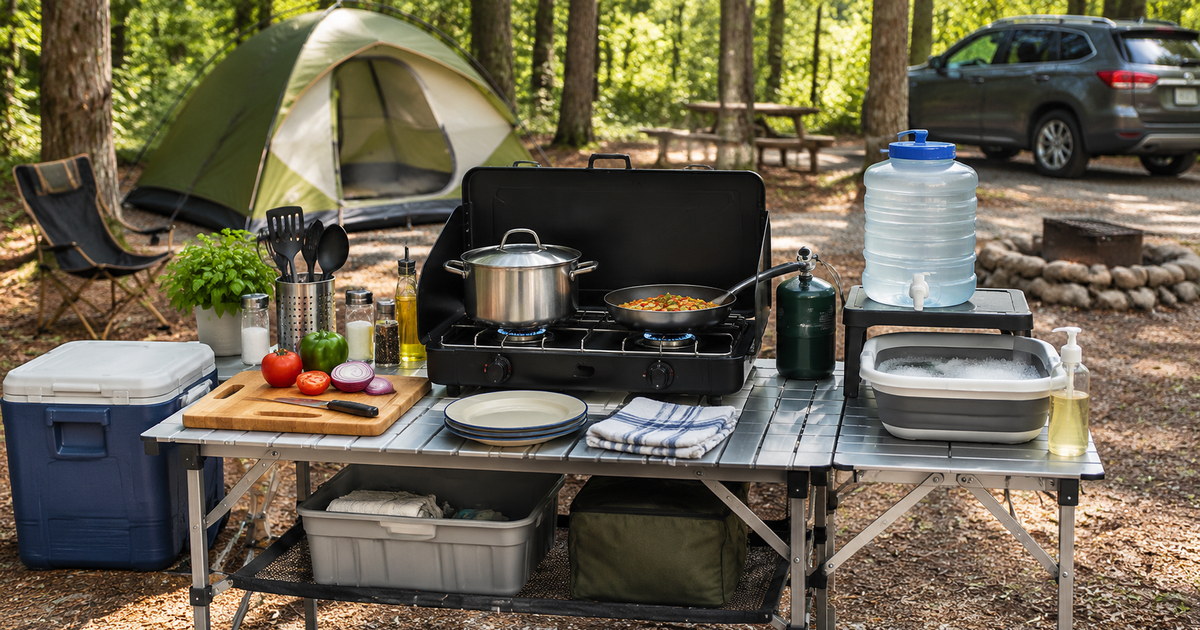
This guide is for car campers and people staying at developed campgrounds, where the vehicle is close enough to carry a cooler and a few heavier items. It is not a backpacking kitchen list: weight and pack size matter less here than easy setup, stable cooking, safe food storage, and quick cleanup.
Plan the meals before buying gear
The easiest way to overpack a camp kitchen is to shop from a long checklist without deciding what you will cook. A Dutch oven, griddle, coffee press, cast-iron skillet, and a full utensil roll can all be useful. None of them is essential if your weekend menu does not need them.
Write down the meals you actually plan to make, then list the equipment each one requires. For a first two-night trip, a menu like this keeps the cooking simple:
| Meal | Simple option | What it needs |
|---|---|---|
| Friday dinner | Wraps, sandwiches or a prepared salad | Cooler, knife, cutting board, plates and a trash bag |
| Saturday breakfast | Oatmeal and eggs | Stove, small pot, frying pan, spatula, bowls and mugs |
| Saturday lunch | Sandwiches or leftovers | Cooler, prep surface, knife and plates |
| Saturday dinner | One-pot pasta, chili or a skillet meal | Stove, lidded pot or pan, spoon, serving utensils and wash kit |
| Sunday breakfast | Coffee and oatmeal | Pot or kettle, mugs, water and a simple cleanup kit |
This menu does not require a grill, Dutch oven, large sink, or a separate coffee machine. If you are cooking for two, a single-burner stove may be enough for one-pot meals. A two-burner stove becomes more useful when you want to boil water while eggs cook, or keep a sauce warm while another pan is in use.
For more general trip planning, start with our car camping essentials checklist. It covers shelter, sleep, lighting, clothing, and the other items that sit outside the kitchen.
Set up three simple kitchen zones
A camp kitchen works best when each task has a place. You do not need a purpose-built kitchen cabinet; a picnic table, folding table, cooler and two storage bins can do the job. Arrange them so raw food, hot cookware, clean plates and dirty dishes do not compete for the same patch of space.
| Zone | Keep here | What the zone is for |
|---|---|---|
| Prep | Cutting board, knife, ingredients, dry-food bin, hand-cleaning supplies | Wash hands, portion ingredients and keep raw food separate from ready-to-eat food |
| Cook | Stove, fuel, pot, pan, spatula, spoon, tongs and heat-safe gloves | Keep the stove on a stable, level surface with clear space around it |
| Serve and wash | Plates, cups, water, wash basin, sponge, soap, towel and trash bag | Serve meals, collect dirty dishes and keep food scraps contained |
At a campground with a fixed picnic table, use it for prep and serving, then place the stove on a separate stable surface if the campground rules and stove manual allow. Do not assume a wooden picnic table is a safe stove stand. A dedicated cook station is an upgrade, not a requirement.
The camp kitchen essentials checklist
1. A stove that matches the way you cook
For a simple car-camping setup, a compact propane stove is usually easier to manage than building every meal around a campfire. A two-burner model gives you room for a pot and pan at the same time. If you mostly boil water or heat one-pot meals, a single burner can save space and money.
Check the fuel type before you buy. Propane, butane and liquid-fuel stoves do not use interchangeable canisters. Read the stove manual, bring the correct fuel, and pack a lighter or matches if the model uses manual ignition. A stove without fuel or a way to light it is just extra weight.
Wind guards help, but they do not make a stove windproof. Choose a sheltered outdoor spot that still has plenty of ventilation, keep the stove away from tent fabric and vehicle openings, and never cook inside a tent, car, camper, garage or other enclosed space.
2. One pot, one pan and a lid
For most beginner menus, a medium pot with a lid and a frying pan cover the basics. The pot handles pasta, oatmeal, soup, rice and hot water. The pan handles eggs, vegetables, pancakes and quick skillet meals. A lid helps food heat more efficiently and keeps splashes down.
Use cookware you already own if it is safe for the stove and easy to transport. A dedicated nesting camp set can save space and keep pieces together, but you do not need to replace a perfectly good home pan just because it is not marketed as camping gear. Check handle stability, pan diameter and the stove's supported cookware size before packing.
Cast iron is useful for people who cook over a fire or want a heavy pan that retains heat, but it is not the easiest starter choice. It is heavy, takes up space and needs appropriate care. For a simple propane-stove setup, stainless steel or a suitable nonstick pan is often easier to handle.
3. A small, useful prep kit
Keep the tool list short: a sharp knife with a sheath, a cutting board, a heat-resistant spatula, a serving spoon, tongs, a can opener if your menu needs one, and a potholder or heat-safe glove. Add a peeler or whisk only if a planned meal calls for it.
Pack knives so the blade cannot cut through a bag or injure someone reaching into the kitchen bin. Store raw meat in sealed containers at the bottom of the cooler, away from food that will be eaten without cooking. Use a separate plate or clean section of the board for cooked food.
4. Plates, cups and eating utensils
Bring one plate or bowl, one cup, and one set of cutlery per person, plus one serving spoon. Reusable dishes reduce trash and are easy to pack together. If you already have durable dishes at home, use them; buying a matching camping set is optional.
Keep a small bag or lidded box for clean tableware. That stops clean forks and cups from ending up beside the sponge, food scraps or damp towels.
5. A cooler and a separate dry-food bin
A cooler is important when your menu includes meat, dairy, eggs, leftovers or other perishables. Pre-chill the cooler if you can, use plenty of ice or frozen packs, and keep the lid closed except when you need something. A cooler's advertised can capacity is not the amount of food it can hold once ice and meal containers are inside.
Keep dry foods—pasta, oatmeal, bread, snacks, seasonings and unopened shelf-stable ingredients—in a separate lidded bin. That makes it easier to find ingredients and keeps them away from melting ice. A regular plastic tote is useful for organization, but it is not bear-resistant food storage.
Food-storage rules vary by park and campground. In bear country, even coolers, cookware, trash, toiletries and empty food containers may count as attractants. Follow the exact local rules for lockers, vehicles or approved bear-resistant containers; do not assume a sealed tote or an ordinary cooler is enough.
6. Drinking water and a basic wash station
Bring drinking water from a known safe source, and plan separately for cooking, handwashing and dishes. Check whether the campground has potable water and whether taps are seasonal. Clear stream or lake water is not automatically safe to drink. If your trip goes beyond a developed campground, use an appropriate treatment method; our backpacking water filter comparison explains common filter types and their limitations.
For a first car-camping trip, a refillable water jug, a small wash basin or plastic tub, a sponge, a little dish soap, a quick-dry towel and a trash bag are enough. You do not need a plumbed sink. A second tub is useful if you want separate wash and rinse water, but it is optional for a small group.
A five-gallon dispenser can be convenient for a family or group because everyone can refill a bottle without repeatedly opening a jug. Remember that five gallons of water weighs about 41.7 pounds before you add the container. Fill it where it will sit, put it on a stable surface, and do not plan to lift it when full.
7. A table, light and a few safety items
Use the campsite's picnic table if it is clean, level and in a suitable place. If the site has no table, a sturdy folding table can provide a prep surface. A dedicated cook station adds shelves and hooks, but it takes up more room in the car than a basic table.
Bring a headlamp or flashlight for each person and a lantern for the shared kitchen area. Keep a potholder, a trash bag and the stove's shutoff instructions within reach. If you bring a fire extinguisher or fire blanket, know how to use it and keep it accessible rather than buried under the cooler.
Five products worth considering
The products below are examples of gear that fits a simple drive-up kitchen. They are not a required shopping list. We selected them for a clear job in the setup and checked the listed specifications against manufacturer or retailer information, along with independent testing where available. TestedWise has not field-tested these products. Availability and product variations can change, so confirm the exact Amazon listing and selected size before checkout.
| Product | Best role | Useful detail | Main trade-off |
|---|---|---|---|
| Coleman Triton 2-Burner Stove | Cooking two items at once | 22,000 total BTUs; two adjustable burners; wind guards | Manual lighting; one 16 oz propane cylinder is listed for up to one hour on high |
| Stanley Wildfare Core 26-Piece Cookset | A compact four-person cookware and tableware kit | 4 qt pot, 8 in pan, 18/8 stainless steel, nesting design | Small skillet and lower-quality plastic serving pieces |
| GCI Outdoor Slim-Fold Cook Station | A dedicated prep and cooking surface | Four side tables, lower rack and heat-resistant aluminum top | 18.9 lb; fixed legs; folded size still takes trunk space |
| Coleman Xtreme 50-Quart Cooler with Wheels | Weekend food storage when you want wheels | 50 qt; holds up to 84 cans; 12.7 lb empty | Ice-retention claims are not a food-safety guarantee; wheel and lid trade-offs |
| Igloo 5-Gallon Portable Sports Cooler | A shared cold-water or drink station | 5 gal; push-button spigot; 14.5 × 13 × 19.5 in | Full of water, it is heavy; pressure-fit lid needs securing for transport |
1. Coleman Triton 2-Burner Propane Camping Stove
Model 5461 · ASIN B09HN1C1YJ · 22,000 total BTUs · 10.55 lb
The Triton is a practical choice when you want to cook a main dish and a side at the same time. Coleman lists two independently adjustable burners, two wind guards, a removable chrome-plated grate, and space for a 10-inch and a 12-inch pan. The published output is 22,000 BTUs total, not 22,000 per burner. Coleman also lists a burn time of up to one hour on high with one 16-ounce propane cylinder, which is sold separately.
One detail that is easy to miss: the Model 5461 uses match-flame ignition. Bring a long lighter or matches; do not assume the stove has a push-button igniter. The wind guards help around a breezy campsite, but they do not replace choosing a sheltered, open-air cooking position.
The Model 5461 uses match-flame ignition, and its listed 22,000 BTU output is total across both burners. If you need a gentle simmer, practice with the flame control before relying on it for a meal. Bring a long lighter or matches, and use the stove in a sheltered but open-air position.
- Best for: two to four car campers who want two cooking surfaces without bringing a large grill.
- Think twice if: you mostly boil water, need a very compact stove, or rely on precise low-temperature simmering.
- Before checkout: confirm the listing is Model 5461, check the fuel connection and bring the correct propane cylinder. Fuel is not included.
2. Stanley Wildfare Core Full Serve 26-Piece Cookset
ASIN B0CWPWGM2Y · 4 qt pot · 8 in tri-ply pan · 4-person set · 4.7 lb
This is a convenient one-box option if you want cookware and basic tableware to stay together. Stanley lists an 18/8 food-grade stainless-steel 4-quart pot, an 8-inch tri-ply frying pan, a lid with strainer holes, four plates, four bowls, four dual-ended cutlery sets, a cutting board with a removable trivet, a spatula and a serving spoon. The pieces nest together for storage.
The main advantage is organization: the pot and pan are real cooking pieces, and the rest of the set covers a family meal without assembling every item separately. The limitation is the size of the frying pan. An 8-inch surface is useful for eggs or a small meal, but it is cramped if you are trying to cook several portions of meat or vegetables at once.
OutdoorGearLab's September 2026 hands-on review rated the set as a value-oriented option for groups, while calling out the small skillet, tiny cutting board and less impressive plastic serving pieces. The stainless cookware was the stronger part of the kit; the collapsible utensils were harder to clean and less convincing than the metal pots. That is a useful distinction when deciding whether you want the whole set or only a pot and pan.
- Best for: a family or small group that values a compact, all-in-one car-camping kit.
- Think twice if: you cook large portions in one pan, prefer full-size kitchen utensils, or already own plates and cutlery.
- Before checkout: verify the 26-piece Wildfare Core Full Serve version, not the smaller Wildfare Go set.
3. GCI Outdoor Slim-Fold Cook Station
Model 15026 · ASIN B00U9BHKM6 · 52 × 21 in tabletop footprint · 18.9 lb
The Slim-Fold is for campers who want a dedicated place for the stove, ingredients and utensils rather than spreading everything across a picnic table. GCI lists a heat-resistant aluminum main top, four fold-out side tables, a lower storage rack and utility hooks. The main top is rated for 48 pounds; each side table is rated for 30 pounds and the lower rack for 35 pounds. It folds to roughly 3.7 inches thick, but the folded panel is still about 21 by 34.6 inches.
Independent testing by CleverHiker found the station useful for prep and cooking, with enough surface area for a two-burner stove and extra shelves for ingredients or dishes. The compromises are practical rather than hidden: it weighs almost 19 pounds, takes up a broad flat area in the trunk, and its legs are not individually adjustable. On uneven ground, it can wobble more than a table with adjustable feet.
Do not treat the lower rack as a place for a fully loaded cooler. The 35-pound rating can be exceeded quickly once ice, food and drinks are added. Keep heavy items on the ground and use the station for the stove and lighter kitchen supplies.
- Best for: frequent car campers who cook full meals and want a repeatable, organized station.
- Think twice if: you have limited trunk space, camp on uneven ground, or only need a surface for occasional sandwiches.
- Before checkout: confirm Model 15026, check the folded dimensions against your vehicle, and leave the side shelves for prep items rather than hot cookware.
4. Coleman Xtreme 50-Quart 5-Day Cooler with Wheels
ASIN B00AU6G4QS · 50 qt · up to 84 cans · 12.7 lb empty
A wheeled cooler is useful when the walk from the parking area to the site is long or when a full cooler is too awkward to carry. The Coleman Xtreme 50 has a 50-quart capacity, a telescoping handle, wheels, molded cup holders and a lid designed to support a seated person. Coleman advertises up to five days of ice retention under its stated test conditions; that is a manufacturer claim, not a guarantee that food will remain at a safe temperature for five days.
Independent testing gives a more realistic picture of the trade-off. OutdoorGearLab described it as a budget-friendly option for short weekend trips, with strong portability for the price but more modest insulation performance. OutdoorGearLab's controlled comparison recorded about 4.1 food-safe days and 4.6 cold-drink days for this model—useful context beside the five-day marketing claim. CleverHiker also noted that the wheels are less useful on rough terrain and that the lid does not have latches. Check the wheels, handles and lid before the first trip, and use the cooler on firm paths where rolling is practical.
For a developed campground with firm paths, the wheels can be helpful. On sand, gravel, roots or rough ground, you may still need to lift it. Pre-chill the cooler, keep it shaded, organize food so the lid stays closed, and use a thermometer if you need to verify the food temperature.
- Best for: short car-camping weekends where you want a large, relatively light cooler that can roll across firm ground.
- Think twice if: you need premium multi-day ice retention, a watertight seal, or reliable rolling over rough trails.
- Before checkout: confirm the 50-quart wheeled version and check the current listing's model, color and return terms.
5. Igloo 5-Gallon Portable Sports Cooler
Model 00042268 · ASIN B08GVSXNPG · 5 gal · 14.5 × 13 × 19.5 in
This is an optional hydration station rather than a must-have for every campsite. The five-gallon capacity and push-button spigot make it convenient for a family or group that wants a shared source of cold drinking water. The recessed, angled tap is easier to use than lifting and tipping a large water jug, and the lid is held in place with a tether rather than a screw thread.
The lid is a pressure-fit design rather than a screw-thread cap, so secure it for transport. Clean the spigot and dry the cooler promptly after use to prevent residue or mold from building up.
Think about the weight before filling it. Five gallons of water alone weigh about 41.7 pounds. Fill it at the campsite or place it on a stable, low surface before adding water; do not plan to carry it across the campground when full. For one or two people, ordinary refillable water bottles and a smaller jug are usually easier.
- Best for: families and groups who want a shared drink station at a drive-up campsite.
- Think twice if: you camp solo, have limited water access, or need a container that can be carried full over a distance.
- Before checkout: confirm the listing is the 5-gallon Model 00042268 with the push-button spigot and tethered lid.
Set up your kitchen in a repeatable order
A consistent setup saves time because you stop deciding where every item belongs each time you arrive. This order works well at a developed campsite:
- Check the site before unpacking. Look for the picnic table, water tap, trash facilities, wind direction, fire restrictions and any posted food-storage rules. Choose a level cooking spot away from tent fabric, dry grass, vehicle openings and foot traffic.
- Put cold and dry food away first. Place perishables in the cooler and keep shelf-stable ingredients in a separate lidded bin. Store food and scented items as the campground or park requires; do not leave food sitting out while you assemble the kitchen.
- Create the prep surface. Set out the cutting board, knife, ingredients and hand-cleaning supplies. Keep raw meat sealed and separate from ready-to-eat food.
- Position and check the stove. Use a stable, level, outdoor cooking surface. Confirm the fuel connection, inspect the hose or regulator if the model has one, and follow the lighting instructions in the manual. Keep the stove clear of tents, cars, awnings and loose fabric.
- Bring out only the cookware and tools you need. Leave the rest in the kitchen bin. A clear surface is safer and easier to work on than a table covered in every utensil you own.
- Set up the wash area before you start cooking. Put the basin, sponge, soap, towel and trash bag where they are easy to reach. Cleanup is quicker when the supplies are ready before dinner is served.
- Reset after each meal. Put food away, wash dishes, strain food scraps from wastewater where required, wipe the prep surface and secure trash. A clean kitchen is easier to use the next morning and less likely to attract wildlife.
Food, fuel and cleanup safety
Keep cold food cold
The USDA recommends keeping cold food at or below 40°F (4.4°C). Its food-safety danger-zone guidance identifies 40°F to 140°F (4.4°C to 60°C) as the range where bacteria can grow rapidly. Do not leave perishable food sitting out while you prepare the rest of the meal. The general limit is two hours in the danger zone, or one hour when the outside temperature is above 90°F (32.2°C).
Use separate containers for raw meat and ready-to-eat food, wash your hands before and after handling food, and bring a food thermometer if you are cooking meat. If the cooler has lost its ice and you cannot confirm the food stayed cold, do not rely on smell or appearance to decide whether it is safe.
Never use a fuel-burning stove in an enclosed space
Never operate a portable gas stove, charcoal grill or other fuel-burning cooking device inside a tent, vehicle, camper, garage or enclosed shelter—even if a door or window is open. These appliances can produce carbon monoxide, an odorless gas that can cause serious poisoning. The CDC specifically warns against using portable gas camp stoves indoors. If rain or wind makes outdoor cooking unsafe, use a campground-approved alternative or switch to a no-cook meal.
Follow the stove manual for fuel connection, lighting, shutoff, storage and clearance. Keep the stove on a stable surface, do not leave it unattended while lit, and let cookware cool before packing it away.
Wash dishes away from lakes and streams
Do not wash dishes directly in a lake, river or stream. Leave No Trace recommends carrying water at least 200 feet from water sources, straining food scraps from dirty dishwater, packing those scraps out, and scattering the strained wastewater where local rules allow. Use only a small amount of soap. Even soap labelled biodegradable should be kept out of waterways.
Developed campgrounds may have a dishwashing sink or specific wastewater rules. Use the facilities when provided and follow posted instructions. In dry environments, water is limited; scrape plates well and use the smallest amount of wash water that will do the job.
Store food and scented items the way the local rules require
In bear country, food storage rules can be stricter than you expect. The National Park Service notes that food, drinks, coolers, trash, toiletries, cookware and other scented items may all count as attractants. Some sites require a bear locker; others specify a locked hard-sided vehicle or an approved bear-resistant container. A plastic kitchen tote is for organization, not wildlife protection.
Check the exact park or campground rules before you arrive. Put food away when it is not being prepared or eaten, clean up promptly, and never leave food scraps or trash at the site.
A simple two-night starter kit
If you want a practical first setup without buying a full outdoor kitchen, this is a sensible packing list for two to four people at a developed campground. Adjust the quantities to your menu and the facilities at the site.
| Pack | Starter quantity | Notes |
|---|---|---|
| Stove and fuel | 1 stove; enough fuel for planned meals plus a reserve | Check the stove manual and fuel type before leaving |
| Cookware | 1 lidded pot; 1 frying pan | Use cookware that fits the stove |
| Prep tools | 1 knife; 1 cutting board; 1 spatula; 1 spoon; 1 pair of tongs | Add a can opener only if the menu needs it |
| Tableware | 1 plate or bowl, cup and cutlery set per person | Pack clean dishes in a separate container |
| Food storage | 1 cooler; 1 dry-food bin | Keep raw food sealed and follow wildlife rules |
| Water | Drinking water plus a separate allowance for cooking and washing | Check campground potable-water availability |
| Cleanup | 1 wash basin or tub; sponge; small soap bottle; towel; trash bags | Follow local wastewater rules |
| Safety and light | 1 headlamp per person; 1 shared lantern; lighter or matches | Keep lights and ignition supplies dry |
Once you have used this setup for a trip or two, you will know what is missing. Maybe you want a second burner, a larger table, a better cooler, or a coffee maker. Add that item because it solves a problem you actually had—not because it appears on somebody else's 50-item checklist.
For a related project, see a separate beginner guide to home fermentation.
Camp kitchen FAQs
What are the absolute essentials for a camp kitchen?
For a simple drive-up campsite, start with a stove and fuel if you plan to cook, one pot, one pan, a knife and cutting board, a few utensils, plates and cups, a cooler for perishables, drinking water, and a basic wash kit. A dedicated kitchen table and large water dispenser are optional.
Do I need a two-burner camping stove?
No. A single burner can handle boiling water and simple one-pot meals. A two-burner stove is more convenient when you want to cook two things at once, such as eggs and coffee water or a main dish and a side.
What cookware do I need for beginner camping?
One medium pot with a lid and one frying pan cover most simple camp meals. Add a spatula or spoon, tongs and a potholder. Use suitable cookware you already own if it fits the stove and can be packed safely.
Is a camp kitchen table necessary?
No. A campground picnic table may be enough. A folding table or dedicated cook station is useful when the site has no table, when you need separate prep and cooking surfaces, or when you camp often enough to value a repeatable layout.
How much water should I bring for a camp kitchen?
Plan drinking water separately from water for cooking, handwashing and dishes. Check whether the campground has potable water before you leave, and bring more when it is hot, the site has no tap, or your group will use water for more than drinking. Do not assume untreated lake or stream water is safe.
How do I keep food cold while camping?
Pre-chill the cooler, use enough ice or frozen packs, keep it shaded, limit how often you open it, and keep perishable food at or below 40°F. Separate raw meat from ready-to-eat food and use a thermometer if you need to confirm the temperature.
Can I use a camping stove inside a tent or car?
No. Never use a portable gas stove, charcoal grill or other fuel-burning cooking appliance inside a tent, vehicle, camper, garage or enclosed shelter. Carbon monoxide can build up even when a door or window is open.
Where should I wash dishes at a campsite?
Use the campground's dishwashing station if one is provided. Otherwise, carry water away from lakes and streams, follow local rules, strain out food scraps, pack those scraps out, and dispose of wastewater at least 200 feet from water sources where permitted. Biodegradable soap still should not go into a lake or stream.
Do I need bear-proof food storage for car camping?
It depends on the park and campground. Some sites provide bear lockers, some allow food in a locked hard-sided vehicle, and some require approved bear-resistant containers. Follow the local rules for food, drinks, coolers, trash, toiletries and cookware; an ordinary storage tote is not bear-proof.
Is cast iron worth bringing camping?
Cast iron is useful for fire cooking and for meals that benefit from a heavy pan, but it is not essential for a basic propane-stove kitchen. It is heavier and needs more care than many stainless-steel or nonstick options. Bring it when you know you will use it.