
The best backpacking water filter is not simply the one with the smallest pore size or the biggest advertised capacity. It is the one that matches the water sources on your route, is practical to use when you are tired or cold, and can be maintained correctly in the field. This comparison looks at three different formats: Katadyn’s collapsible bottle, Sawyer’s adaptable squeeze system, and the compact Membrane Solutions straw.
Quick comparison: three backpacking filter styles
| Model | Format | Published filtration details | Capacity / flow claims | Best suited to |
|---|---|---|---|---|
| Katadyn BeFree 1.0L | Integrated 1 L collapsible flask | 0.1-micron hollow-fiber membrane; manufacturer says bacteria, cysts and sediment | Up to 1,000 L; up to 2 L/min | Fast, simple solo hydration with minimal setup |
| Sawyer Squeeze SP129 | Inline squeeze filter with pouches and adapters | 0.1-micron absolute hollow fiber; manufacturer claims bacteria and protozoa reduction | Rated up to 100,000 gallons by Sawyer; flow varies | Flexible bottle, pouch, hydration-pack or gravity use |
| Membrane Solutions Straw I (S1) | Personal drinking straw | 0.1-micron hollow fiber; coarse screen, PP cotton and activated carbon stages listed | Up to 5,000 L; maximum 450 ml/min | Compact personal use or a lightweight backup |
These figures come from manufacturer or retailer product information, not a side-by-side laboratory test by TestedWise. Maximum flow rates are not directly comparable: water clarity, filter condition, squeezing pressure, temperature and setup all affect real-world performance.
What matters more than the headline micron rating?
1. Know what the filter is designed to reduce
Katadyn lists its standard BeFree 1.0L as a 0.1-micron hollow-fiber microfilter for bacteria, cysts and sediment. Sawyer describes its Squeeze as a 0.1-micron absolute hollow-fiber filter and publishes reduction claims for bacteria and protozoa. Membrane Solutions lists a 0.1-micron hollow-fiber stage for the Straw I. None of those descriptions should be read as proof of virus removal.
The CDC explains that most portable filters do not remove viruses. Its guidance distinguishes filters designed to remove parasites from those with sufficiently small absolute pore sizes for bacteria and parasites, while still not removing viruses. For trips where human waste contamination or poor sanitation may be a concern, plan a suitable disinfection step or use a treatment method specifically validated for the organisms of concern.
2. Match the format to how you collect water
A bottle-style filter is convenient when one person wants to fill, filter and drink from the same container. A squeeze filter is more versatile if you need to refill a clean bottle, connect a hydration system or set up a gravity arrangement. A straw is compact, but it is less convenient when you need to fill a cooking pot, share water or carry treated water away from the source.
3. Treat capacity as a manufacturer rating, not a promise
Katadyn’s 1,000-liter figure, Sawyer’s 100,000-gallon rating and Membrane Solutions’ 5,000-liter figure are not directly comparable life-expectancy guarantees. Sediment can reduce flow, cleaning practices differ, and a filter can be damaged by misuse or freezing after it has been wetted. Follow the exact model’s instructions and replace any filter that may have been damaged.
4. Consider maintenance before you leave home
Test the complete setup with clean water before a trip. Learn how to clean or backflush it, check the seals and threads, and make sure you have the compatible pouch or bottle. A filter that is difficult to operate with cold hands or a nearly empty pouch may be a poor match even if its specifications look impressive.
1. Katadyn BeFree 1.0L: the simplest bottle-style option
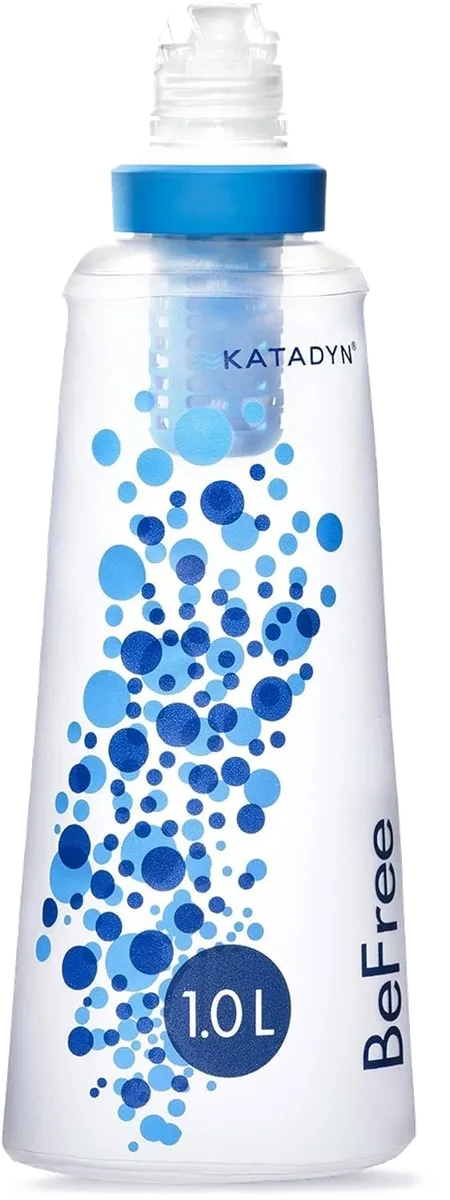
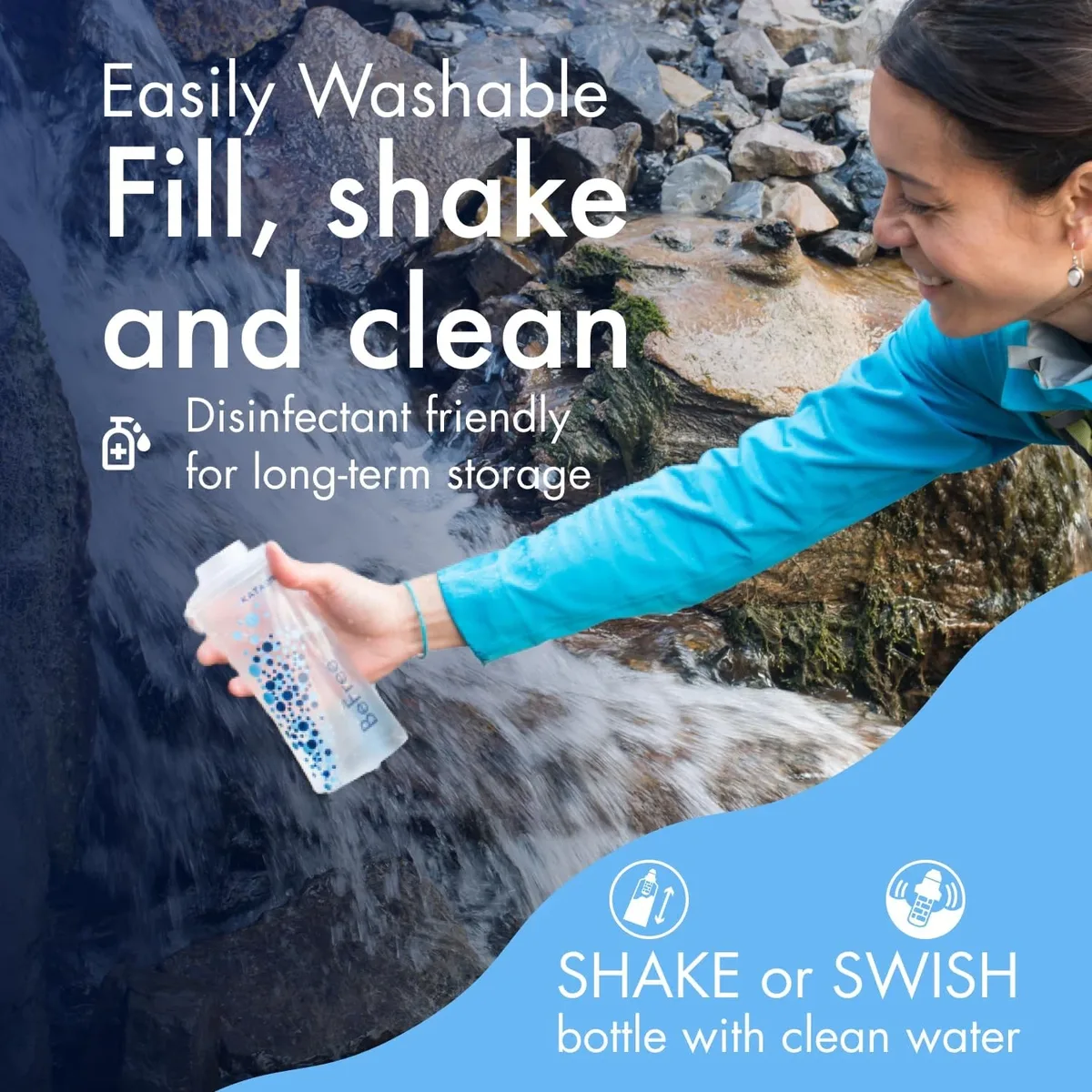
Bottle-style microfilter · 1.0 L flask · approximately 63 g
The standard BeFree 1.0L (model 8018006) pairs a collapsible TPU flask with Katadyn’s EZ-Clean hollow-fiber membrane. Katadyn lists a 0.1-micron pore size, up to 2 liters per minute of output and a treated-water capacity of up to 1,000 liters, depending on water quality. The manufacturer’s instructions describe cleaning the membrane by shaking or swishing it in water rather than using a backflushing syringe.
- What stands out: The integrated flask keeps the setup simple and packs down when empty.
- Published weight: 63 g / about 2.3 oz for the standard 1.0L model.
- Maintenance: Shake or swish the membrane as directed; no backflushing tool is required.
- Important limit: The standard BeFree 1.0L is not the separate BeFree AC model. Do not assume it includes an activated-carbon stage.
What to check before buying: Confirm the listing is for the standard 1.0L model and inspect the flask, seams, cap and mouthpiece before a trip. The supplied retailer feedback is positive about packability and ease of use, but also includes reports of soft-flask leaks or seam problems. That does not establish a failure rate, but it is a good reason to test the reservoir at home and carry a backup water container.
Check current Amazon listing →2. Sawyer Squeeze SP129: the most adaptable setup
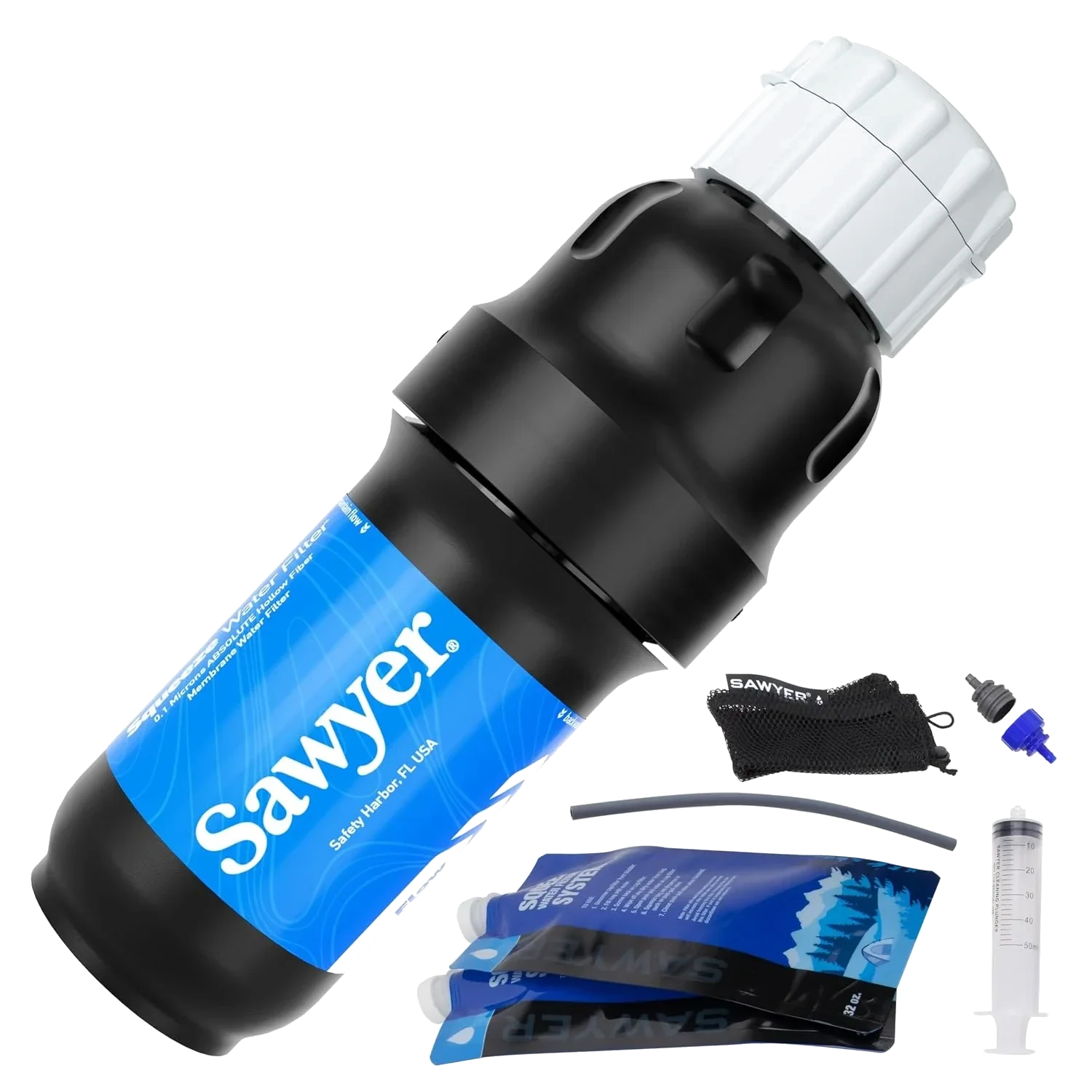
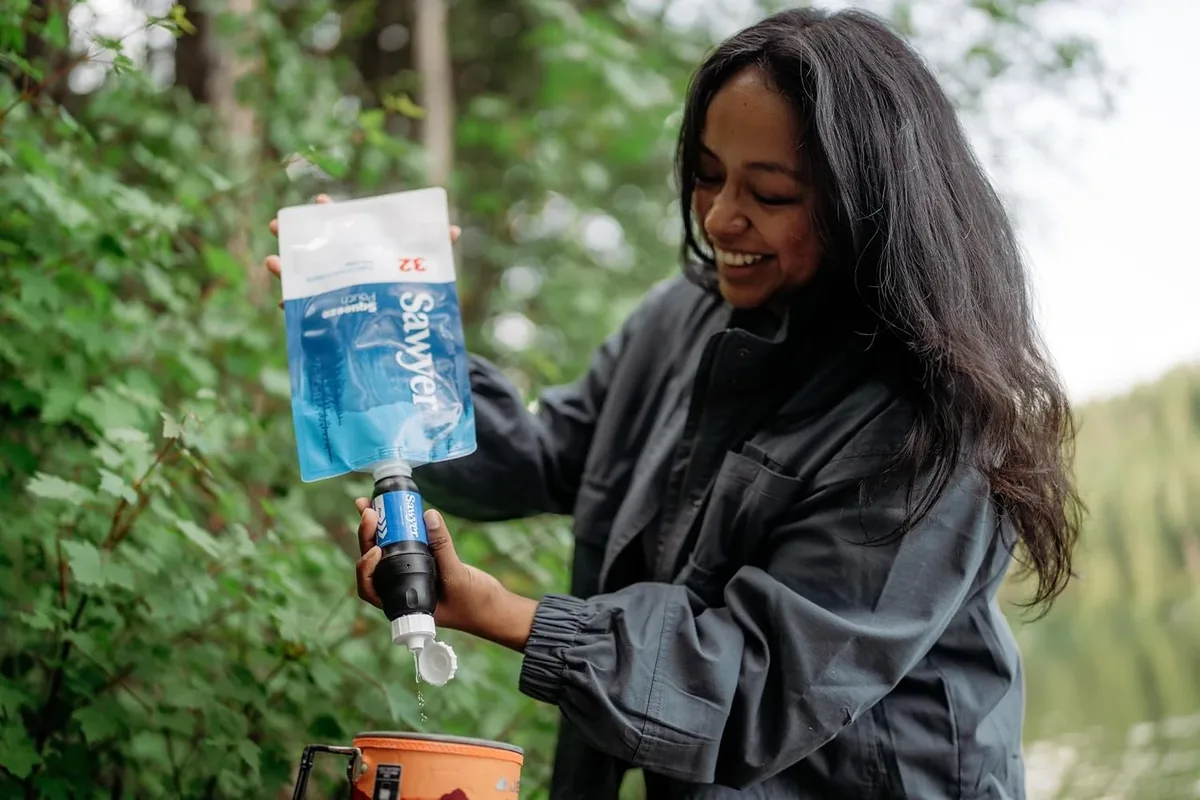
Squeeze filter · pouch, bottle and hydration-system compatibility
The Sawyer Squeeze is the most flexible format in this group. The SP129 kit supplied for this comparison lists the filter, two 32-ounce collapsible pouches, a drinking straw, hydration-pack adapters and a mesh storage bag. Sawyer describes the membrane as a 0.1-micron absolute hollow-fiber filter and rates it for up to 100,000 gallons under its stated conditions.
- What stands out: It can be used with compatible squeeze pouches, standard 28 mm threaded bottles, hydration systems or a gravity arrangement.
- Filtration claims: Sawyer publishes reduction claims for bacteria and protozoa; the standard Squeeze is not a virus purifier.
- Maintenance: Backflush when flow slows and follow Sawyer’s cleaning and storage instructions.
- Kit variation: Pouches and adapters differ across bundles. Check the SP129 contents rather than assuming every Squeeze package is identical.
What to check before buying: The filter itself is only one part of the system. Inspect the pouch seams, threads, O-rings and adapters, and avoid overtightening threaded connections. The supplied listing feedback is generally positive about portability and versatility, while pouch durability and flow after use receive mixed comments. Bring a spare compatible bottle or water container if a leaking pouch would leave you without a practical way to collect water.
Check current Amazon listing →Read Sawyer’s official water-filter care and compatibility FAQs
3. Membrane Solutions Water Filter Straw I (S1): a compact personal backup
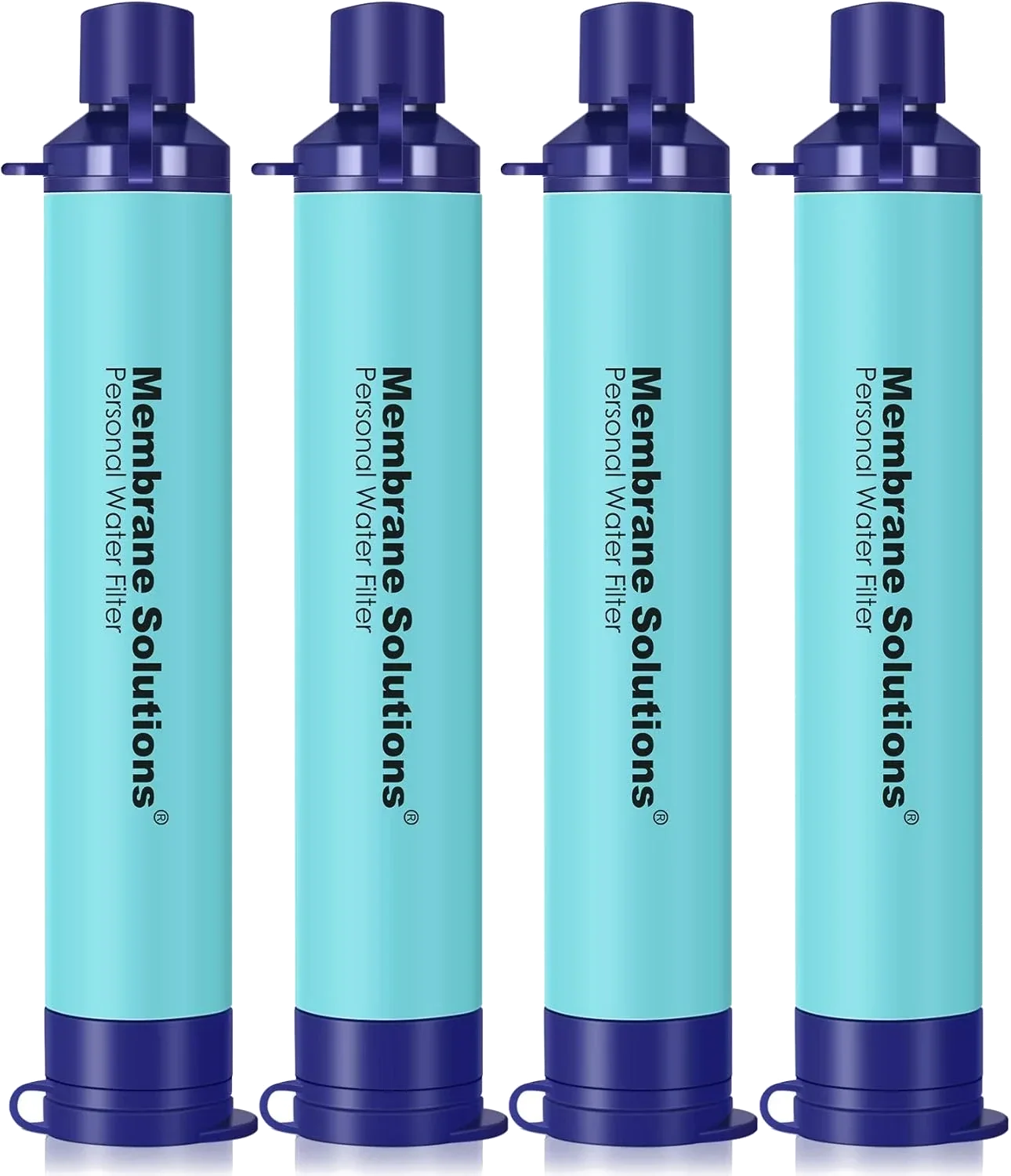
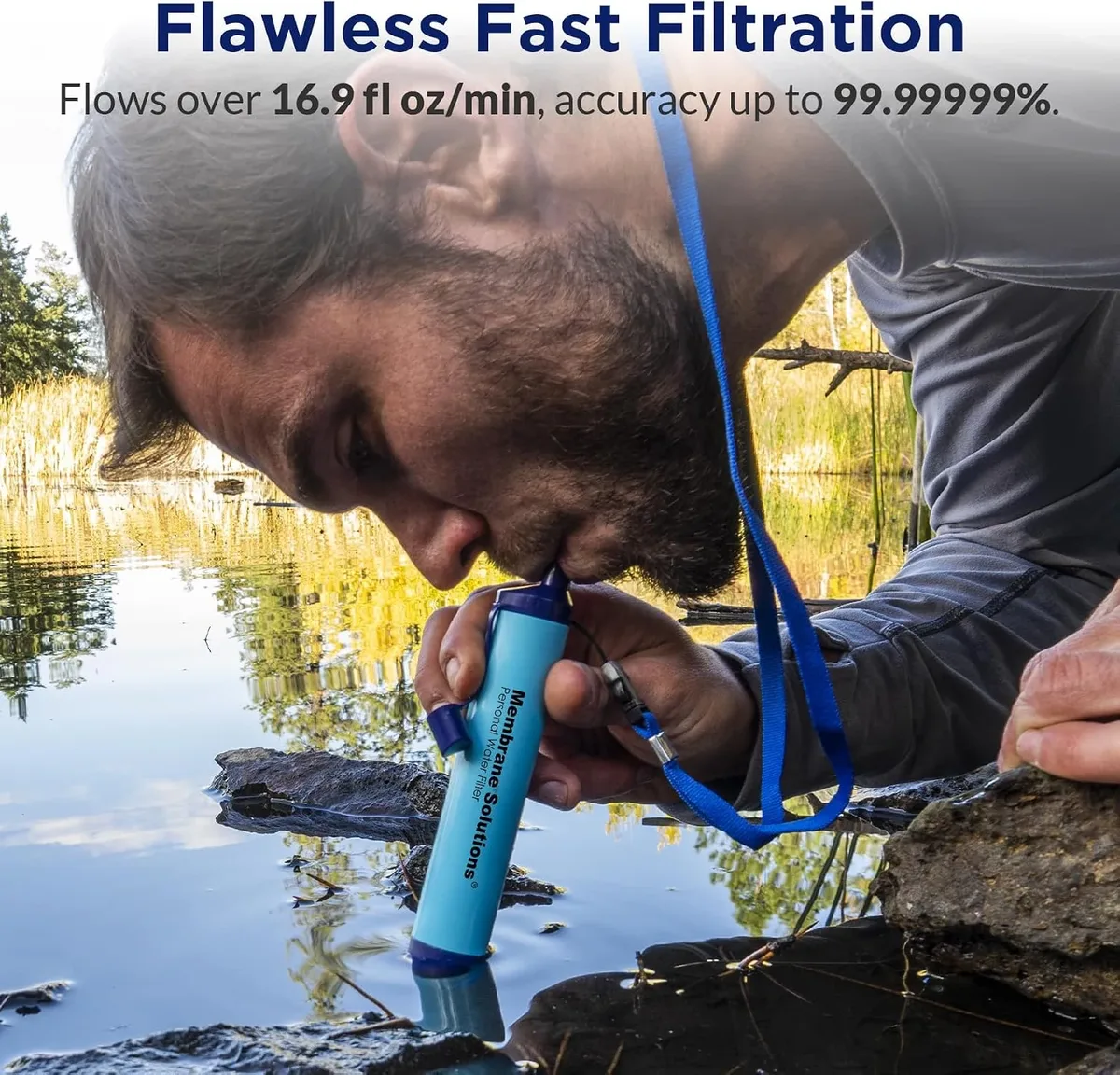
Personal straw filter · 0.1-micron hollow fiber · approximately 2 oz
The supplied S1 listing describes a five-stage arrangement: a coarse screen, two polypropylene-cotton layers, activated carbon and an ultrafiltration hollow-fiber membrane. Membrane Solutions’ official product page lists the Straw I (SKU OESF002) at up to 5,000 liters of cartridge life, a maximum flow rate of 450 ml per minute and a 0.1-micron hollow-fiber pore size. The supplied retailer material also describes compatibility with 28 mm threaded bottles.
- What stands out: A small, simple format that can be carried as a personal filter or backup.
- Published flow: Up to 450 ml/min; this is a maximum manufacturer figure, not a guaranteed trail rate.
- Use format: Drink through the straw or connect it to a compatible bottle or setup as directed.
- Important limit: A straw is less useful for filling a separate clean-water container or preparing meals than a squeeze or gravity system.
Certification wording needs care: The supplied retailer title mentions NSF/ANSI 42, 372 and 401. Those standards address different areas such as aesthetic effects, lead content and certain emerging contaminants; they do not, by themselves, establish that this straw is certified to remove viruses or all disease-causing organisms. The manufacturer’s Straw I specification page lists the pore size, stages, flow and capacity, but does not establish virus-purifier status. Do not treat the certification wording as a substitute for checking the exact certified claim.
The supplied retailer feedback describes the straw as compact and convenient, but long-term durability experiences are mixed. Test the exact unit before relying on it and follow the manufacturer’s priming, backflushing and drying instructions.
Check current Amazon listing →Which backpacking water filter should you choose?
- Choose Katadyn BeFree 1.0L if you want a quick, integrated bottle-style system for one person and value simple shake-or-swish cleaning.
- Choose Sawyer Squeeze SP129 if you want more ways to collect and transfer water, or plan to connect a bottle, hydration system or gravity setup.
- Choose Membrane Solutions Straw I if compact personal drinking is the priority and you understand the limitations of a straw format.
There is no universal winner. The best format depends on the trip, water source, group size and how much maintenance you are prepared to do. For longer trips, a squeeze or gravity setup is usually more practical when you need to fill bottles or cooking containers. For quick solo drinking, a bottle or straw may be simpler.
A safer way to plan backcountry water treatment
Use the cleanest source available and avoid water near livestock, campsites, sewage discharge or heavy human activity when possible. Clear water is not necessarily safe. If the water is cloudy, pre-filter sediment as directed by your treatment system before using the microfilter.
When you cannot be confident that a filter alone addresses the organisms of concern, follow current public-health guidance. The CDC identifies boiling as the best way to kill germs in water. Bring clear water to a rolling boil for one minute, or three minutes above 6,500 feet. Filtering and then disinfecting is another option when boiling is not practical. Chemical disinfection does not make water containing fuel, pesticides, heavy metals or other harmful chemicals safe to drink.
Frequently asked questions
Does a 0.1-micron backpacking water filter remove viruses?
Do not assume that it does. The three products in this comparison are described as microfilters. Their published pore-size and bacteria/protozoa claims do not establish virus removal. Use a treatment method validated for viruses when the water source or public-health guidance calls for it.
Is the Katadyn BeFree AC the same as the BeFree 1.0L?
No. The standard BeFree 1.0L (model 8018006) uses a hollow-fiber membrane and a collapsible flask. The BeFree AC is a separate two-stage model that adds replaceable activated carbon for taste and odor. Check the model number and product name carefully; the standard model should not be described as having the AC carbon stage.
Is Sawyer Squeeze better than a water-filter straw?
It is more versatile for transferring filtered water into bottles or a cooking container. A straw is smaller and simpler for direct drinking, but it is less convenient when you need to store or share treated water.
Can these filters remove chemicals or heavy metals?
Do not rely on these hollow-fiber backpacking microfilters for dissolved chemicals, fuel, salt or heavy-metal removal. Activated carbon can improve some taste and odor issues, but the presence of a small carbon stage does not make a filter suitable for every chemical contaminant.
How often should I clean a backpacking water filter?
Follow the instructions for the exact model. Katadyn’s standard BeFree membrane is cleaned by shaking or swishing. Sawyer recommends backflushing when flow begins to diminish and before storage. Membrane Solutions provides its own priming and backflushing instructions for the Straw I.
Should I carry a backup water treatment method?
For remote trips, it is sensible to have a backup that is appropriate for the route and conditions. A damaged pouch, clogged filter or frozen wet filter can interrupt your water plan. Choose a backup method that addresses the organisms of concern and learn how to use it before the trip.
Bottom line: Katadyn is the straightforward bottle option, Sawyer is the most adaptable system, and Membrane Solutions is the compact straw. Compare the complete kit—not just the filter element—and make a separate plan for viruses and chemical contamination. A lightweight filter is useful only when it is matched to the water source and maintained correctly.