
For outdoor grilling for beginners, the first cooker does not need to be the biggest one on the patio. It needs to suit the food you actually cook, the time you have, and the space where you are allowed to use it. Gas is usually the easiest place to start; charcoal rewards people who enjoy tending a fire; and a flat-top griddle is the better tool for breakfasts, smash burgers, and foods that would slip through a grate.
Affiliate disclosure: This article contains affiliate links. TestedWise may earn a commission if you purchase through them, at no additional cost to you. Read the full disclosure.
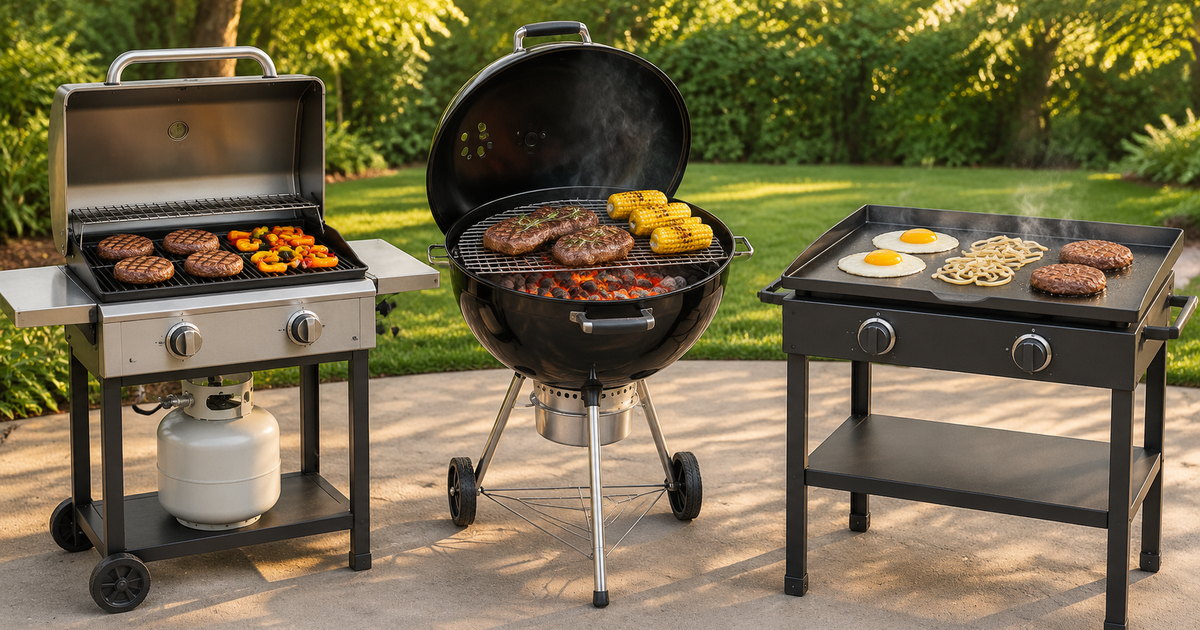
This guide is for beginners choosing an outdoor cooker for a patio, backyard, tailgate or other permitted open-air space. It explains the practical differences, shows how to control heat, and identifies the few tools that make a first cook easier. It is not a recipe collection or a ranking based on hands-on testing: TestedWise has not field-tested the products listed below.
What is the difference between a grill and a griddle?
The word grill is often used for almost any outdoor cooker, but the cooking surface matters. A traditional gas or charcoal grill has a grate. Food sits above the heat, and drippings can fall between the bars. A griddle has a solid, flat metal plate. The plate itself gets hot and transfers heat directly to the food.
Gas grills: burners under a grate
A propane or natural-gas grill uses burners to heat the cooking grates and the air inside the lid. Most models have control knobs for each burner, so you can raise or lower the heat without moving fuel around. A two-burner grill can also create a simple hot side and cooler side by turning one burner off.
Gas is convenient for weeknight meals because lighting and heat adjustment are relatively straightforward. You still need to preheat the grill, manage flare-ups, clean grease, and keep an eye on the fuel supply. Propane and natural gas are not interchangeable: buy a grill designed for the fuel connection you actually have.
Charcoal grills: the fuel is the fire
A charcoal grill cooks over burning briquettes or lump charcoal. You light the fuel, wait for it to become ready, then control the fire mainly by arranging the coals and adjusting the air vents. That extra work gives you a direct connection to the heat and smoke, which many people enjoy. It also means the temperature will not respond as quickly as turning a gas knob.
A kettle grill is a sensible first charcoal shape because its lid, bowl and adjustable vents let you cook directly over the coals or move food to a cooler area. The trade-offs are lighting time, ash disposal, and the need to learn how airflow changes the fire.
Flat-top griddles: a solid plate instead of bars
An outdoor griddle uses burners beneath a flat steel cooking plate. Food cooks on the hot surface rather than over an open grate. That makes it especially useful for eggs, pancakes, bacon, chopped vegetables, fried rice, fajitas and smash burgers. Small pieces stay on the plate, and there are no grate gaps for asparagus, shrimp or diced onions to fall through.
A griddle does not give food the same grate marks or charcoal character as a traditional grill. Its steel surface also needs care: many models require an initial seasoning process, then a quick scrape, wipe and thin coat of oil after cooking. If you do not want that routine, a conventional gas grill may be a better fit.
What about pellet grills?
Pellet grills feed compressed wood pellets into a fire pot and use an electronic controller to manage heat. They are popular for smoking and longer cooks, and some models can grill at higher temperatures too. They can be a good choice if you specifically want to smoke ribs, pork shoulder or brisket, but they add a hopper, electrical components and another fuel system. For a first cooker focused on burgers, chicken, vegetables and quick outdoor meals, gas, charcoal or a griddle is usually a simpler starting point.
Gas vs. charcoal vs. griddle at a glance
The comparison below is about day-to-day use, not which cooker can produce the highest temperature in ideal conditions. Grill size, burner layout, fuel, wind, lid design and the food being cooked all affect the result.
| What matters | Gas grill | Charcoal grill | Flat-top griddle |
|---|---|---|---|
| Best at | Everyday burgers, chicken, sausages, steaks and vegetables | Traditional barbecue flavor, searing and cooking over a live fire | Smash burgers, eggs, bacon, pancakes, fajitas and small foods |
| Getting started | Usually the quickest; light the burners as the manual directs | Requires lighting charcoal and waiting for the coals to be ready | Ignite the burners and preheat the plate; a new plate may need seasoning first |
| Heat control | Knobs make adjustments simple; multiple burners can create zones | Air vents and coal placement control the fire; takes practice | Independent burner controls create hotter and cooler parts of the plate |
| Flavor and texture | Clean grilled flavor and grate marks; smoke is usually lighter | Charcoal aroma and a fire-cooked character | Even contact browning; no traditional grate marks |
| Cleanup | Grates, grease tray and burners need routine attention | Grates plus cooled ash and charcoal residue | Scrape while warm, wipe dry, and protect the seasoned surface with oil |
| Ongoing work | Check fuel, hose, regulator, burners and grease management | Buy and store charcoal; manage airflow and dispose of ash safely | Maintain seasoning and keep the steel plate dry and protected |
| Not ideal if | You want charcoal smoke or do not have an approved place for a propane tank | You want dinner ready with minimal setup or do not want to handle ash | You mainly want classic grill marks, smoke flavor or slow roasting under a lid |
Retailer buying guides reach a similar practical conclusion: gas is valued for quick starts and easier adjustment, charcoal for its distinct flavor, and griddles for foods that benefit from a continuous flat surface. Lowe's grill buying guide also recommends choosing size and fuel around the space and routine, rather than shopping by feature count alone.
How to choose the right type for your routine
Before comparing burners, BTUs or accessories, answer these questions. They will narrow the field faster than a long product list.
1. What do you cook most often?
- Burgers, chicken pieces, sausages and steaks: a gas or charcoal grill is the natural fit. Gas makes repeat meals easier; charcoal is appealing if you want the fire and smoke to be part of the experience.
- Eggs, bacon, pancakes, chopped vegetables and smash burgers: a griddle is more versatile for these foods because the cooking surface is continuous.
- Large roasts, ribs or long smoking sessions: consider whether a pellet grill or a charcoal setup with indirect heat is more appropriate. These cooks require more time and temperature management than a quick beginner meal.
- A mixture of all of the above: a gas grill is the broadest first purchase for many households. A griddle can be added later if breakfast and flat-top meals become a regular part of your outdoor cooking.
2. How much time do you want to spend before dinner?
If you want to turn the grill on after work and cook without building a fire, gas is usually the least demanding option. Charcoal asks you to plan ahead: light the fuel, let it become ready, arrange the coals, and adjust the vents. A griddle is also straightforward to ignite, but it needs preheating and the steel surface has a maintenance routine that a grate does not.
3. How many people do you normally cook for?
Do not compare cooking-area numbers without considering the shape of the surface. A 22-inch kettle and a 22-inch tabletop griddle both advertise a cooking area in the low 360-square-inch range, but the food sits differently. A grate leaves space between bars; a griddle uses almost the whole plate. A compact tabletop gas grill with about 200 square inches is easier to store and carry, but it will feel small when several people want a full meal at once.
For two people or occasional small meals, a compact tabletop model may be enough. If you regularly cook for a family or host friends, look at the actual usable grate or plate dimensions, not just the number of burners or the product's headline capacity. Leave some room to move food away from the hottest area.
4. Where will the grill live?
A full-size grill needs a safe outdoor position and room to open its lid. A tabletop grill or griddle needs a stable, level, heat-resistant surface and a place to store it when it is cool. Check the folded or assembled dimensions against your storage area and vehicle before buying a portable model.
Apartment, condominium and rental rules matter. Many buildings restrict open-flame cooking on balconies or near combustible structures, and local fire codes can be stricter than the manufacturer's minimum clearance. If gas or charcoal is not allowed where you live, do not try to work around the rule; check whether an approved electric grill is permitted instead.
5. Are you comfortable with the fuel and maintenance?
Gas means managing a propane cylinder or an approved natural-gas connection, checking hoses and cleaning grease. Charcoal means storing dry fuel, lighting it safely and waiting for ash to cool before disposal. A griddle means seasoning and protecting its cooking plate. None is maintenance-free; choose the routine you are most likely to keep up with.
The beginner's guide to grill heat
Most first-time grilling problems are heat problems. The outside gets too dark before the middle cooks, food sticks to the grate, or a flare-up catches a fatty piece of meat. Learning two ideas—direct heat and indirect heat—makes a traditional grill much easier to use.
Direct heat: cook over the heat source
Direct heat means the food sits above the lit burner or hot coals. It is useful for foods that cook relatively quickly, such as burgers, thin steaks, sausages, shrimp and vegetables. The surface browns quickly, so stay close and turn food when it is ready rather than walking away.
Indirect heat: cook beside the heat source
Indirect heat means the food is placed away from the active burner or coals, usually with the lid closed. The hot air inside the grill cooks the food more gently, much like an outdoor oven. It is useful for thicker chicken pieces, larger cuts and foods that need time to cook through without burning on the outside.
Make a two-zone setup
A two-zone setup gives you a hot area for browning and a cooler area where food can finish cooking or wait out a flare-up.
- On a two-burner gas grill: light one burner and leave the other off, or use different settings if the model and manual allow. The lit side is the direct zone; the unlit side is the indirect zone.
- On a charcoal kettle: arrange the lit coals on one side of the charcoal grate and leave the other side without coals. Cook over the coals for direct heat and move food to the empty side for indirect heat.
- On a flat-top griddle: use the independent burner controls to create a hotter cooking area and a lower-temperature holding area. The plate stays in contact with food, so this is not the same as indirect oven-style cooking, but it helps prevent everything from cooking at one temperature.
For a clear visual explanation of gas and charcoal heat zones, McCormick's grill heat guide shows how burner settings and coal placement create direct and indirect areas.
How to use each type for the first time
First cook on a gas grill
- Read the model's lighting and fuel instructions. Check that the propane cylinder, regulator and hose match the grill. Do not adapt a fuel connection unless the manufacturer approves the exact accessory.
- Check for leaks when required. NFPA describes using a soapy solution on the hose, regulator and connections; bubbles indicate escaping gas. If you find a leak, turn the cylinder off and do not light the grill until the problem is fixed.
- Open the lid before lighting. This is a basic safety step. Follow the ignition sequence in the manual and never let unburned gas build up under a closed lid.
- Preheat as the manual directs. Give the grates time to heat before food goes on. A cold grate is more likely to make food stick and can produce uneven browning.
- Start with two heat zones. Use the hotter side to brown food and the cooler side to finish thicker pieces or move food away from a flare-up.
- Turn off the burners and cylinder as instructed. Let the grill cool before cleaning or covering it. Empty the grease tray on the schedule in the manual.
First cook on a charcoal grill
- Set up the grill outdoors on a safe surface. Open the vents and make sure the charcoal area is clear of dry leaves, paper and other combustibles.
- Use a chimney starter or the manufacturer's approved lighting method. A chimney starter lets air move through the charcoal and avoids the need to pour lighter fluid over the fuel. Place the starter on a non-combustible surface and use heat-resistant gloves when it is hot.
- Wait until the coals are ready. With briquettes, beginners commonly wait until much of the surface is covered with light gray ash. Weather, fuel type and chimney size affect the timing.
- Arrange a two-zone fire. Carefully pour or move the coals to one side of the grill, leaving the other side cooler. Use the grill's handles and tools rather than reaching over the fire.
- Adjust the vents in small steps. More airflow generally feeds the fire; less airflow reduces it. Give the grill time to respond instead of opening and closing vents repeatedly.
- Let the coals cool completely after cooking. Follow the manual and local rules for ash disposal. NFPA recommends placing fully cooled coals in a metal container with a lid.
Never add charcoal lighter fluid to coals that are already lit or hot. Do not use gasoline, alcohol or other improvised fuels. If you use a chimney starter, keep children and pets away from it and remember that the metal body remains hot after the coals have been poured out.
First cook on a flat-top griddle
- Confirm the model and read its first-use instructions. Some griddles arrive with a protective oil coating. The Blackstone 1813 manual, for example, says to wash the cooking surface once with hot, soapy water, rinse and dry it completely, then follow the seasoning process. That first wash is not the same as everyday cleaning.
- Season the plate as directed. Apply very thin layers of the recommended cooking oil and heat them until the surface changes color and the oil bonds to the steel. Several thin coats are more useful than one thick, sticky layer.
- Preheat with the lid or hood in the position specified by the manual. Do not assume the hood is designed for every stage of cooking. Keep hands away from hot metal handles and surfaces.
- Start with a moderate setting. The plate holds heat, so turning a burner down does not cool the surface immediately. Use one side for higher heat and the other for gentler cooking.
- Use only a light film of oil when needed. Too much oil can pool and make food greasy. Keep the rear grease opening and collection cup clear.
- Clean while the plate is still warm, not dangerously hot. Scrape residue toward the grease opening, use a small amount of water only as the manual permits, wipe the plate dry, and finish with a thin protective layer of oil.
A griddle is easy to cook on once it is prepared, but the seasoning routine is part of owning it. If you want to put a cooker away without thinking about a bare steel surface, choose a grate-style gas or charcoal grill instead.
A simple first cook that works on all three
For the first meal, skip delicate fish, expensive steaks and complicated recipes. Burgers, sliced peppers and onions, and buns are forgiving enough to teach you how your cooker behaves. Keep the menu small so you can pay attention to heat rather than juggling six pans.
| On a gas grill | On a charcoal grill | On a griddle |
|---|---|---|
| Preheat the grates. Brown the burgers over direct heat, then move them to the cooler side if they need more time. Cook peppers and onions in a grill basket or on a suitable tray. | Light the charcoal and create a hot side and a cooler side. Brown the burgers over the coals, then move them away from direct heat to finish. Keep the lid position and vents consistent while you learn the kettle. | Preheat the seasoned plate. Cook peppers and onions first on a moderate area, then cook the patties. If making smash burgers, use a clean, suitable press and avoid crowding the surface. |
| What to learn: how quickly the burners heat the grates and how the cooler zone helps. | What to learn: how coal placement and vents change the heat over time. | What to learn: how the plate retains heat and how the two zones differ. |
Before cooking, prepare a clean plate for finished food and keep raw meat on a separate plate. Use clean tongs or a clean turner for cooked food; do not put cooked burgers back on the plate that held raw patties. Keep perishable food cold until it is ready to cook or serve. The FDA's outdoor food-safety guidance says food should not remain in the 40°F–140°F danger zone for more than two hours, or one hour when the outdoor temperature is above 90°F. A food thermometer is more reliable than color, touch or a timer. The USDA's safe minimum temperatures are listed below.
Six products worth considering
These examples were selected for a clear beginner use case: one full-size two-burner gas option, one classic charcoal kettle, one tabletop griddle, and three tools that solve specific problems. We checked manufacturer specifications, manuals and independent hands-on reviews where available. TestedWise has not field-tested these products. The picks are examples, not a required shopping list; product availability and model variations can change, so confirm the exact version before checkout.
| Product | Best role | Useful detail | Main trade-off |
|---|---|---|---|
| Weber Spirit E-210 2-Burner Gas Grill | Everyday patio and backyard grilling | 360 sq. in. primary area; 90 sq. in. warming rack; 26,600 BTUs | 90 lb; assembly required; propane tank sold separately |
| Weber Original Kettle Premium 22 | Traditional charcoal grilling | 363 sq. in.; lid thermometer; adjustable dampers; One-Touch ash cleaning | Requires charcoal lighting, airflow control and ash disposal |
| Blackstone Original 22-Inch Tabletop Griddle with Hood | Flat-top meals and breakfast | 361 sq. in.; two heat zones; 24,000 BTUs; rear grease management | Seasoning and oil care; no traditional grate marks |
| TempPro TP19H Instant-Read Thermometer | Checking internal food temperature | 4-inch probe; backlit rotating display; IP65 water resistance | Instant-read tool, not a leave-in wireless probe |
| OXO Good Grips Grilling Turner and Tongs Set | Basic food handling | Stainless-steel turner and tongs; non-slip grips; dishwasher safe | Two useful tools, not a full accessory kit |
| Weber Rapidfire Chimney Starter | Lighting charcoal without lighter fluid | 1.6-gallon capacity; holds about 5.7 lb of briquettes | Only useful if you choose charcoal; the chimney stays hot after use |
1. Weber Spirit E-210 2-Burner Gas Grill
Model 1501000 · ASIN B0DPH7QGTP · 360 sq. in. primary area · 26,600 BTUs
The Spirit E-210 is a current two-burner propane cart grill for someone who wants a straightforward everyday setup rather than a portable tabletop unit. Weber lists 360 square inches of primary cooking space, a 90-square-inch warming rack, two burners producing 26,600 BTUs per hour, Snap-Jet ignition, porcelain-enameled cast-iron grates, a built-in lid thermometer and a cabinet that hides the 20-pound propane tank. The grill weighs about 90 pounds, requires assembly, and the tank is sold separately. Weber advertises a 10-year limited warranty, with coverage varying by component.
For a first-time owner, the practical checks are the ignition, regulator, burner controls and the manual's setup instructions. Keep the grill outdoors in a well-ventilated space, and stop using it if a control or regulator does not behave as the manual specifies. Weber lists a 10-year limited warranty, with coverage varying by component; register the grill and keep the purchase documentation.
- Best for: beginners who want a full-size, two-burner propane grill for regular patio or backyard meals, with enough room to create a hot side and a cooler side.
- Think twice if: you need a portable grill, want a low purchase price, or regularly cook for a large group. At about 90 pounds, this is a cart grill, not a carry-out option.
- Before checkout: confirm Model 1501000 and ASIN B0DPH7QGTP, check that the listing is the liquid-propane version, and budget for a separate 20-pound propane cylinder.
2. Weber Original Kettle Premium 22-Inch Charcoal Grill
Model 14401001 · ASIN B00MKB5TXA · 363 sq. in. cooking area · 22-inch kettle
The 22-inch Original Kettle Premium is a good reference point for a beginner who specifically wants to learn charcoal cooking. Weber lists a porcelain-enameled bowl and lid, adjustable lid and bowl dampers, a built-in lid thermometer, a hinged cooking grate, two tool hooks and a One-Touch cleaning system that sweeps ash into an enclosed catcher. The manufacturer lists a 10-year limited warranty for the bowl and lid.
An independent hands-on review by AmazingRibs highlights the Premium's enclosed ash catcher and hinged grate, while warning that the lid thermometer can be inaccurate. Confirm the exact model number and included features before checkout. A kettle is still a charcoal grill: you have to light fuel, arrange the coals and learn how the vents affect temperature. The built-in thermometer measures the air temperature inside the lid area; it does not tell you whether the center of a burger or chicken breast has reached a safe internal temperature.
- Best for: beginners who enjoy charcoal flavor, want to learn direct and indirect cooking, and have time to manage a fire.
- Think twice if: you want a fast weeknight start, dislike ash cleanup, or need a cooker that can be left unattended.
- Before checkout: confirm the Premium version and Model 14401001. The standard Original Kettle and Premium Kettle share a similar name but do not have identical features.
3. Blackstone Original 22-Inch Tabletop Griddle with Hood
Model 1813 · ASIN B07ZS5RQZ4 · 361 sq. in. · 24,000 total BTUs · about 38 lb
The Blackstone 1813 is for cooks who want a flat top rather than a traditional grate. Blackstone's official manual library lists Model 1813 in its 22-inch tabletop griddle family; the model-specific owner's manual identifies it as the Original 22-inch griddle with hood and documents its two independently controlled H-style burners, 24,000 BTUs, rear grease management, seasoning and cleaning routine. The Model 1813 manual identifies it as a 22-inch griddle with hood; retailer specifications list 361 square inches of cooking area and 24,000 BTUs from two burners.
The solid plate is the reason to buy it. Eggs, bacon, pancakes, onions, diced vegetables and smash burgers stay on the surface instead of falling between bars. The care instructions make the main ownership trade-off clear: the plate needs seasoning and must be dried and protected from moisture. Check the controls and connections before the first use, and stop using the unit if a burner control does not shut the gas off. At 37.5 pounds, it is portable by car, but not a lightweight cooker to carry far.
- Best for: people who cook breakfast outdoors, make smash burgers or fajitas, and want two temperature zones on one flat surface.
- Think twice if: you want smoky charcoal flavor, classic grate marks, or a surface that can be put away without seasoning and oil care.
- Before checkout: confirm Model 1813 with the hood, not the visually similar 1666 tabletop model without a hood. Check whether the selected listing includes the hose or other fuel adapter you need.
4. TempPro TP19H Instant-Read Meat Thermometer (formerly ThermoPro)
Model TP19H · ASIN B07XXSYLL8 · 4-inch stainless-steel probe
A food thermometer is more useful to a beginner than a collection of specialty grill gadgets. The TP19H is a folding instant-read model: open the probe, insert it into the thickest part of the food, wait for the reading to settle, then close it for storage. TempPro's current product page lists a 4-inch stainless-steel probe, a backlit display that rotates for easier viewing, a temperature lock, calibration, a magnetic back and IP65 water resistance. The manufacturer lists ±0.9°F accuracy within the stated 14°F to 212°F range.
Its appeal is the simple operation and readable display rather than wireless features. It is an instant-read thermometer, not a leave-in probe: do not leave it in food while the grill is closed. Insert it near the end of cooking, check the temperature in the thickest area without touching bone, and clean the probe between readings when moving between raw and cooked food.
- Best for: beginners who want a simple way to check burgers, chicken, steaks, pork and fish without guessing by color.
- Think twice if: you want a wireless probe that stays in a roast or smoker during a long cook. This is a quick spot-check tool.
- Before checkout: confirm TP19H, not a different TempPro model. Some Amazon listing titles and older packaging still use the ThermoPro name from before the brand transition.
5. OXO Good Grips Grilling Turner and Tongs Set
ASIN B08R6FMMD2 · Stainless-steel turner and tongs · 2-piece set
For a first grill, two well-chosen tools are more useful than a case filled with pieces you may never touch. OXO's set pairs a stainless-steel turner with a set of tongs. The turner has a wide, beveled head and a double-bend design for lifting food; the tongs have scalloped edges, non-slip grips and a built-in bottle opener. Both pieces are dishwasher safe.
The pair covers most basic handling: tongs for sausages, vegetables and moving food, and a turner for burgers, fish fillets and other foods that need support underneath. You can use suitable kitchen tongs you already own, but long handles help keep hands farther from the heat. There is no need to buy a 20- or 30-piece kit before you know which tools your cooking style requires.
- Best for: beginners who want a simple, durable pair of tools for a gas grill, charcoal kettle or griddle.
- Think twice if: you already own long, heat-safe tongs and a sturdy spatula. The set is an upgrade, not a requirement.
- Before checkout: confirm the listing is the OXO Good Grips Grilling Turner and Tongs Set, not a kitchen-only utensil set with shorter handles.
6. Weber Rapidfire Chimney Starter
Model 7416 · ASIN B000WEOQV8 · 1.6-gallon capacity
If you choose charcoal, a chimney starter is one of the few accessories that makes the first fire easier without adding much complexity. Weber lists a cone-shaped lower grate, a ventilated chamber, a heat shield, a main handle and a flip-up helper handle. The 1.6-gallon chimney holds about 5.7 pounds of standard briquettes and is designed to light them without lighter fluid.
Place a suitable fire starter beneath the chimney on a non-combustible surface, light it as directed, and wait for the coals to become ready before pouring them into the grill. The chimney itself becomes extremely hot. Weber recommends wearing gloves when it is hot, and the helper handle is there to give you a more controlled two-handed pour. Keep the starter away from children, pets, dry leaves and anything that can burn.
- Best for: anyone who chooses a charcoal kettle and wants a repeatable way to light briquettes.
- Think twice if: you choose gas or a griddle. It has no role in those setups.
- Before checkout: confirm Weber Model 7416. Use it outdoors only and follow the grill and starter instructions.
Cleaning, storage and common beginner mistakes
Cleaning is not a separate job that happens once a season. A short reset after each cook makes the next one easier and reduces the chance of grease igniting.
After a gas-grill cook
Turn the burners off using the sequence in the manual, then close the propane cylinder valve. Once the grates are safe to handle, remove stuck food with an appropriate scraper or cleaning tool. Empty the grease tray before it becomes overloaded. Periodically inspect the hose, regulator, burners and ignition system; do not use a grill with a damaged hose or a suspected gas leak.
After a charcoal cook
Let the coals and ash cool completely before handling them. Empty the ash catcher or bowl according to the manual and place cooled coals in a metal container with a lid. Do not put warm ash in a plastic trash can, cardboard box or paper bag. Keep the vents clear so the grill can breathe properly next time.
After a griddle cook
Follow the model's cleaning instructions. For the Blackstone 1813, the manual describes scraping the warm plate, clearing the grease management area, wiping the surface dry and applying a thin coat of oil. Store the griddle in a dry place and cover it if it remains outdoors. Moisture trapped under a cover can still lead to rust, so keep the cover ventilated and the surface protected.
Be careful with wire-bristle grill brushes
Do not assume every old grill brush is safe to keep using. In 2026, the U.S. Consumer Product Safety Commission expanded the recall of Cuisinart metal-wire grill brushes; the recall includes all Cuisinart wire-bristle grill brushes and some tool sets, including the Cuisinart CGS-5020 20-piece set. CPSC also issued recalls involving Weber and Nexgrill wire-bristle brushes. Small bristles can detach, stick to the grate or food, and cause serious injuries if swallowed. Stop using any recalled model and follow the manufacturer's remedy instructions. A bristle-free scraper or other non-wire cleaning method avoids this particular loose-bristle hazard; whatever tool you use, inspect the cooking surface before food goes on it.
Four mistakes that make a first cook harder
- Buying by BTUs alone. BTU output is not a complete measure of cooking performance. Surface size, burner layout, heat distribution, lid design and the way you cook matter too.
- Putting food on before the cooker is ready. Give grates and plates time to preheat as the manual recommends. A rushed start often means sticking and uneven browning.
- Filling every inch of the cooking surface. Leave room to turn food and move it away from a flare-up or hot spot. A little space makes temperature control easier.
- Guessing when meat is done. Color and cooking time are not reliable safety checks. Use a food thermometer and follow the safe internal temperatures below.
Grill safety and safe food temperatures
All propane, charcoal and pellet grills belong outdoors. Do not use them in a house, garage, tent, camper, vehicle or other enclosed or partly enclosed space. Burning fuel can produce carbon monoxide, which has no smell and can become dangerous before you realize it is present. The CDC warns never to burn charcoal indoors or use portable gas camp stoves indoors; the U.S. Fire Administration's outdoor-fire guidance also says grills should only be used outside.
Set the grill well away from siding, deck railings, eaves and overhanging branches. Keep a three-foot safety zone around it for children and pets, never leave a lit grill unattended, and open the lid before lighting a gas grill. The National Fire Protection Association's grilling guidance recommends checking propane connections for leaks with a soapy solution, keeping grease buildup out of the grill and drip tray, and keeping children and pets at least three feet away. Follow the grill's manual and local fire rules; the U.S. Fire Administration says not to store or use a grill on a porch or balcony.
Safe minimum internal temperatures
Use a clean food thermometer and insert it into the thickest part of the food, away from bone. These are the USDA's safe minimum temperatures for common grilling foods:
| Food | Minimum internal temperature | Rest time |
|---|---|---|
| Beef, pork, lamb and veal steaks, chops and roasts | 145°F | At least 3 minutes |
| Ground beef, pork, lamb and veal (including burgers) | 160°F | None specified |
| Chicken and other poultry, including ground poultry | 165°F | None specified |
| Fish | 145°F | Or until opaque and separates easily with a fork |
These temperatures are safety minimums, not a guide to personal doneness preferences. The USDA Food Safety and Inspection Service temperature guidance explains the required rest time for whole cuts and the higher temperature for ground meat and poultry. Keep raw meat separate from cooked food, wash hands and tools after handling raw ingredients, and use a clean plate for serving.
Outdoor grilling FAQs
Which type of grill is easiest for a beginner?
For most people cooking burgers, chicken, sausages and vegetables, a gas grill is the easiest starting point. It lights quickly and uses control knobs to adjust heat. A griddle is also straightforward to light, but its steel surface needs seasoning and ongoing oil care. Charcoal is rewarding but requires more fire management.
Is gas or charcoal better for beginners?
Gas is usually better if convenience and repeatable weeknight cooking matter most. Charcoal is better if you specifically want charcoal flavor and enjoy learning how to arrange fuel and control airflow. Neither is automatically better food; the right choice depends on the cook and the meal.
Is a griddle the same as a grill?
No. A traditional grill cooks food on bars above the heat source. A griddle heats a solid, flat plate. Griddles are especially useful for eggs, pancakes, bacon, smash burgers, chopped vegetables and small foods that might fall through a grate.
Can you cook burgers on a flat-top griddle?
Yes. A griddle is particularly good for smash burgers because the patty makes broad contact with the hot steel. Use a clean, suitable press, avoid crowding the plate, and cook ground beef to 160°F measured with a food thermometer.
Do I need a two-burner grill?
Not always. One burner can be enough for simple meals for one or two people. Two burners give you more flexibility: you can cook at different temperatures or leave one side off to create a cooler zone. Choose based on how much food you cook at once, not simply the burner count.
What is the difference between direct and indirect grilling?
Direct grilling places food over the active burner or coals for faster browning. Indirect grilling places food away from the active heat, usually with the lid closed, so it cooks more gently. A two-zone setup gives you both options and a place to move food if it browns too quickly.
What temperature should a beginner grill be?
There is no single correct grill temperature for every food. Thin burgers and vegetables need different heat from thick chicken pieces or a roast. Learn to create a hotter and a cooler zone, follow the recipe and appliance manual, and use a food thermometer to check the internal temperature rather than relying on the lid gauge.
What tools do I really need for outdoor grilling?
Start with long-handled tongs, a sturdy turner, a food thermometer, a clean serving plate and the cleaning tool recommended for your grill. A chimney starter is useful only if you choose charcoal. Large tool kits, grill lights and wireless thermometers can wait until you know you need them.
Can I use a gas or charcoal grill on an apartment balcony?
Do not assume it is allowed. Apartment rules, condominium documents, local fire codes and insurance requirements may prohibit propane or charcoal grills on balconies and near combustible structures. Check the rules for your exact building and location before buying or lighting a grill. If open-flame cooking is prohibited, ask whether an approved electric grill is allowed.
Can I use a grill in a garage if the door is open?
No. Never use a propane, charcoal or pellet grill in a garage, tent, camper, vehicle or other enclosed or partly enclosed space. Opening a door or window does not make fuel-burning equipment safe indoors because carbon monoxide can accumulate.