
Best Camping Generators: 5 Quiet Inverter Models Compared for Car Camping & RVs
The best camping generator is not necessarily the one with the most watts. For a tent-camping weekend, a 40- to 50-pound inverter that is quiet and easy to carry may be far more useful than a 4,500-watt machine. An RV owner, on the other hand, may need a 30-amp outlet and enough starting power to handle an air conditioner. Fuel choice, campsite rules, carbon-monoxide protection, noise measurement, and the difference between running watts and starting watts can matter just as much as the headline wattage.
Affiliate disclosure: This article contains affiliate links. TestedWise may earn a commission if you purchase through them, at no additional cost to you. Read the full disclosure.
For this guide, we compared five current Amazon US listings with manufacturer specifications and current product documentation. The lineup covers a premium compact gasoline inverter, a very light dual-fuel model, a compact RV-ready dual-fuel generator, a budget-oriented 2,800-watt dual-fuel inverter, and a larger 4,500-watt RV-ready unit. The Honda EU2200i was also included in Bob Vila's 2026 hands-on portable-generator testing; the other four models are evaluated here from published specifications and available product information rather than a TestedWise hands-on test.
Quick answer: The Honda EU2200i is the strongest choice for quiet, compact gasoline power if you value proven portability and do not need dual fuel. The Champion 2500W Dual Fuel 201183 is the easiest pick for a lightweight gasoline/propane setup. The Westinghouse iGen2550DFc is more attractive for a small RV because it adds a 30A TT-30R outlet without becoming a heavy generator. The WEN DF280iX gives you more rated output for the weight and price class. If your camping setup needs substantially more power, the Champion 4500W Dual Fuel 201319 is the step-up option, but its roughly 100-pound weight changes how portable it really is.
Camping generator comparison: five different use cases
| Model | Rated / peak output | Fuel | Weight | Best fit |
|---|---|---|---|---|
| Honda EU2200i | 1,800 / 2,200W | Gasoline | 47.4 lb | Quiet tent and car camping |
| Champion 201183 | 1,850W gas / 1,665W propane; 2,500W peak | Gasoline + propane | 39 lb | Lightweight dual-fuel camping |
| Westinghouse iGen2550DFc | 1,900W gas / 1,700W propane; 2,550W peak gas | Gasoline + propane | 43.2 lb | Compact RV-ready setup |
| WEN DF280iX | 2,250W gas / 2,000W propane; 2,800W peak | Gasoline + propane | 45 lb | More output without a large generator |
| Champion 201319 | 3,500W gas / 3,150W propane; 4,500W peak | Gasoline + propane | 99.2 lb | RV and higher-draw camping loads |
Do not read the peak-watt column as the amount of power a generator can continuously supply. Running or rated watts are the number that matters for the steady load. Starting or surge watts are the temporary headroom available when a motor-driven appliance starts. A refrigerator, air conditioner, pump, or compressor can briefly demand much more power than it uses once running.
Published runtime figures also need context. Honda's 8.1-hour figure is at 25% load; Champion's 11.5-hour and 34-hour figures for the 201183 are also 25%-load figures. WEN publishes a 9-hour gasoline figure for the DF280iX at half load, while Westinghouse publishes 11 hours on gasoline at 25% load. These are not directly comparable runtime tests. Load, fuel, eco mode, temperature, altitude, and maintenance all change actual runtime.
The five camping generators worth comparing
Best premium compact gasoline generator
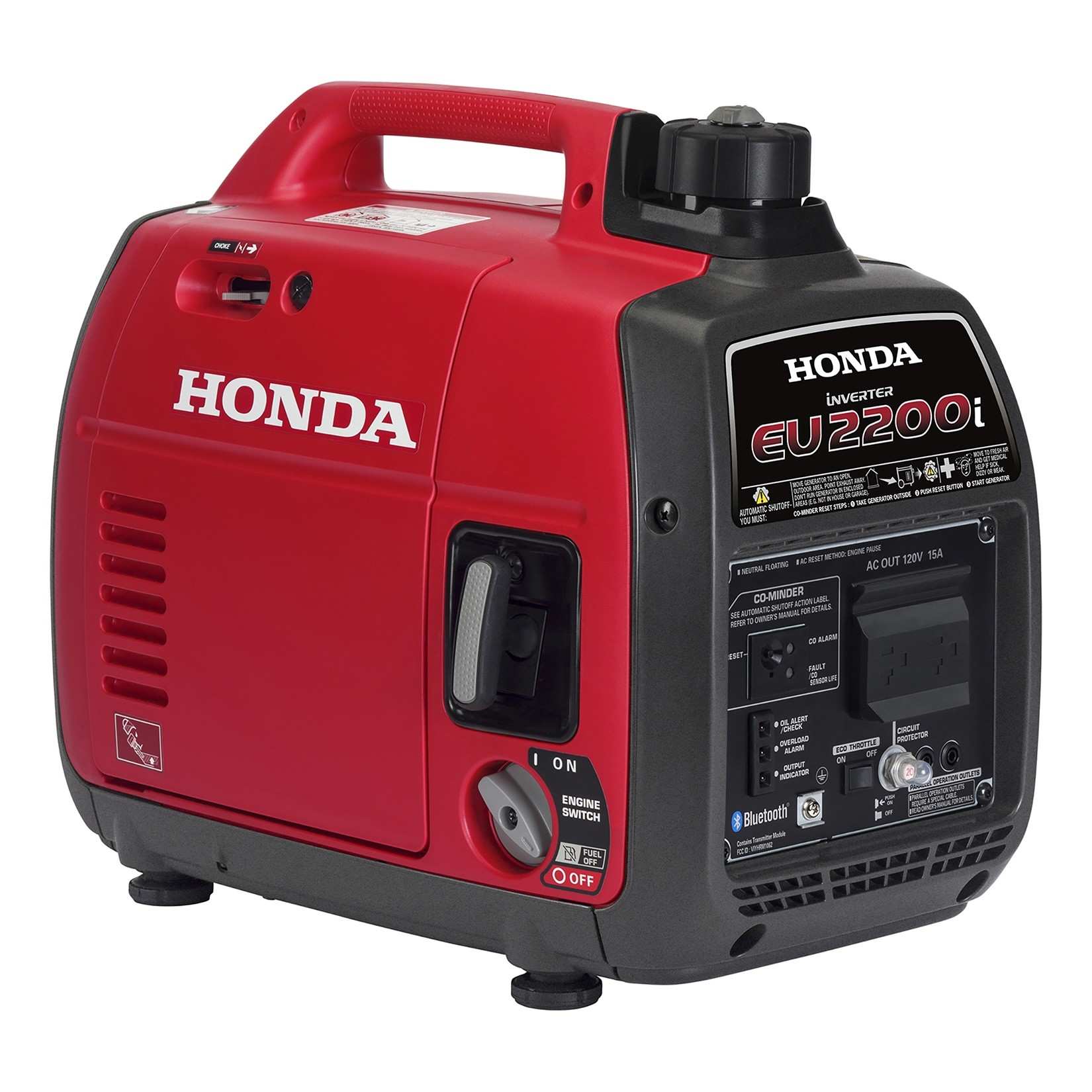
1. Honda EU2200i
The EU2200i is the model to consider when your priority is a small, quiet generator that you can actually carry without turning setup into a two-person job. Honda rates it at 2,200 peak watts and 1,800 rated watts, with a 0.95-gallon fuel tank and a dry weight of 47.4 pounds. The official noise figures are 48 dB(A) at 25% load and 57 dB(A) at rated load.
It is gasoline-only, so you give up propane flexibility. In return, the package is unusually compact and straightforward. Honda includes CO-MINDER, Eco Throttle, Bluetooth connectivity through the My Generator app, and parallel capability. The 120V control panel has a 20A duplex receptacle rather than a built-in 30A RV outlet.
The independent testing matters here. Bob Vila's 2026 portable-generator test named the EU2200i its best overall model. The tester reported easy transport, quiet operation, strong power delivery, and successful use with a refrigerator and camp equipment. That is independent evidence from Bob Vila's test environment, not a TestedWise test, and it does not mean the Honda is automatically the best fit for every campsite.
The biggest practical limitation is capacity. If your camping load includes a microwave, coffee maker, refrigerator and RV air conditioner at the same time, 1,800 running watts leaves little headroom. The EU2200i makes more sense when the generator is there for a refrigerator, lights, charging, small appliances, or intermittent tools. It can also be paralleled with another compatible Honda unit when you need more output.
- 2,200W maximum / 1,800W rated output; 120V inverter power.
- 8.1 hours at 25% load; 48–57 dB(A) published noise range.
- 47.4 lb dry weight; 0.95-gallon tank; gasoline only.
- CO-MINDER, Eco Throttle, Bluetooth/app monitoring, and parallel capability.
- Honda's current US page states this model is not for sale in California.
View the Honda EU2200i Amazon listing · Honda official specifications · Bob Vila 2026 portable-generator testing
Best lightweight dual-fuel option
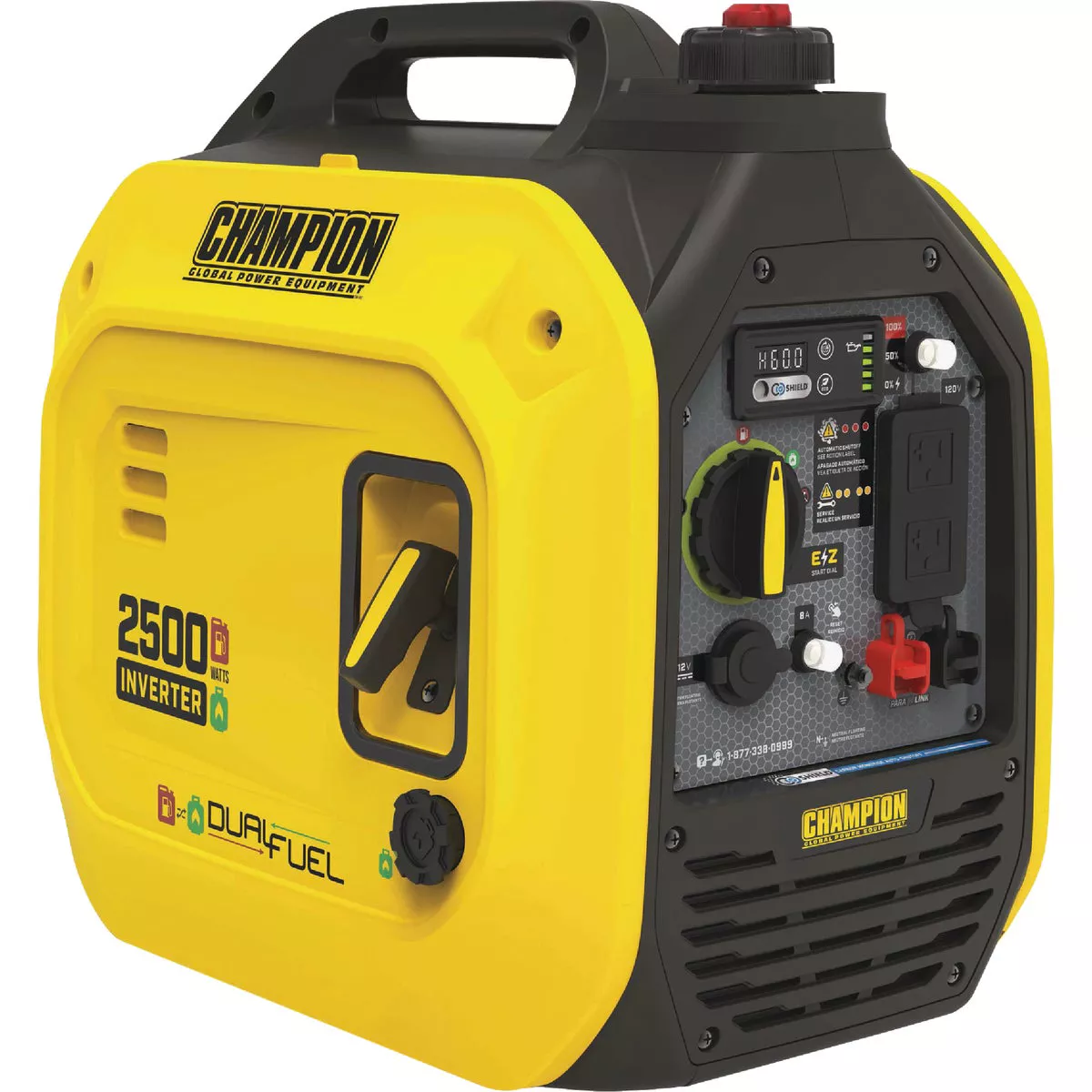
2. Champion Power Equipment 2500W Dual Fuel Inverter 201183
At 39 pounds, the Champion 201183 is the lightest generator in this comparison. That makes a bigger difference at a campsite than the specification sheet suggests. A generator that has to be lifted from a vehicle, moved to a safe operating position, and packed away after every trip benefits from a simple carry handle and low weight.
Champion rates the 201183 at 2,500 starting watts and 1,850 running watts on gasoline, dropping to 1,665 running watts on propane. It is a true dual-fuel design, so you can use gasoline when portability and peak output matter or propane when storage life and fuel flexibility matter more. Champion publishes 11.5 hours of gasoline runtime and up to 34 hours on a 20-pound propane cylinder, both at 25% load.
The generator uses recoil starting and has a covered 120V 20A duplex outlet, a 12V automotive-style outlet, USB through the supplied adapter, and parallel capability. Champion also lists CO Shield, low-oil shutdown, Economy Mode, clean inverter output below 3% THD, and a three-year limited warranty.
The trade-off is that propane reduces the rated output to 1,665 watts. That is still enough for many camping loads, but it is important if you are planning to run a high-draw appliance. The 201183 is better thought of as a compact campsite power source than an RV air-conditioner specialist.
For buyers in California, this model has an important advantage over several alternatives in this guide: Champion's current specification page lists the 201183 as CARB compliant. Always verify the exact model number and listing before ordering, because generator families often contain very similar variants.
- 2,500W peak; 1,850W running on gasoline and 1,665W on propane.
- 53 dB(A) at 23 feet; 39 lb; 1.1-gallon gasoline tank.
- Up to 11.5 hours on gasoline or 34 hours on a 20-lb propane tank at 25% load.
- CO Shield, Economy Mode, low-oil shutdown, clean inverter power and parallel capability.
- CARB compliant according to Champion's current product specification.
View the Champion 201183 Amazon listing · Champion official specifications
Best compact RV-ready generator
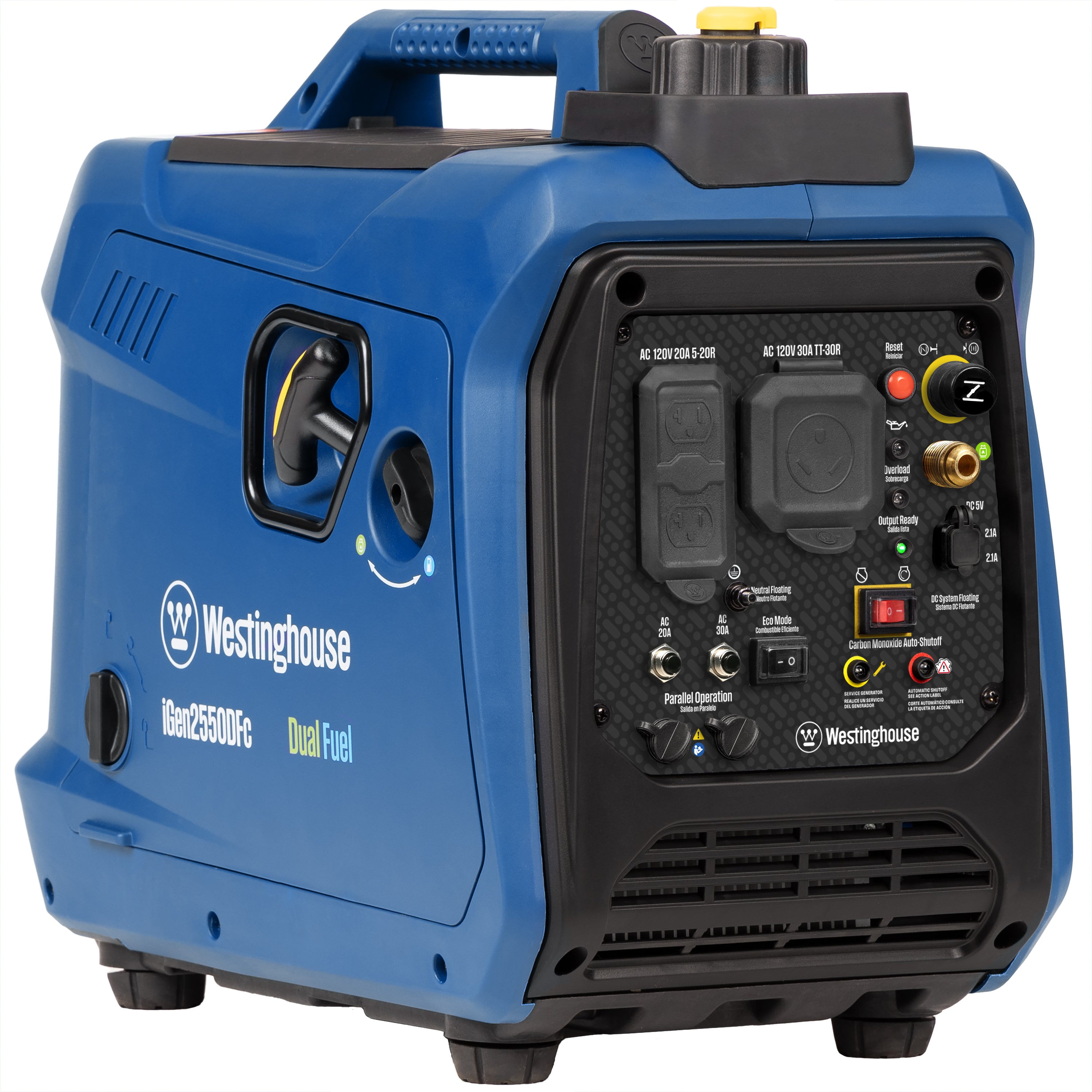
3. Westinghouse iGen2550DFc
The iGen2550DFc sits between the Honda and the larger Champion in a useful way: it remains light enough to move without wheels, but it adds a 120V TT-30R 30A RV outlet. That makes it more interesting for small travel trailers and campers than a compact generator with only household receptacles.
Westinghouse rates the unit at 2,550 peak and 1,900 running watts on gasoline, with 2,300 peak and 1,700 running watts on propane. It has an 80cc four-stroke engine, a 1.1-gallon tank, Eco Mode, parallel capability, a CO sensor, low-oil shutdown, two 5V USB ports, and a standard 120V 20A duplex outlet alongside the RV outlet.
The manufacturer's published noise figure is as low as 52 dBA, with gasoline runtime listed at up to 11 hours at 25% load. Westinghouse also lists 25 hours at 25% load on propane. Those numbers should not be compared directly with a model whose manufacturer uses a different load or measurement setup, but they explain why this model is attractive for RV parks and other noise-sensitive settings.
There is a significant limitation for California buyers: Westinghouse's current specification page lists the iGen2550DFc as not CARB compliant. That means a buyer in California should not treat this as an interchangeable option with a CARB-compliant generator simply because the wattage and physical size look similar.
The 30A outlet also needs to be understood correctly. A TT-30R makes the generator RV-ready from a connector perspective, but it does not magically provide enough power for every RV air conditioner. Check your air conditioner's startup demand and the generator's running-watt capacity before assuming compatibility.
- 2,550W peak / 1,900W running on gasoline; 2,300W / 1,700W on propane.
- 43.2 lb dry weight; 1.1-gallon tank; recoil start.
- 120V TT-30R RV outlet plus 20A household outlet and USB ports.
- 52 dBA published noise figure; Eco Mode; parallel capability; CO sensor.
- Westinghouse currently lists the model as not CARB compliant.
View the Westinghouse iGen2550DFc Amazon listing · Westinghouse official specifications

Best value for more compact output
4. WEN DF280iX
The DF280iX is the practical middle ground if 1,800 to 1,900 running watts feels restrictive but a 100-pound RV generator is overkill. WEN rates it at 2,800 surge watts and 2,250 rated watts on gasoline, or 2,800 surge and 2,000 rated watts on propane. At 45 pounds, it stays within the range that one person can reasonably carry from a vehicle to a campsite.
Its feature list is unusually complete for the size. WEN includes two 120V 5-20R receptacles, a 12V DC outlet, two 5V USB ports, parallel capability, Eco Mode, fuel shutoff, low-oil protection, overload protection, and the Watchdog CO shutdown sensor. WEN states that the generator produces less than 1.2% THD at full load and less than 0.3% at no load.
The gasoline tank is 1.58 gallons. WEN publishes up to 9 hours of runtime at half load on gasoline and up to 13.9 hours at half load on a 20-pound propane tank. Again, these are manufacturer figures at a defined load, not a promise of nine or thirteen hours while running a refrigerator, microwave, air conditioner, and chargers together.
The DF280iX is also a useful example of why a larger wattage number does not automatically make a generator better for camping. It does not have the built-in 30A RV receptacle found on the Westinghouse and larger Champion. If your goal is a compact generator for household-style outlets, charging, refrigeration and occasional appliances, that may not matter. If your trailer expects a TT-30R connection, choose an RV-ready model instead.
WEN's current product information emphasizes fuel shutoff, which lets the carburetor consume remaining fuel before shutdown. That can be useful when a generator spends most of the year stored between trips. Lowe's currently lists the DF280iX as CARB compliant, but verify the exact listing and model number before buying for California.
- 2,800W peak; 2,250W running on gasoline and 2,000W on propane.
- 45 lb; 1.58-gallon tank; 60 dB at no load.
- Up to 9 hours at half load on gasoline; up to 13.9 hours at half load on propane.
- Two 120V outlets, 12V DC, dual USB, Eco Mode, fuel shutoff and CO Watchdog.
- Parallel capable; current Lowe's listing states CARB compliant.
View the WEN DF280iX Amazon listing · WEN official specifications
Best for higher-draw RV and camping loads
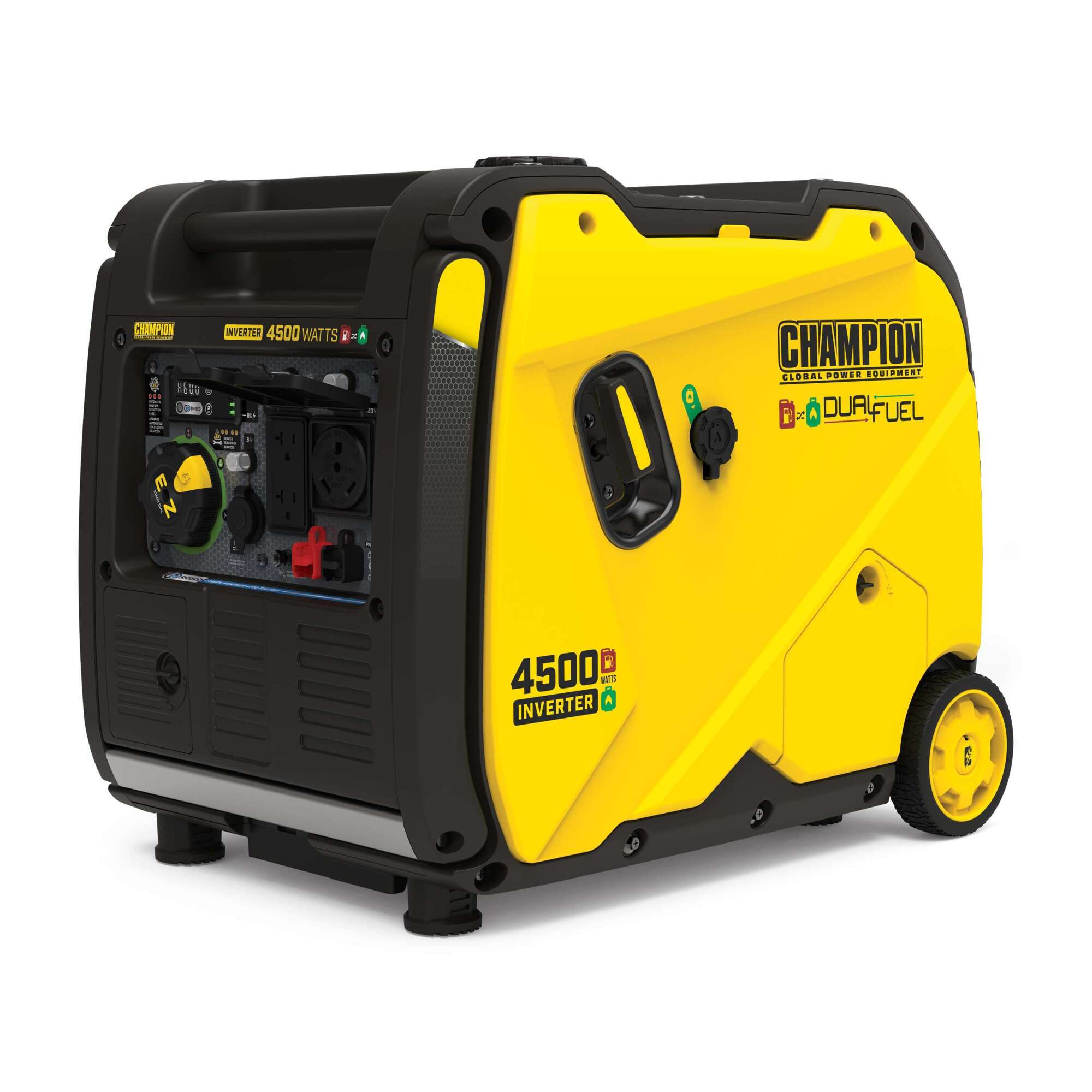
5. Champion Power Equipment 4500W Dual Fuel Inverter 201319
The 201319 is not a lightweight camping generator. At 99.2 pounds before fuel, it belongs in the “roll it into position” category rather than the “carry it to a tent” category. The reason to accept that weight is output: Champion rates it at 4,500 starting and 3,500 running watts on gasoline, with 4,500 starting and 3,150 running watts on propane.
It is designed around RV-style use. The covered panel includes a 120V TT-30R 30A RV receptacle, a 120V 20A household duplex, a 12V automotive outlet and parallel connections. Electric start, recoil backup, a mechanical fuel gauge, Intelligauge, CO Shield, low-oil shutdown and wheels with a folding handle make it easier to manage once it is on the ground.
Champion publishes up to 14 hours of gasoline runtime and up to 21 hours on a 20-pound propane tank at 25% load. Noise is listed at 61 dB(A) from 23 feet. The inverter output is specified at less than 3% THD, and the unit carries a three-year limited warranty.
This is the model to consider when a smaller generator repeatedly runs out of headroom. A travel trailer with an air conditioner, refrigerator, lights and charging equipment can create a very different load from a tent campsite with a cooler and a few phones. The 201319 gives you substantially more continuous power, but it also adds fuel weight, storage space, and a much larger physical footprint.
There is a compliance wrinkle worth checking. Champion's current product page lists the 201319 as EPA certified but does not state a CARB certification in its specification table, while some retailers publish conflicting CARB information. For a California purchase, verify the exact current listing and certification rather than assuming that another Champion dual-fuel model has the same status.
- 4,500W peak / 3,500W running on gasoline; 3,150W running on propane.
- 99.2 lb dry weight; 2.25-gallon gasoline tank; electric and recoil start.
- 30A TT-30R RV outlet, 20A household duplex, 12V outlet and parallel capability.
- Up to 14 hours gasoline or 21 hours propane at 25% load; 61 dB(A) at 23 feet.
- CO Shield, electric start, wheels, fuel gauge and three-year limited warranty.
View the Champion 201319 Amazon listing · Champion official specifications
How many watts do you need for camping?
Start with the appliances you actually intend to run, not the generator size you saw in a product title. Write down each device's running watts, then identify which devices have a motor or compressor that can create a startup surge. Add the running loads you expect to use at the same time, then leave practical headroom rather than planning to operate a generator at its limit.
For example, a refrigerator may have a modest running draw but a larger startup demand. A microwave can draw well over 1,000 watts while operating. A coffee maker or induction cooktop can also use a large share of a small generator's capacity. The mistake is to add the nameplate wattages without asking whether the appliances will actually run simultaneously.
Do not use the generator's peak wattage as if it were a continuous rating. A 2,500-watt generator with 1,850 running watts is not a 2,500-watt continuous power source. That distinction becomes especially important when you move from a tent campsite to an RV.
Why inverter generators are better suited to camping
Most campers looking for a portable gasoline generator should start with an inverter generator rather than an open-frame conventional generator. An inverter unit electronically produces and regulates its AC output, allowing the engine to slow down when the load is light. That can reduce fuel consumption and noise compared with a generator that runs at a fixed engine speed.
There is another reason inverter technology is useful at camp: clean electrical output. The models in this comparison publish low total harmonic distortion figures, which makes them appropriate for electronics such as laptops, phones, televisions, chargers and modern appliances. It does not mean you can ignore the generator's rated capacity or safety instructions, but it is one reason inverter generators are common in camping and RV applications.
The Honda EU2200i, Champion 201183, Westinghouse iGen2550DFc, WEN DF280iX and Champion 201319 are all enclosed inverter designs. That does not make them silent. The published sound figures range from the high 40s to around 60 dB(A), and the measurement conditions differ. Treat the manufacturer's number as a reference point, not a universal campsite noise ranking.
If a campground has generator-hour restrictions or prohibits gasoline generators altogether, a portable power station may be a better fit. A battery power station produces no exhaust and is effectively silent, but its usable energy is limited by battery capacity and recharge options. A fuel generator can be refueled, which is why it remains useful for multi-day trips and higher sustained loads.
Gasoline vs. propane for camping
Gasoline usually wins for compact output and availability. It is the most common fuel for small portable generators and generally gives the generator its higher running-watt rating. The downside is storage: gasoline needs proper containers, rotation and attention to stale fuel.
Propane is attractive for storage and fuel flexibility. A sealed propane cylinder can sit for much longer than gasoline without the same concern about fuel degradation in a carburetor. Dual-fuel generators also give you a fallback if one fuel becomes inconvenient. But propane usually reduces the generator's rated output, as shown clearly by the Champion 201183 and Westinghouse iGen2550DFc.
For a weekend trip, the difference may be simple: gasoline is convenient if you already carry it for the vehicle or other equipment; propane can be convenient if your camping setup already uses 20-pound cylinders. For long-term emergency storage, dual fuel is more valuable because it gives you more than one way to keep the generator operating.
Generator noise at a campsite
Noise is one of the most underestimated camping-generator specifications. A generator can be technically “quiet” and still be unwelcome at a crowded campground if it is placed too close to neighboring sites or run outside permitted hours.
Pay attention to the measurement distance and load. Honda lists 48 dB(A) at 25% load and 57 dB(A) at rated load. Champion lists 53 dB(A) at 23 feet for the 201183. Westinghouse lists 52 dBA for the iGen2550DFc, while WEN lists 60 dB at no load for the DF280iX. Champion lists 61 dB(A) at 23 feet for the 201319.
Those figures are useful, but they are not a controlled head-to-head test. Sound changes with engine load, terrain, reflective surfaces, distance, background noise and the direction of the exhaust. A small inverter running lightly can be dramatically less intrusive than the same generator under a heavy load.
Before buying, check the campground's generator hours and local rules. A generator that is perfectly acceptable for dispersed camping may be inappropriate at a developed campground with quiet hours.
RV air conditioners and 30-amp outlets
A 30A TT-30R outlet is useful if you own an RV, but it should not be treated as proof that a generator can start every RV air conditioner. The outlet describes the connection; the generator's continuous and surge output determine how much electrical load it can actually support.
The Westinghouse iGen2550DFc has a TT-30R outlet but only 1,900 running watts on gasoline. That may be enough for some smaller or efficient RV air-conditioning setups under the right conditions, but you should check the air conditioner's startup demand before buying.
The Champion 201319 has 3,500 running watts on gasoline and 3,150 on propane, giving it substantially more headroom for higher-draw RV loads. Even then, do not assume that any 13,500- or 15,000-BTU air conditioner will start successfully. Soft-start equipment can change the startup requirement, ambient temperature affects cooling load, and other appliances may already be drawing power.
If your main reason for buying a generator is RV air conditioning, build the decision around the air conditioner first. If you are building a complete first camping setup, pair the generator decision with our car camping essentials checklist rather than choosing power equipment in isolation. Then add the refrigerator, battery charger, microwave, coffee maker, lighting and other loads you expect to use simultaneously.
California and CARB considerations
California buyers need to check emissions certification before ordering a portable fuel generator. “EPA certified,” “CO shutoff,” and “CARB compliant” are not interchangeable terms.
- Honda EU2200i: Honda's current product page states that the listed model is not for sale in California.
- Champion 201183: Champion lists the 201183 as CARB compliant.
- Westinghouse iGen2550DFc: Westinghouse currently lists CARB Compliant as “No.”
- WEN DF280iX: Lowe's currently lists the model as CARB compliant.
- Champion 201319: Champion's current product page lists EPA certification but does not state CARB status; retailer information is inconsistent, so verify the exact current certification before a California purchase.
This is one reason to use the exact model number when shopping rather than searching only for “best camping generator.” Two generators that look almost identical can have different emissions certification, outlet layouts or regional availability.
Generator safety: the part you cannot compromise
A portable fuel generator must be treated as an outdoor combustion appliance. Carbon monoxide is colorless and odorless, and a generator can produce dangerous concentrations quickly.
That includes the common campsite mistake of putting a generator just outside a tent or RV because the weather is bad. The exhaust can still enter through openings or accumulate in a location where people are sleeping. Follow the generator's manual and the campground's rules for weather protection. A generator cover must never block ventilation or exhaust.
CO shutdown technology is a valuable additional safety feature, but it is not permission to operate the generator closer to people. Champion's CO Shield and WEN's CO Watchdog are designed to shut the engine down when dangerous CO levels are detected. Westinghouse and Honda also provide CO monitoring on the models in this comparison. The CPSC specifically recommends looking for portable generators with automatic CO shutoff protection, while still emphasizing outdoor placement.
Refueling requires its own discipline. Shut the generator down, allow it to cool, and follow the manual before adding gasoline. Never refuel a hot or running generator. Keep gasoline and propane away from flames, sparks and hot exhaust components.
Fuel storage, maintenance, and transport
A generator that sits in a garage for eleven months and is expected to start on the first morning of a trip needs more care than a device that is used every week. Follow the manufacturer's maintenance schedule, check oil before use, inspect the air filter and spark plug as specified, and run the generator periodically if the manual calls for it.
Fuel management is equally important. Gasoline can degrade during storage, so use fresh fuel and follow the manufacturer's storage procedure. The WEN DF280iX includes a fuel-shutoff feature designed to let the carburetor consume remaining fuel before the generator stops. That can reduce stale-fuel problems, but it does not remove the need for proper fuel storage.
Propane cylinders should be transported and stored according to the cylinder and generator instructions. Never leave fuel cylinders or gasoline containers in the path of hot exhaust. During transport, shut the generator off, allow it to cool, and secure it so it cannot move around the vehicle.
Weight also becomes a maintenance issue. A 39- to 47-pound generator can usually be handled by one person. A roughly 100-pound generator with fuel is a different proposition. The Champion 201319's wheels and folding handle help, but you still need to plan how it gets from the vehicle to the operating position.
Camping generator buying mistakes to avoid
- Buying by peak watts alone. Use running watts for the continuous load and check startup requirements for motors and compressors.
- Assuming an RV-ready outlet guarantees air-conditioner compatibility. The TT-30R connector does not tell you how much power the generator can continuously deliver.
- Comparing noise numbers as if they were laboratory measurements. Check distance and load conditions before calling one generator quieter than another.
- Ignoring fuel-specific output. Dual-fuel generators often produce fewer running watts on propane than on gasoline.
- Forgetting campground rules. Quiet hours and generator bans can make a fuel generator unusable even when it technically meets your power needs.
- Skipping regional emissions checks. California buyers should verify CARB status for the exact model and variant.
- Putting the generator too close to the campsite. A CO sensor does not make an unsafe location safe.
- Buying more generator than you can realistically move. A 4,500-watt generator may solve a power problem while creating a transport problem.
- Assuming a generator replaces a power station in every situation. If you need silent power near a tent, a battery power station may be the better tool.
Frequently asked questions
What is the best camping generator for most people?
For compact car and tent camping, the Honda EU2200i is the strongest premium choice in this group because it combines 1,800 running watts, a 47.4-pound weight, low published noise, parallel capability and a strong independent 2026 test result from Bob Vila. If you want propane as a second fuel, the Champion 201183 is the more flexible lightweight alternative.
Is 2,000 watts enough for camping?
It can be. Around 1,800 to 2,250 running watts is enough for many combinations of refrigeration, lighting, charging and small appliances. It becomes less comfortable when you add a microwave, induction cooktop, coffee maker or RV air conditioner at the same time. Calculate the simultaneous running load and check startup demand before deciding.
Is a dual-fuel generator better for camping?
It can be more versatile, especially for multi-day trips or emergency backup. Gasoline usually provides the higher rated output, while propane offers a convenient alternative fuel and longer storage life. The extra fuel flexibility is most useful if you already have a safe way to transport and store propane.
Can a 2,500-watt generator run an RV air conditioner?
Sometimes, but the generator's running and starting capability and the specific air conditioner matter. A 2,500-watt peak rating does not mean 2,500 watts are available continuously. Check the air conditioner's startup requirements and consider a soft-start system if appropriate.
Can I run a camping generator in a tent or RV with the windows open?
No. Never operate a fuel generator inside a tent, RV, camper, garage, shed, carport or other enclosed or partially enclosed space. CPSC and CDC guidance calls for outdoor operation more than 20 feet from windows, doors and vents, with exhaust directed away from occupied areas.
Are inverter generators safe for laptops and phones?
Inverter generators are designed to provide regulated electrical output and are commonly used with sensitive electronics. The five models here publish low-THD inverter output. You should still use the generator within its rated capacity and follow the manual for grounding, extension cords and electrical connections.
Which camping generator is best for California?
Do not choose by brand alone. Check the exact model's CARB certification. In this group, Champion lists the 201183 as CARB compliant, Lowe's lists the WEN DF280iX as CARB compliant, Honda states that the listed EU2200i is not for sale in California, and Westinghouse lists the iGen2550DFc as not CARB compliant. Champion's 201319 page does not state CARB status, so verify that exact model before ordering.
Should I buy a generator or a portable power station for camping?
Choose a generator when you need long-duration power that can be replenished with fuel, especially for higher sustained loads. Choose a power station when silent operation, indoor-adjacent use without exhaust, and simple charging are more important. For a detailed battery-based alternative, see our portable power station comparison.
For a first camping generator purchase, the safest approach is to define the campsite, the food and cooking setup you plan to power, and the equipment you will carry. Our camp kitchen guide can help you identify which electrical loads are actually worth adding before you size the generator. Then define the campsite, the appliances, the simultaneous load, the fuel you can legally and safely carry, and the generator hours permitted at the destination. Once those constraints are clear, the right wattage usually becomes much easier to identify.