
Best 12V Car Refrigerators for Road Trips and Camping: 5 Models Compared
A portable car refrigerator changes the way you pack food for a road trip. Instead of managing melting ice, you can set a temperature, keep groceries chilled, or freeze food for a longer drive. The hard part is that these products are not interchangeable. A 21-quart fridge with a removable battery is built for a different trip than a 59-quart dual-zone unit, and a premium compressor model may be worth the extra cost only if you use it often enough to notice the difference.
Affiliate disclosure: This article contains affiliate links. TestedWise may earn a commission if you purchase through them, at no additional cost to you. Read the full disclosure.
For this comparison, we reviewed five current Amazon US listings alongside manufacturer specifications and Car and Driver's November 2026 electric-cooler testing. We focused on compressor-based 12V refrigerators rather than small thermoelectric coolers. The independent test results below belong to Car and Driver, not TestedWise; we did not conduct hands-on cooling or battery-runtime tests on these five products.
Quick answer: The BougeRV CRH20 21QT with its 240Wh battery is the most flexible compact choice if you want cooling away from the vehicle. The EKOJUCE 54QT gives you much more storage for a lower-cost large-format setup. Choose the SetPower DT55 if you need two separately controlled compartments, the ICECO VL45 if compressor quality and a longer compressor warranty matter most, or the Anker SOLIX EverFrost 2 40L if you want a removable battery and several ways to recharge.
Portable 12V car refrigerator comparison
| Model | Capacity and layout | Power setup | What makes it different | Best fit |
|---|---|---|---|---|
| BougeRV CRH20 | 21 qt; single zone | 12/24V DC, AC, optional 240Wh battery bundle | Compact carry handle; independent test winner | Solo trips and flexible off-vehicle use |
| EKOJUCE 54QT | 54 qt; single zone | 12/24V DC and 100–240V AC | Large capacity and app control | Families wanting one large cooling compartment |
| SetPower DT55 | 59 qt; dual zone | 12/24V DC and AC; optional battery bundle | Separate temperature controls and two compartments | Keeping frozen and chilled food together |
| ICECO VL45 | 47.5 qt; single zone | 12/24V DC and 110–240V AC | SECOP compressor; 5-year compressor warranty | Frequent use and long-term ownership |
| Anker SOLIX EverFrost 2 40L | 42 qt; single zone | 12V car socket, AC, solar, USB-C; 288Wh battery included | Removable LFP battery, app, wheels and handle | Off-grid trips without a separate power station |
Capacity labels are not a substitute for checking the outside dimensions. A 59-quart refrigerator can occupy a large part of an SUV cargo area, while a smaller unit may fit behind a front seat. Also check the lid's opening direction and the space needed to lift it. A fridge that technically fits may be awkward to use once it is strapped into place.
The five portable car refrigerators worth comparing
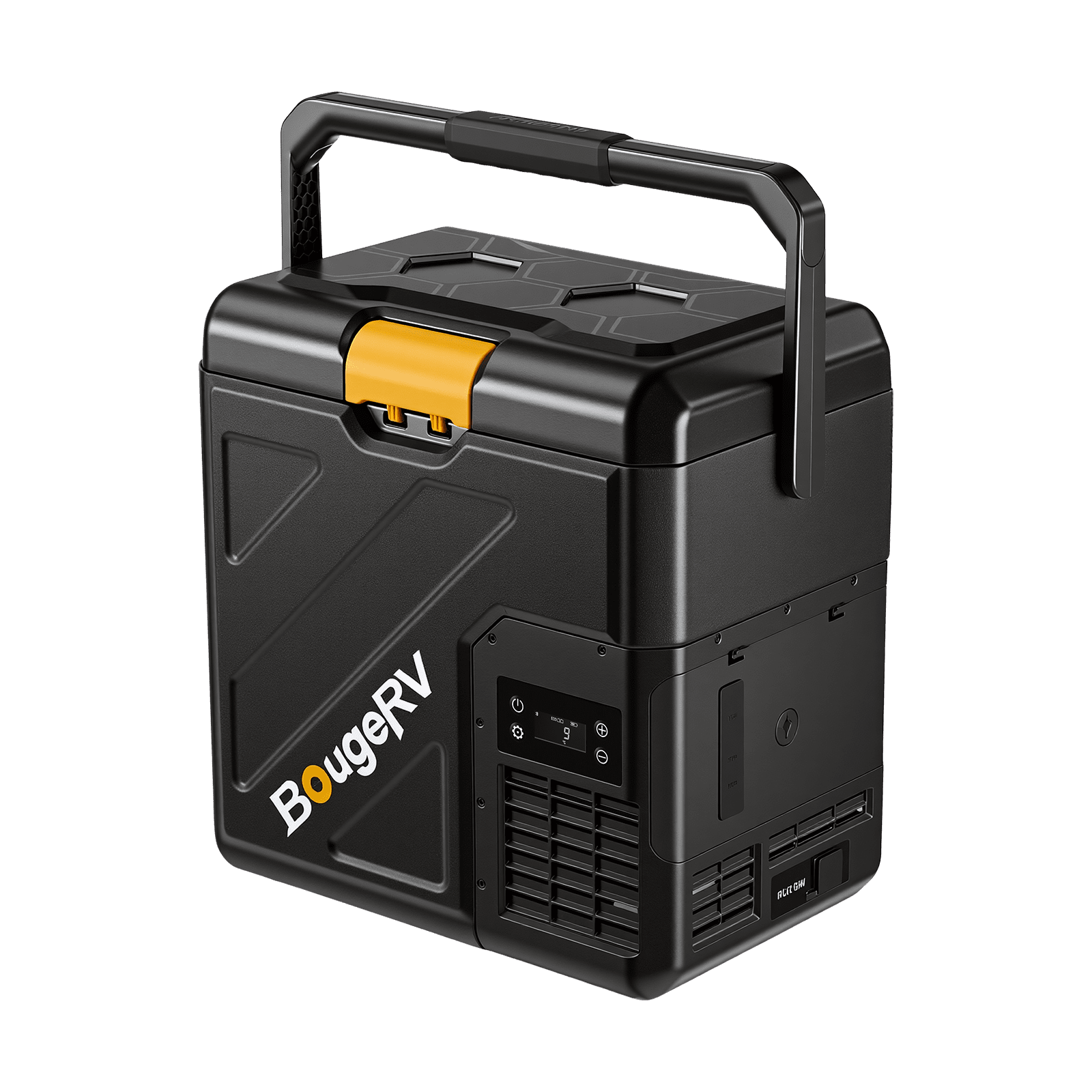
Best compact option with a removable battery bundle
1. BougeRV CRH20 21QT with 240Wh Battery
The CRH20 is the smallest refrigerator in this group, and that is its main advantage. At 21 quarts, it is easier to place in a smaller vehicle or move between the car and campsite than a 50- or 60-quart chest. BougeRV lists a single-zone compressor, a temperature setting range of -4°F to 68°F, 12/24V DC and 100–240V AC inputs, app control, and a rated input of 60W. The current manufacturer page lists the fridge-only version at 22.58 pounds; the battery-equipped test unit reviewed by Car and Driver weighed about 28 pounds.
Car and Driver selected the 21-quart battery-equipped model as its best overall electric cooler in its November 2026 update. Its test unit held 27 cans and reached a lowest measured temperature of -0.8°F. The included 240Wh battery is the feature that makes this bundle different from an ordinary 12V fridge: you can move it away from the car without immediately needing a separate power station. BougeRV says the battery can provide up to 30 hours under certain conditions, but that is a manufacturer claim, not a guaranteed runtime for a hot vehicle, a full fridge, or a freezer setting.
The compromise is capacity. A 21-quart box is sensible for one or two people, drinks, snacks, or a short trip, but it is not a family grocery fridge. If you regularly carry several days of food, move up to one of the larger models below. Also confirm that the Amazon listing is the battery bundle; the fridge-only and fridge-plus-battery versions are separate configurations.
- 21 qt / 20 L single-zone compressor fridge; -4°F to 68°F set range.
- 240Wh battery is included with the specific battery bundle linked here; the fridge-only configuration is different.
- Car and Driver test: 27 cans and a lowest measured temperature of -0.8°F.
View the battery-equipped Amazon listing · BougeRV CRH20 specifications · Car and Driver 2026 test

Best value direction for a large single-zone fridge
2. EKOJUCE 54QT Portable Refrigerator
The EKOJUCE is a better fit when storage matters more than a compact footprint. Its Amazon listing identifies a 54-quart compressor refrigerator with app control, a -4°F to 68°F temperature range, 12/24V DC input, and 100–240V AC power. It is a single-zone design, so the whole compartment follows one temperature setting. That is straightforward if you want one large chilled space or one large freezer, but it cannot keep drinks refrigerated and frozen food separated at two independent temperatures.
Car and Driver named its 54-quart EKOJUCE unit the best-value pick in the same 2026 comparison. The test sample held 75 cans and reached a lowest measured temperature of -0.2°F. The test team also noted that the unit felt less refined in some exterior details than more expensive competitors. There is a small specification difference worth checking: Car and Driver reported a 29-pound test sample, while the current Amazon listing's item details show a higher shipping/product weight figure. Treat the exact delivered variant and weight on the listing as the deciding information rather than assuming every production run is identical.
This is the most sensible direction if you want a large, single-zone compressor fridge without paying for a removable battery or a premium metal-shell build. It is less attractive if you need two temperature zones, a compact cabin-friendly shape, or a brand with a long-established specialist fridge service network. The Amazon listing is the EKOJUCE 54QT version; check that capacity and model name before ordering because the brand sells other cooler sizes and unrelated appliances.
- 54 qt single-zone compressor fridge with app control.
- 12/24V DC and 100–240V AC power; listed temperature range -4°F to 68°F.
- Car and Driver test: 75 cans and a lowest measured temperature of -0.2°F.

Best fit when you need separate fridge and freezer compartments
3. SetPower DT55 59QT Dual-Zone Refrigerator
The DT55 is the practical choice for people who want to keep drinks and fresh food cold while freezing meat or ice in a separate compartment. SetPower describes it as a true dual-zone refrigerator with independent temperature controls, app monitoring, an interior light, a drain, and four fixing clips for securing the unit. Its 59-quart size is split between two compartments, so do not compare the full 59 quarts with a 59-quart single-zone fridge as if the usable space were identical.
The manufacturer lists the 59-quart version at 24.6 × 15.9 × 22.6 inches and 37.3 pounds. It specifies up to 50W in MAX mode and 38W in ECO mode, plus a three-year compressor warranty and one-year full-unit coverage. Those wattage figures are rated operating figures, not a promise that the fridge draws that amount continuously for every hour. Compressor cycling, ambient heat, set temperature, ventilation, and how often the lid is opened all change actual energy use.
There is one specification caveat: SetPower's current product page describes a -4°F to 68°F range in its dual-zone feature copy, but another section on the same page gives a 0°F to 50°F refrigeration range. Because those endpoints conflict, check the current DT55 manual and the exact Amazon configuration before relying on the lowest freezer setting. The Amazon listing linked here is the 59-quart DT55; battery bundles and accessories are separate options, so do not assume a removable battery is included.
- 59 qt / about 55 L, with two separately controlled compartments.
- 12/24V DC and AC power; 38W ECO and 50W MAX figures from the manufacturer.
- 37.3 lb listed weight; 3-year compressor and 1-year full-unit warranty.
View the 59QT DT55 Amazon listing · SetPower DT55 specifications
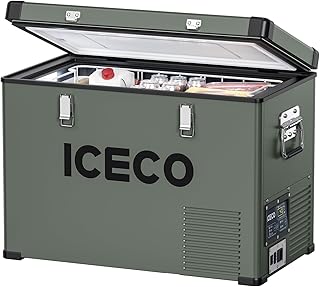
Best long-term ownership proposition for frequent use
4. ICECO VL45 47.5QT Single-Zone Fridge
The ICECO VL45 is a more traditional overlanding-style refrigerator. It uses a SECOP compressor, a metal shell, a single temperature zone, and separate cables for 12/24V DC and 110–240V AC operation. ICECO lists a cooling range of 0°F to 50°F, a 45-liter / 47.5-quart capacity, and external dimensions of 27.4 × 15.8 × 19.2 inches for the current VL45 configuration. The company states that the compressor is covered for five years and other parts for one year.
The main reason to consider this model is not an app or a removable battery. It is the more substantial build and the compressor warranty. That can matter if the refrigerator will live in a truck, van, or RV and run regularly through multiple seasons. ICECO also lists three-stage low/medium/high battery protection and MAX/MIN compressor modes. The low mode is intended to reduce compressor speed and energy use, while MAX prioritizes faster cooldown.
The trade-offs are price, weight, and simplicity. At roughly 47.5 quarts and around 50 pounds depending on the exact bundle, it is not a lightweight cooler to carry from the parking lot. It is also single-zone, so you cannot independently run one compartment as a freezer and another as a refrigerator. The Amazon listing and the manufacturer's current product page may package the cover differently; check whether the listing you select includes the cover or sells it separately.
- 45 L / 47.5 qt single-zone capacity; 0°F to 50°F cooling range.
- SECOP compressor, 12/24V DC and 110–240V AC operation.
- 5-year compressor warranty and 1-year warranty on other parts, according to ICECO.
View the ICECO VL45 Amazon listing · ICECO VL45 specifications and warranty

Best battery-integrated option for off-grid trips
5. Anker SOLIX EverFrost 2 40L
The EverFrost 2 is not simply a 12V fridge with an adapter. It is a portable electric cooler built around a removable 288Wh LFP battery, and the 40-liter version holds about 42 quarts. Anker lists a temperature range of -4°F to 68°F, car-socket and wall charging, 100W solar input, 60W USB-C charging, app control, and a wheeled body with a retractable handle. One 288Wh battery is included with the standard 40L purchase; a second battery is an additional purchase or part of a separate bundle.
Car and Driver selected the EverFrost 2 for overlanding and off-grid camping. In its test, the 42-quart unit held 60 cans and reached a lowest measured temperature of -6.4°F. The test team took 54 minutes to cool the empty unit to 32°F from its starting test conditions. That is a useful reminder that a manufacturer's fast-cooldown claim and a third-party test are not necessarily measuring the same thing. Anker's own 52-hour runtime figure for one battery is based on an empty cooler in ECO mode, with a 39°F internal setting and 77°F ambient temperature; it should not be read as a guaranteed runtime when the unit is full, set to freeze, or used in a hot vehicle.
The EverFrost 2 is the most self-contained off-grid choice here, but it is also heavy and expensive. The official product page lists a net weight of about 50.7 pounds before food is added. Its wheels and handle help on level ground, but they do not make it easy to lift into a high SUV cargo area. If you already own a suitable power station and do not need a battery built into the fridge, a conventional 12V compressor model may be a better-value purchase.
- 40 L / 42 qt single-zone capacity; one 288Wh LFP battery included.
- -4°F to 68°F range; car, AC, solar, and USB-C charging options.
- Manufacturer runtime claim: up to 52 hours with one battery under its stated empty-cooler ECO test conditions.
View the 40L EverFrost 2 Amazon listing · Anker official specifications · Car and Driver 2026 test
Compressor vs. thermoelectric coolers: buy the right technology
This distinction matters more than a brand name. A compressor refrigerator works much like a household refrigerator: it actively removes heat and can maintain a set temperature below the surrounding air. The five products above use compressor-based cooling. They can be set to refrigerator temperatures or, within their stated ranges, used as freezers.
A thermoelectric cooler uses a Peltier module. It generally cools to a certain number of degrees below the surrounding air rather than holding a precise refrigerator temperature in every condition. On a hot day, the inside can remain much warmer than you expect. These units can be fine for keeping drinks somewhat cooler on a short drive, but they are not a like-for-like substitute for a compressor fridge when you need reliable food storage or freezing.
Also be careful with the word cooler. Some product listings use it for passive ice chests, thermoelectric boxes, and compressor refrigerators. Check the product description for a compressor, a temperature setpoint range, and 12/24V DC input. If the listing only says it cools a fixed number of degrees below ambient temperature, it is probably a thermoelectric product.
How to choose the right size and power setup
1. Choose capacity around the food you will actually carry
As a starting point, a 20–25-quart fridge can work for one or two people on short trips, especially if it is mainly for drinks, breakfast items, and a few perishables. Around 35–45 quarts is a more flexible range for a couple or a small family on a weekend. A 50–60-quart model makes sense when you need room for several days of food, but it takes up more cargo space and becomes heavy when full. These are planning ranges, not strict rules; packaging, baskets, the shape of containers, and the number of frozen items all affect usable space.
Before ordering, measure the cargo area and the height needed to open the lid. Include room for ventilation around the compressor housing and enough space to remove baskets. If the fridge will sit behind a seat, check that passengers can still use the seat and that the lid can open without hitting the tailgate or roof. A slightly smaller model that is easy to reach is often more useful than a larger box buried under luggage.
2. Decide whether one temperature zone is enough
A single-zone fridge is simpler and often gives you more usable room for the same outside dimensions. You can set it to refrigerator temperature or freezer temperature, but the entire compartment follows that one setting. A dual-zone fridge has separate compartments and independent controls, so you can chill drinks while freezing food. The partition, second lid, and separate compartments take up space, and the unit may be heavier. Choose dual-zone only if you will use both temperatures regularly.
3. Understand the difference between 12V compatibility and off-engine runtime
A 12V car refrigerator can run from a vehicle accessory socket while you drive, but that does not automatically mean it can run all night without risk to the starter battery. Some vehicles shut the accessory socket off with the ignition; others keep it live. A fridge's low-voltage cutoff helps reduce battery-drain risk, but it cannot guarantee that an old, weak, or already-partly-discharged starter battery will still start the engine.
For overnight or multi-day use, a separate power source is usually the cleaner plan: a fridge with a built-in battery, a compatible external battery pack, or a portable power station with a regulated 12V DC output. If you use a power station, check both the DC output rating and the fridge's input requirements. Running the fridge through an AC inverter can add conversion losses, so a suitable DC connection is often more efficient. Our portable power station comparison explains how watt-hours, output ratings, and ports affect real use.
4. Read wattage and runtime claims carefully
A 50W maximum input rating does not mean the compressor consumes 50Wh every hour. The compressor cycles on and off as the fridge approaches its set temperature. Average draw changes with outside temperature, setpoint, how much warm food you load, how often the lid opens, and how much air can circulate around the unit. A fridge running in a shaded vehicle at 38°F is a different load from one trying to freeze food in a hot cargo area.
For a rough first estimate, divide usable battery capacity in watt-hours by the fridge's average power draw in watts. The difficulty is that the average draw is often not published under conditions that match your trip. Do not substitute the maximum input wattage for average draw, and do not treat a brand's runtime figure as universal. When runtime matters, check the manual, start with pre-chilled food, use ECO mode if appropriate, and measure your actual setup with a DC watt meter or the power station's energy display.
5. Compare battery protection and included accessories
Check whether the base listing includes an AC adapter, a 12/24V DC cable, a battery, a protective cover, baskets, and a tie-down kit. Some brands show the battery-equipped bundle in their main product photos but sell the fridge-only version as the default option. The BougeRV and Anker listings in this guide are linked to battery-equipped configurations; the SetPower, ICECO, and EKOJUCE base listings do not include an internal battery.
Battery protection is also model-specific. A low/medium/high cutoff is useful, but the exact cutoff voltage and restart behavior matter more than the number of levels in the marketing copy. Read the manual for the actual thresholds. If the fridge will be used in a pickup bed or off-road vehicle, check the fixing points and secure it so it cannot slide during braking or on rough ground.
Food safety and vehicle-battery protection
A refrigerator is only useful for food safety if you verify the temperature. The USDA says perishable foods should be kept at 40°F or below, and frozen foods at 0°F or below. Set the fridge to the temperature you need, but use a separate refrigerator thermometer to confirm what the food is experiencing. A display can show the sensor's location rather than the warmest part of the compartment, and the temperature can vary after the lid has been open.
- Pre-cool before loading. Plug the refrigerator into household AC power before the trip and chill the food separately. Do not expect a small battery to pull a warm fridge and warm groceries down to temperature quickly.
- Pack cold food, not warm food. Loading room-temperature groceries makes the compressor work harder and delays reaching a safe temperature.
- Keep raw meat sealed and separated. Use leakproof containers and place raw meat below ready-to-eat foods where possible.
- Keep the lid closed. Organize food in baskets or meal groups so you do not leave the lid open while searching.
- Protect the starter battery. Check whether your 12V socket stays live with the engine off, use the correct low-voltage cutoff, and choose a separate battery for overnight use.
- Allow airflow around the compressor. Do not wedge the fridge tightly against luggage or cover its ventilation openings.
The USDA's cold-storage guidance sets 40°F or below for refrigerated perishables and 0°F or below for frozen foods. For broader trip planning, our car-camping essentials checklist covers food storage, water, and the other basics to prepare before leaving home.
Buying mistakes to avoid
- Buying a thermoelectric cooler when you need a freezer. A temperature drop below ambient is not the same as a compressor fridge with a defined setpoint.
- Assuming 12V means safe overnight operation. Check whether the vehicle socket stays live and whether you have a separate battery for parked use.
- Choosing by quart rating alone. Check internal dimensions, baskets, lid clearance, and how the box fits in your vehicle.
- Assuming every dual-zone model has two equal compartments. Some split the capacity unevenly; look at the dimensions of each compartment if you have large containers.
- Confusing max watts with daily energy use. Compressor cycling means average draw is different from the highest input rating.
- Overlooking the bundle variation. Confirm whether the Amazon listing includes a battery, cover, AC adapter, and the exact size you intend to buy.
- Ignoring the warranty exclusions. A five-year compressor warranty does not mean every electrical part, control board, or accessory has five years of coverage.
Frequently asked questions
Can a 12V car refrigerator run while the engine is off?
Yes, if it has a live 12V supply or a separate battery, but the vehicle's accessory socket may turn off with the ignition. Running a fridge from the starter battery for long periods can leave too little charge to start the vehicle. For overnight camping, use a built-in battery or a separate power station where possible.
What size 12V refrigerator is best for car camping?
A 20–25-quart unit can suit one or two people on a short trip. Around 35–45 quarts gives a couple more flexibility for a weekend, while 50–60 quarts is better for families or longer trips that need more food storage. Measure the vehicle space and check the usable compartment dimensions before choosing.
Are compressor car fridges better than thermoelectric coolers?
For reliable food storage and freezing, a compressor refrigerator is generally the better tool because it can hold a set temperature below ambient conditions. Thermoelectric coolers are usually less expensive and can be adequate for drinks on a short drive, but their cooling performance depends more heavily on outside temperature and they are not a direct substitute for a freezer.
Can a portable car refrigerator freeze food?
Some can. Check the actual temperature range and the lowest setting in the manual. A unit that reaches 0°F or below can be used as a freezer, but use a separate thermometer to verify the food compartment temperature rather than relying only on the display.
How long will a 12V fridge run on a portable power station?
It depends on the battery's usable watt-hours and the refrigerator's average draw over time. Maximum input wattage is not the same as average consumption because the compressor cycles. Use the manufacturer's runtime data only with its stated temperature, load, and ambient conditions, and leave a reserve for conversion losses and other devices.
Is a dual-zone car refrigerator worth it?
It is worth considering if you regularly need chilled food and frozen food at the same time. A dual-zone layout adds flexibility but also adds weight, partitions, and more controls. If you only need one temperature, a single-zone fridge is usually simpler and may offer more usable space for its exterior size.