
An ice cooler is hard to beat for a short trip: it works without wiring, can be loaded into any car and is easy to replace. A 12V compressor fridge changes the packing routine, especially when you travel for several days and want to stop buying ice. But it also turns food storage into an electrical planning problem. Choose based on your route, not a cooler's advertised number of days.
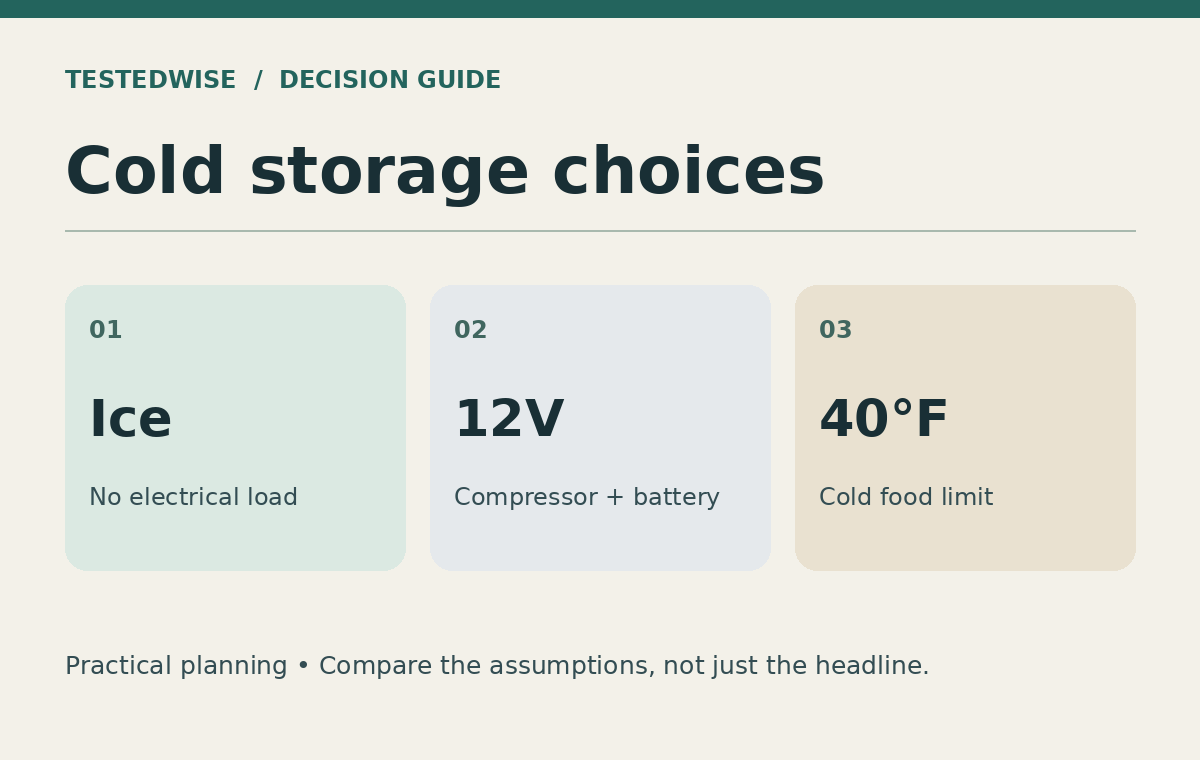
Compare the three technologies
| Type | How it cools | Main limitation |
|---|---|---|
| Ice cooler | Stored ice or frozen packs absorb heat | Ice occupies volume and melts |
| 12V compressor fridge | Refrigeration cycle with a thermostat | Needs dependable power and ventilation |
| Thermoelectric cooler | Electric heat transfer with no compressor | Cooling depends heavily on ambient temperature |
The word electric doesn't guarantee refrigerator temperatures. A thermoelectric model often specifies a temperature difference from ambient; a hot car may therefore leave food too warm. A compressor fridge is designed to regulate toward a set temperature within its operating conditions. Neither type is a substitute for checking actual food temperature.
Measure usable capacity rather than box volume
A 48-quart cooler may have a substantial fraction occupied by ice, frozen packs and containers. A nominally smaller fridge can sometimes hold the same grocery load because you don't need a bed of ice. But its compressor hump and basket can make awkward items difficult to fit. Take measurements of your largest food container, milk carton and drink bottles. Check the internal dimensions and lid opening, not just advertised liters.
A dual-zone fridge can be useful when frozen food and chilled food both need to travel. It may require more energy and take up extra space; temperature behavior can vary by zone and ambient conditions. A single-zone box plus an insulated lunch bag may be plenty for a family that buys groceries along the way.
Build a simple trip cost comparison
If you buy $6 of ice per day for a three-day trip, ice costs $18. Twenty such trips would be $360 in ice, assuming the same weather and purchase routine. This is a planning example, not a current retail price. A fridge might reduce that recurring purchase but require a battery, charging accessories or mounting hardware. A $300 difference in total setup cost divided by $18 of avoided ice purchases would take about 17 trips to break even before charging costs, maintenance or resale. If you already have a cooler and make ice at home, the equation changes dramatically.
A hypothetical compressor consuming 45 W for 40% of the day uses 432 Wh/day. Multiply by trip duration and allow for delivery losses. If a 12V outlet is only powered while driving, it won't cover a long night on its own. Use our car fridge runtime calculator to check the storage interval. Avoid draining the starter battery; verify socket behavior, fuse and connector limits, and the vehicle and fridge manuals.
Food temperature comes before convenience
USDA recommends maintaining cold perishable food at 40°F (4.4°C) or colder. Pack chilled food into a pre-cooled container and use a thermometer in a representative location. Keep raw meat sealed and separated from ready-to-eat foods. Open the lid only when needed; a dedicated drinks cooler can reduce access to the food box. Follow campground wildlife storage rules, whether the box has a plug or not.
The display on a powered fridge is not a measurement of every item inside. Check temperature after loading groceries, after a long drive and when power is interrupted. If safe cold storage cannot be maintained, use shelf-stable meals or a reliable alternate cold source; don't judge safety by smell or taste.
Choose by route and packing pattern
For a one-night campsite near a grocery store, a cooler is usually the simpler option. For frequent road trips with daily driving and suitable charging, a compressor fridge may reduce ice runs. For a stationary campsite in hot weather, the electrical plan decides: a large compressor fridge on a small battery may be less reliable than a well-managed cooler and dependable ice supply. If you sometimes travel without a vehicle, the lighter empty cooler may be easier to carry.
Before purchasing, measure the cargo opening and floor space, check the lid can open while loaded, and secure the container using vehicle-appropriate restraint. Leave manufacturer-specified ventilation clearance around a fridge and keep plugs protected. Never assume the vehicle's cabin or trunk stays cool when parked.
Frequently asked questions
Can a car fridge run overnight without the engine?
Yes, with a suitable independent power source and enough usable energy. The actual runtime depends on average draw and other loads; a low-voltage cutoff is not a guarantee that the vehicle will start.
Is a compressor fridge always colder than an ice cooler?
No. A properly packed ice cooler can maintain safe temperatures, and a powered fridge can warm up if the battery runs out or ventilation is poor. Measure the contents rather than relying on technology alone.
When is an electric cooler not worth buying?
When trips are short, ice is easy to obtain, or the extra battery and charging equipment would be used only rarely. Compare actual models in the related 12V fridge guide after deciding you need powered cooling.