
If you want to make a little stuffed animal, crochet is an inviting place to start. If the thing you've always wanted is a soft scarf or a stretchy hat, knitting is worth learning. Neither craft is inherently easy for everyone. The best first choice is the technique that matches a project you actually want to finish, with tools and yarn that let you see what your hands are doing.
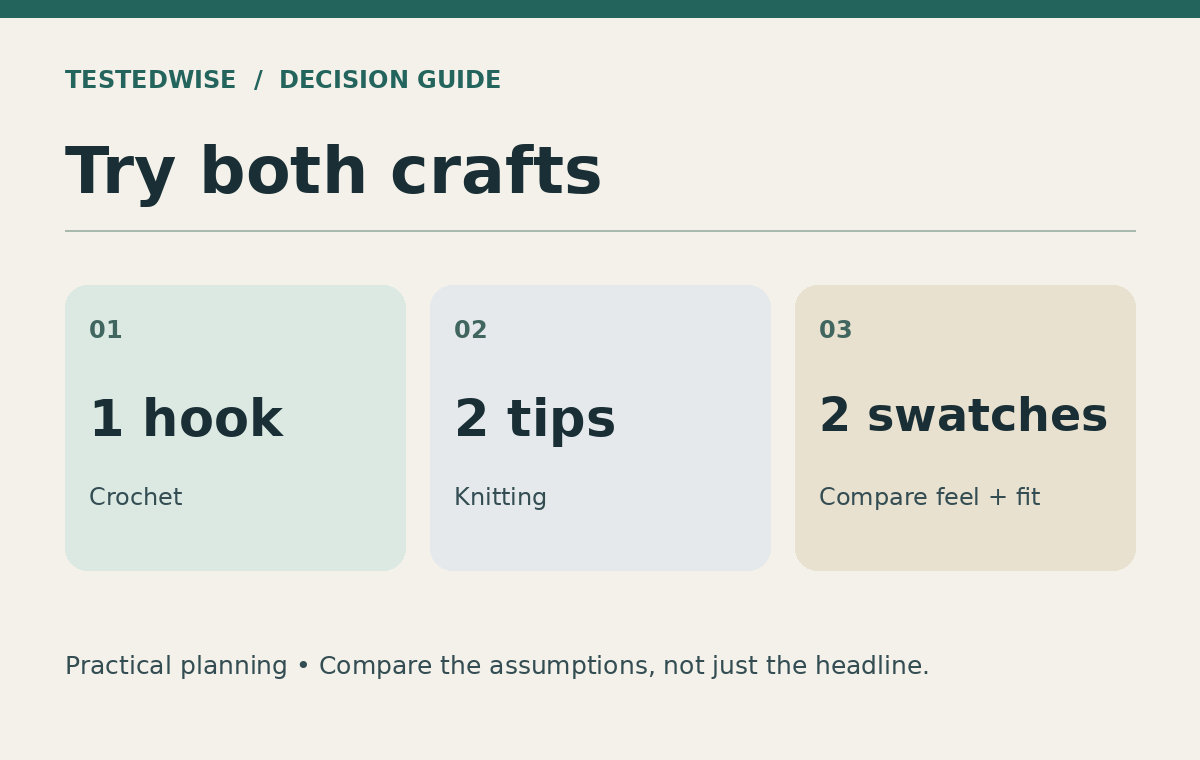
Compare the two crafts
| Feature | Crochet | Knitting |
|---|---|---|
| Core tools | One hook for ordinary crochet | Two needle tips, straight or circular |
| Live stitches | Usually one active loop at a time | Many live stitches on the needle |
| Common beginner fabric | Single crochet or simple rows | Garter stitch (knit every row when working flat) |
| Typical first project | Coaster, simple square, small pouch | Scarf swatch, simple rectangle, dishcloth |
| Fixing mistakes | Often pull back to the mistake and rework | May require securing live stitches or carefully undoing stitches |
Some techniques differ from these basics, including Tunisian crochet or specialized knitting. The comparison here is about the ordinary beginner versions.
Pick a first project by the finish you want
For an amigurumi toy, crochet's dense stitches and shaping in rounds can be useful. A beginner kit with visible stitches and a guided sequence can be easier than choosing separate tools and interpreting a complex pattern. Start with a flat square first if shaping and the initial ring are frustrating.
For a wearable, knitting often produces a fabric with stretch and drape, depending on stitch, fiber and gauge. Crochet can also make excellent wearable fabric; open stitches and appropriate yarn change its feel. Avoid a first project that combines unfamiliar techniques, expensive yarn and an exact garment fit. A rectangle that doesn't have to fit your body is a more forgiving experiment.
Buy the smallest useful set of tools
Choose a smooth, light-colored medium-weight yarn and the hook or needle size indicated by the yarn label or practice pattern. The Craft Yarn Council's weight system helps you interpret labels and gauge ranges; it isn't a promise that every yarn in the same category behaves identically. For ordinary worsted-weight practice yarn, a size around 5 mm is a possible starting point, but use the pattern and label for your material.
Crochet needs a hook, yarn, scissors, a yarn needle and a few stitch markers. For knitting, choose a pair of comfortable needles or a circular needle suitable for flat work, plus the same small accessories. A giant tool assortment is unnecessary for your first project. Avoid fuzzy novelty yarn, dark yarn and tiny hooks until you can distinguish individual loops. Check that the kit has enough yarn to practice, not merely enough to finish under ideal conditions.
A fair two-swatch experiment
Set aside two short sessions, one for each technique, using the same yarn weight. For crochet, make a chain, practice single crochet across a short row and mark the first and last stitches so you can count them. Follow a reliable pattern for the turning chain; whether it counts as a stitch depends on the stitch and instructions. For knitting, practice casting on, working knit stitches across a short row, turning and knitting back, then learn a basic bind-off from a tutorial. Keep both samples small and avoid measuring speed during the first attempt.
Look at three things afterward: can you see where the next stitch goes, can you recover when you lose your place, and do you like the fabric? If one method hurts your hands, stop, relax your grip and adjust tool size or technique. Don't force repetitive work through pain. A small swatch can reveal more than an hour of watching videos.
Gauge matters when size matters
Gauge is stitches and rows over a measured area, usually four inches (10 cm). If a pattern calls for 16 stitches in four inches but you make 20, your stitches are smaller; a fixed stitch count will produce a narrower piece. Swatch using the specified stitch pattern and follow the instructions for washing or blocking before measuring a wearable. Adjust tools or tension and swatch again rather than guessing. For a practice coaster, an imperfect size is rarely a disaster.
US and UK crochet terminology differ, so check the pattern's convention before assuming an abbreviation means the same stitch. Knitting instructions also have abbreviations for increases, decreases and repeats. The Craft Yarn Council references below provide a useful vocabulary; a clear project tutorial can demonstrate the movements that a written abbreviation cannot.
Frequently asked questions
Which uses more yarn?
There is no reliable universal percentage. Stitch construction, gauge, yarn, fabric density and finished dimensions all affect consumption. Compare swatches at the desired finished size and follow the pattern yardage.
Can I use the same yarn for both?
Usually yes, provided the yarn fits the project and tool size. Gauge, texture and drape may differ. Try it with leftover practice yarn before buying a full garment quantity.
Should I learn both at once?
You can, but a short project in one craft first reduces the number of unfamiliar movements. If you prefer crochet, our beginner kit comparison helps narrow the options. If neither feels comfortable, a simple embroidery or visible-mending project may be a better first handcraft.