
Best Trading Card Binders: 9-Pocket vs Toploader Storage
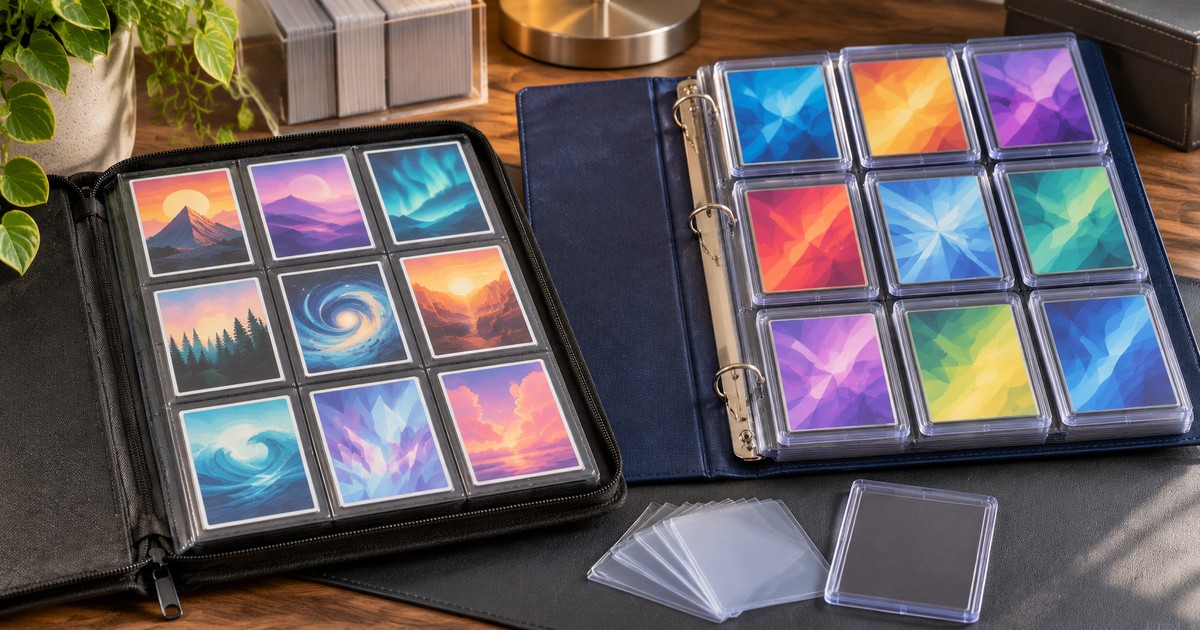
The best trading card binders are not simply the ones with the most pockets. The important decision is whether you want to store sleeved cards for easy browsing or keep cards inside rigid top loaders for extra physical support. This guide explains the difference, shows what to check before buying, and compares five Amazon US binder options for Pokémon, Magic: The Gathering, and sports-card collections.
Affiliate disclosure: This article contains affiliate links. TestedWise may earn a commission if you purchase through them, at no additional cost to you. Read the full disclosure.
1. Quick comparison: which storage type fits your cards?
If you are deciding between a standard 9-pocket trading card binder and a top-loader binder, start with the way your cards are protected today. A regular binder page is made for a card, usually inside a soft sleeve. A top-loader binder has larger pockets designed to hold the whole rigid plastic holder. They are not interchangeable formats.
| Storage type | What goes into each pocket | Best for | Main trade-off |
|---|---|---|---|
| Standard 9-pocket binder | A standard-size card, usually inside a soft sleeve | Pokémon and MTG sets, player collections, trading and browsing | Does not normally fit a rigid 3 × 4-inch top loader |
| 3-ring album with 9-pocket pages | Sleeved cards in compatible punched pages | Collections that need to be reorganized or expanded over time | Pages may need to be purchased separately; ring placement and page fit matter |
| Top-loader binder | A card already inside a rigid top loader | Valuable singles, sports-card hits, display collections and cards handled less often | Larger, heavier and usually lower-capacity than a standard card binder |
| Storage box | Loose sleeved cards or cards in top loaders, depending on box design | Bulk cards, duplicates, sorted sets and overflow | Less convenient for viewing a collection page by page |
My practical recommendation: Most collectors do not need to put every card in a top loader. Use a side-loading 9-pocket binder for the cards you want to organize and look through. Give the cards that need rigid support their own sleeves and top loaders, then store those holders in a properly sized top-loader binder or storage box. This tiered approach is usually more manageable than buying one oversized binder for every card.
2. What 9-pocket and toploader actually mean
“9-pocket” describes the page layout
A 9-pocket page has three columns and three rows when viewed from the front. Most trading card pages can be viewed from both sides, so a page may hold nine cards on the front and nine on the back. A binder with 20 double-sided 9-pocket pages can therefore advertise space for up to 360 standard cards: 20 pages × 9 pockets × 2 sides.
That capacity is a count of card positions, not a promise that every card setup will fit. Thick sleeves, double-sleeving, oversized cards, or a page designed for a different card size can reduce usable capacity. Some products also use “page” and “sheet” differently in their listings. Check the number of physical pages and whether the pockets are accessible on both sides before comparing capacity claims.
“Toploader” describes the rigid holder
A top loader is a rigid plastic holder that a sleeved trading card slides into. The familiar regular size has outer dimensions of 3 × 4 inches and is designed for standard-size cards up to 35 points thick. The 35pt figure is a thickness rating for the card, not the number of cards a binder can hold and not the size of the pocket.
A top-loader binder uses pockets wide and tall enough for the rigid holder, rather than only for the card itself. Some have four pockets per page; others have nine. That is why the phrase “9-pocket vs toploader” can be misleading: the two labels describe different things. You can buy a 9-pocket top-loader binder, but you cannot assume that an ordinary 9-pocket binder will accept top loaders.
Ringless and 3-ring are separate design choices
A fixed-page zip binder is usually ringless: its pages are built into the binder and cannot be moved. A 3-ring album uses punched pages that can be added, removed, or rearranged. Both can have 9-pocket pages. The ring mechanism is not what determines whether the binder fits a top loader; the pocket dimensions do.
3. Five trading card binders worth comparing
The products below cover three different needs: fixed-page 9-pocket storage, an expandable 3-ring album, and binders designed for rigid top loaders. Product information was checked against manufacturer specifications where available and the exact Amazon US listing identifiers. The two marketplace top-loader examples rely more heavily on seller-supplied listing details, so treat their stated capacity and included accessories as claims to verify on the selected Amazon variation. TestedWise has not physically tested these binders.
Best overall for a regular sleeved-card collection
1. Vault X 9-Pocket Exo-Tec Zip Binder
The Vault X Exo-Tec is a strong fit for collectors who want a finished, ringless binder rather than a separate album and page system. The manufacturer lists 20 double-sided pages with nine side-loading pockets per page, for a stated capacity of 360 standard-size cards. It also specifies a padded, water-resistant Exo-Tec cover, a heavy-duty zipper, and archival-safe, acid-free, PVC-free materials.
Its published internal pocket size is 68 × 97 mm, and Vault X says the binder accepts single- and double-sleeved cards. That makes it a useful choice for a Pokémon or MTG collection where cards are protected in soft sleeves and you want to view both sides of a page without handling each card individually.
Important limitation: this is not the Vault X top-loader-compatible model. Its standard pockets are smaller than the outside dimensions of a regular 3 × 4-inch top loader. Do not buy this version expecting to slide rigid holders into it. The company sells a separate top-loader-compatible binder with larger pockets.
Best alternative for a clean, framed page presentation
2. Ultra PRO Vivid 9-Pocket Zippered PRO-Binder
Ultra PRO’s Vivid PRO-Binder is another fixed-page option for standard-size cards. The manufacturer lists 20 9-pocket pages, side-loading pockets, a padded leatherette cover, a matching zipper and a capacity of up to 360 cards in Deck Protector sleeves. Its black page backing separates the front and back pockets and gives each card a framed appearance.
The material specification is particularly useful to check: Ultra PRO describes the pages as acid-free and non-PVC. This is a practical alternative to the Vault X binder if you prefer the Vivid cover style or already use Ultra PRO sleeves. It is designed for standard cards in sleeves, not for cards that remain inside rigid top loaders.
One detail worth remembering is that “360 cards” assumes the intended standard-card setup and one card per pocket. It does not mean 360 double-sleeved cards will fit every page with the same ease, nor does it make the binder suitable for thick memorabilia cards. Test one sleeved card in a pocket before filling the binder.
Review Ultra PRO’s official Vivid PRO-Binder specifications.
Best for collectors who want to add or rearrange pages
3. Ultra PRO 2-Inch Pikachu 3-Ring Trading Card Album
This is a different kind of purchase from a fixed-page zipper binder. Ultra PRO’s Pikachu album is a 2-inch D-ring binder made for 3-ring-punched card storage pages. Its main advantage is flexibility: you can sort pages by set, team, player, year or collection theme, then add or remove compatible pages as the collection changes.
That flexibility is useful if you are building a collection gradually or want to move cards between sections without buying a completely new binder. It is also a reminder that “3-ring album” does not tell you how many cards it holds. Capacity depends on the page format, the number of sheets, and how much room the rings have before the binder becomes overfilled.
Before ordering: treat this as the album shell and check the exact package contents. The manufacturer describes it as an album for use with 3-ring-punched storage pages; do not assume that a set of 9-pocket pages is included. Buy pages that match the ring spacing and the card size you collect. Avoid packing the rings so tightly that pages bow or cards press against the mechanism.
Best toploader-binder option to compare for a larger rigid-holder collection
4. TRUGQ 9-Pocket Toploader Binder — 324-Holder Listing
The TRUGQ listing is aimed at collectors who want to keep cards inside rigid holders while still arranging them in a page-by-page album. Its product title advertises capacity for 324 top loaders, 36 pages, a PU-leather exterior, anti-yellowing polypropylene inserts, and 20 top loaders in the package. The raised spine-tab concept is intended to make sections easier to identify.
This type of binder makes sense when your collection is already protected in top loaders and you want to browse the cards without taking each holder out of a storage box. The page format is larger than a standard 9-pocket card binder because each pocket has to accommodate the full rigid holder.
The limitation is documentation. The listing information available for this marketplace brand is not as detailed as the published fit specifications from Vault X or Ultra PRO. Before loading a valuable collection, compare the pocket opening with the exact top loaders you own. Check whether the advertised 20 included holders are part of the selected color and variation, and do not treat “waterproof” wording as a reason to expose cards to liquids.
Open the TRUGQ 324-capacity Amazon listing · Cross-check the listed product details.
Best starter bundle when you still need holders and sleeves
5. Foluck 9-Pocket Top Loader Binder — 252-Card Listing
The Foluck listing describes a 9-pocket top-loader binder with 14 pages and a stated capacity of 252 top-loaded cards. Its package details advertise 100 top loaders and 100 soft card sleeves, along with a padded PU cover and a soft velvet lining. That bundle can be convenient if you are setting up a top-loader collection from scratch and do not already have the protective holders.
Its lower stated capacity than the TRUGQ listing is not automatically a disadvantage. A smaller binder can be easier to handle, and the included sleeves and top loaders may reduce the number of separate purchases for a new collector. The trade-off is that 100 included holders do not fill 252 pockets, so you will still need additional compatible top loaders if you plan to use the full stated capacity.
Check the exact variation before buying. Marketplace bundles can change, and the title, package list and selected color need to agree. Confirm the holder dimensions and thickness that fit the pockets; a binder described as “toploader compatible” is not automatically suitable for every thick, oversized or magnetic holder.
Open the Foluck 252-capacity Amazon listing · Cross-check the listed package contents.
4. How to choose the right trading card binder
Before comparing cover colors or advertised capacity, answer a few practical questions. The right binder is the one that fits the cards you actually own, the protection you already use, and the way you want to handle the collection.
Start with the holder, not the binder name
Look at a card you intend to store. Is it loose, inside a penny sleeve, double-sleeved, inside a rigid top loader, or already graded and sealed in a slab? Those are different outer dimensions. A product titled “trading card binder” may only accept a bare standard-size card, while a “toploader binder” is designed around the outside size of the rigid holder.
If you already have a stack of top loaders, measure one of them before shopping. If you have not bought sleeves yet, decide whether you want standard soft sleeves, thicker deck sleeves, or inner sleeves plus an outer sleeve. The complete setup has to fit together; checking only the card size is not enough.
Choose side-loading pockets for a binder you open often
Side-loading pages have an opening along the side edge rather than at the top. They are popular for fixed-page binders because the card is less likely to slide straight out when the binder is upright. They do not make a binder spill-proof, and they cannot compensate for a pocket that is too loose or a binder that is packed beyond its intended capacity. A zipper or secure closure adds another layer of containment when the binder is carried.
Decide whether you need fixed pages or removable pages
A fixed-page binder is straightforward: the pages are part of the album, the capacity is known, and there is no ring mechanism to work around. A 3-ring album gives you more freedom to add or rearrange sheets. That can be useful for set completion, but it creates another compatibility check. The punched holes, page size, pocket orientation and ring spacing must all match the binder.
Do not fill a ring binder until the pages are flat and the cards clear the rings when the binder closes. A badly aligned or overfilled album can put pressure on page edges and the cards nearest the spine. Leave room for the binder to close naturally rather than forcing the cover down.
Collector discussions reflect the same practical trade-off. Some Pokémon and MTG collectors favor side-loading, ringless binders for everyday sets; others prefer three-ring pages because they can replace or rearrange sheets. Some keep a separate top-loader binder for selected higher-value cards. Those comments are personal experience rather than controlled product tests, but they show why there is no single best format for every collection. See a discussion of fixed-page and 3-ring binders and collector preferences for ringless and top-loader storage.
Check material claims carefully
For pages that touch cards or sleeves, look for clear statements such as acid-free and PVC-free. These terms are not interchangeable with “waterproof,” “premium” or “archival style.” A manufacturer that publishes a material specification gives you more to evaluate than a generic product title. If a marketplace listing does not identify the page material, do not assume it is archival-safe just because the cover feels sturdy.
Think about weight and how you will use the binder
A standard 9-pocket binder is generally easier to carry to a game night, trade event or card shop. A top-loader binder is bulkier because each pocket holds a rigid holder rather than just a sleeved card. A full binder can become surprisingly heavy. If a child will carry it, if you take it to events, or if it will sit on a shelf, choose a size that remains comfortable when full rather than judging the empty binder alone.
5. Card size, sleeve fit, and toploader compatibility
Compatibility is where many disappointing purchases happen. A listing may say “standard size,” “9-pocket,” or “toploader compatible,” but those words do not tell you every dimension you need. Compare the outer size of the holder with the usable pocket size, and test the complete setup before storing valuable cards.
Standard-size cards are not all exactly the same
Pokémon and Magic: The Gathering cards are commonly treated as standard-size cards. TCGplayer’s published conditioning guide lists Pokémon and Magic cards at 63 × 88 mm. Ultra PRO commonly describes standard-size cards as 2.5 × 3.5 inches, a rounded imperial measurement. Yu-Gi-Oh! cards are smaller: TCGplayer lists them at 59 × 86 mm. A standard-size pocket may still hold a smaller card, but it can leave more room for movement. Use sleeves designed for the card game rather than relying on the binder pocket to keep a loose card centered.
Understand what 35pt means
Ultra PRO describes its regular 3 × 4-inch top loaders as holders for standard-size cards up to 35 points thick. A point is one-thousandth of an inch, so 35pt refers to card thickness, not pocket count. Memorabilia cards, relic cards, patch cards and other thicker sports cards may need a different holder thickness. Never force a thick card into a standard holder just because its width and height look right.
Compare the outer holder with the pocket opening
A regular Ultra PRO 3 × 4-inch top loader measures about 76 × 102 mm externally. Vault X lists the internal pockets of its standard 9-pocket Exo-Tec binder at 68 × 97 mm. Those measurements explain why the regular Exo-Tec binder is intended for cards in sleeves rather than cards inside rigid top loaders. The top loader is wider and taller than the pocket space.
Vault X publishes a separate top-loader-compatible binder with larger 116 × 91 mm pockets. Its 9-pocket model has 14 double-sided pages and a stated capacity of 252 cards in 35pt top loaders; the 4-pocket version has 12 double-sided pages and a stated capacity of 96. That lower capacity makes sense because each pocket has to hold the rigid case as well as the card. The company’s FAQ says some standard 55pt holders from other brands may also fit if their dimensions match, but it excludes thicker or oversized 75pt and 100pt-plus holders, wide or tall styles, and magnetic holders. It also says the binder is not designed for loose cards or graded slabs. This is a useful manufacturer-documented example of a 9-pocket top-loader binder, separate from Vault X’s regular 9-pocket Exo-Tec model. See the Vault X 9-pocket top-loader-compatible binder and read its fit and capacity FAQ.
6. How to protect a card before it goes in a binder
A binder is an organizing and storage system. It is not a substitute for the sleeve or rigid holder that protects the card surface. Think in layers, with each layer doing a different job.
For a regular 9-pocket binder
- Start with clean hands and a clean surface. Keep food, drinks, dust and loose tools away from the cards.
- Use a correctly sized soft sleeve. The sleeve helps reduce surface contact, scratches and handling marks. It should fit the card without forcing the corners.
- Use an inner sleeve only if the card and outer sleeve are designed to work together. Double-sleeving adds another layer but also increases the overall thickness. Check the binder manufacturer's double-sleeve compatibility and test the fit.
- Slide the sleeved card into the pocket gently. Hold the card by its edges and do not push against a corner if the pocket feels tight.
For a top-loader binder
- Put the card into a soft sleeve first. Ultra PRO recommends a soft sleeve before a top loader to help reduce surface scratches and corner wear.
- Slide the sleeved card into a correctly sized rigid top loader. Match the holder to the card size and thickness. Do not force a thick card into a 35pt holder.
- Consider a top-loader sleeve or team bag. A compatible outer sleeve can help keep dust and loose debris away from the top-loader opening. Check that the extra layer still fits the binder pocket.
- Put the complete holder into the top-loader binder. The pocket should accept the rigid holder without pressure on the card or the page seam.
More layers do not automatically mean better protection. A card that is squeezed into an undersized sleeve or holder can be damaged during insertion. Choose compatible sizes and stop if the fit is tight.
What about cards going to a grading company?
Do not assume that the storage holder is also the right submission holder. PSA's current shipping guide tells submitters to sleeve each card and place it in a semi-rigid holder; it explicitly says not to use top loaders for submissions. The guide specifies a 3 5/16 × 4 7/8-inch semi-rigid holder for standard trading cards. Follow the current instructions of the grading company you are using, because submission requirements can differ and can change.
7. The best storage approach by collection type
| Collection | Good starting setup | What to watch for |
|---|---|---|
| Pokémon set collection | Side-loading 9-pocket binder with standard-size sleeves | Use set numbers to leave spaces for missing cards; keep valuable pulls in a separate top-loader section if needed |
| Magic: The Gathering | 9-pocket binder for organized sets or favorite cards; deck boxes for active decks | Deck sleeves can be thicker than penny sleeves, so check double-sleeve fit and avoid overfilling pages |
| Sports cards | 9-pocket binder for base sets and player collections; top loaders for selected hits | Memorabilia and patch cards may exceed 35pt; use a holder and binder rated for the actual thickness |
| High-value raw singles | Soft sleeve plus a correctly sized top loader, then a top-loader binder or box | Use a separate setup for oversized holders, magnetic holders and graded slabs |
| Bulk cards and duplicates | Cardboard storage boxes with dividers | Do not spend binder space on every duplicate if you rarely need to view them |
| Graded cards | A slab case or binder specifically sized for graded holders | Neither a standard 9-pocket binder nor a regular top-loader binder should be assumed to fit slabs |
Pokémon collectors: build around the set, not just the rare pulls
If your goal is to complete a set, a standard 9-pocket binder makes it easy to see what is missing. You can arrange cards by set number, leave empty pockets for cards you have not found yet, and keep reverse holos or variants in a consistent sequence. For cards you consider more valuable, use a separate top-loader system rather than forcing every card into the same level of protection.
MTG players: separate collection storage from deck storage
A binder works well for trade cards, favorite art, set collections and cards you want to compare. The deck you play regularly is usually better kept in a deck box with sleeves chosen for shuffling and play. A binder is not a convenient substitute for a deck box when you are taking a deck to a match or event.
Sports-card collectors: account for thickness
Base cards and many standard inserts fit ordinary 3 × 4-inch top loaders rated up to 35pt. Patch, relic, memorabilia and other thicker cards may need 55pt, 75pt, 100pt or larger holders. The holder size must be compatible with the binder pocket. A product that accepts standard 35pt top loaders is not automatically compatible with every sports card holder in your collection.
8. How to load and organize a binder safely
A little preparation makes a binder easier to use and reduces the chance of damaging cards while sorting. You do not need a complicated cataloging system. Start with a repeatable order and leave enough space for the collection to grow.
Before the first card goes in
- Check the binder's page count, pocket orientation and stated card capacity.
- Confirm whether the pockets are designed for bare cards, soft sleeves, double-sleeved cards or rigid top loaders.
- Inspect the zipper, seams, page edges, ring mechanism and cover for damage.
- Test one card in one sleeve and one pocket. For top-loader binders, test the exact holder as well.
- Decide how you will sort the collection before filling the first page.
Pick a sorting system you can maintain
For a game with set numbers, sorting by set and collector number is usually easy to maintain. For sports cards, you might sort by sport, year, team, player or product line. If you mainly collect artwork or favorite characters, a theme-based order may be more enjoyable. The best system is the one that makes it easy to find a card and return it to the right place.
Write the section name on a removable index card or a binder label rather than attaching adhesive labels to card sleeves or pages. Keep a simple spreadsheet or collection app for cards that need extra notes, such as purchase date, condition, serial number or whether a card is stored in a top loader.
Load one card at a time
Open the pocket carefully and guide the sleeved card in by its edges. Do not bend the card to make it pass the opening. If the card catches, remove it and check for a sleeve that is too large, a pocket seam that is folded inward, or an incompatible page. Do not put two cards in one pocket unless the page manufacturer explicitly says it is designed for that use. Two cards can rub against each other and may be harder to remove without catching a corner.
Keep the binder from becoming overfilled
When a binder is full, its pages should still turn without being forced and the cover should close without pressure. If the pages bow, the rings are difficult to open, or the zipper strains, move some cards to a second binder or storage box. A stated maximum capacity is not a target you must reach. A little room makes browsing and handling easier.
9. Long-term storage: light, heat, moisture, and handling
A premium binder cannot compensate for a poor storage environment. Trading cards are printed on paper-based stock and can be affected by physical pressure, moisture, heat, light and careless handling. The Library of Congress guidance for works on paper recommends a cool, relatively dry, clean and stable environment, minimal light exposure, and avoiding attics, basements and places with environmental extremes or leak risks. Those are useful household principles for a card collection, even though the Library of Congress guidance is not a card-specific grading standard.
Choose a stable indoor location
A shelf in a regularly used room or an interior closet is generally a better choice than an attic, garage, shed or damp basement. Avoid placing binders directly beside radiators, heating vents, windows with strong sunlight or plumbing that could leak. Do not leave a binder in a hot car. Temperature and humidity swings are harder on paper than a stable indoor environment.
Keep direct light away from cards
Bright light and ultraviolet exposure can fade printed materials over time. Keep the binder closed when you are not browsing it. If you display a few favorite cards, use a display setup that limits direct sunlight and remember that a display case is not the same thing as a storage system for the rest of the collection.
Store binders upright and supported
Keep binders upright like books, with enough support that they do not lean sharply or slump. Do not cram them tightly together on a shelf, and do not stack heavy objects on top. A top-loader binder can be heavier than a regular 9-pocket album, especially when full, so use a shelf that can support its weight.
Handle cards with care
Use a clean, dry work surface and keep food and drinks away. Hold cards by the edges when possible. Avoid touching the card surface unnecessarily, and do not use tape, rubber bands or adhesive directly on a card or its sleeve. The Library of Congress recommends clean hands and a clean work area for handling works on paper; the same careful habit is sensible for collectible cards.
10. Common binder-buying mistakes
Buying a regular 9-pocket binder for top loaders
This is the most common mismatch. Nine pockets per page do not mean the pockets are large enough for a rigid holder. Check the usable pocket size or choose a binder that explicitly states top-loader compatibility and the holder size it accepts.
Assuming every “toploader compatible” binder fits every top loader
Some binders are designed around standard 35pt holders. Others may accept a specific 55pt holder. Oversized holders, thick memorabilia-card holders, magnetic one-touch cases and graded slabs are different products. Look for dimensions and thickness limits, not just a broad compatibility phrase.
Confusing 9-pocket capacity with top-loader capacity
A binder advertised for 360 standard cards may not hold 360 top loaders. The rigid holders take up more room, so the pocket layout and capacity are different. Compare the number of actual pockets intended for your holder, not the number of cards a similar-looking binder stores.
Forgetting to budget for sleeves or pages
A ring album may be sold as the binder only. A top-loader binder may not include the rigid holders. Some marketplace bundles include a limited number of top loaders or sleeves, and those accessories may vary by color or package. Read the package contents for the exact listing you select.
Using a top loader without a soft sleeve
A rigid holder adds support, but it is not a replacement for the soft sleeve that sits against the card. Follow the holder manufacturer's instructions and use a sleeve that fits. Do not push an unsleeved card into a top loader if the manufacturer recommends a soft sleeve first.
Overfilling a binder because the listing gives a large number
Maximum capacity is not always the most comfortable working capacity. Thick sleeves, double-sleeving, page construction and how tightly the binder closes all matter. Leave space rather than forcing the last few cards into a crowded page.
Using a storage binder for graded slabs
Graded cards are sealed in holders that are much larger than raw cards or standard top loaders. Use a case or binder specifically designed for slabs and check the exact grading-company holder dimensions. Do not try to squeeze a slab into a regular binder pocket.
For the next part of the decision, see protective storage for another kind of collection.
A music-themed display project for a personal collection is covered in a music-themed display project for a personal collection.
11. Frequently asked questions
Is a 9-pocket binder better than a top-loader binder?
Neither is universally better. A standard 9-pocket binder is usually more compact and convenient for viewing a larger set of sleeved cards. A top-loader binder is designed to hold cards already inside rigid plastic holders, which adds more physical support but takes up more space. Choose based on the holder your cards are in and how often you want to browse them.
Can you put top loaders in a regular 9-pocket binder?
Usually not. Standard 9-pocket pages are sized for cards in soft sleeves, not for the larger outside dimensions of a 3 × 4-inch rigid top loader. Only use a regular binder if its manufacturer explicitly confirms that the pocket dimensions accept your exact top loader.
Can a top-loader binder also be 9-pocket?
Yes. “9-pocket” describes the number of pockets on a page. “Toploader” describes the type of holder those pockets are designed to fit. A 9-pocket top-loader binder has nine larger pockets intended for rigid holders.
Do I need to sleeve a card before putting it in a top loader?
Use a soft sleeve first unless the holder manufacturer gives different instructions for a specific product. Ultra PRO recommends placing a card in a soft sleeve before a top loader to help prevent surface scratches and corner wear during storage and handling.
What does 35pt mean on a top loader?
It is a thickness rating for the card the holder is designed to accept. It does not describe the number of pockets or the outside size of the binder. A standard 3 × 4-inch top loader is commonly specified for standard-size cards up to 35pt thick.
Will a 9-pocket binder hold double-sleeved Pokémon or MTG cards?
Some will, but do not assume every pocket has enough room. Check the binder manufacturer's double-sleeve statement and test a card in the exact inner and outer sleeves you plan to use. A tight fit can make cards harder to insert and remove and may put pressure on corners.
Are side-loading binder pages safer than top-loading pages?
Side-loading pages can make it less likely that a card slides straight out when the binder is stored upright. They are not a guarantee against spills or damage. Pocket fit, page material, closure, handling and storage conditions still matter.
Are ringless binders better than 3-ring binders?
Ringless fixed-page binders are convenient and avoid a ring mechanism beside the cards. Three-ring binders are easier to expand and reorganize. A well-matched 3-ring album can work well, but use compatible pages, avoid overfilling, and make sure cards do not press against the rings when the binder closes.
How many cards does a 9-pocket binder hold?
It depends on the number of pages and whether both sides are usable. A binder with 20 double-sided pages and nine pockets per side can hold 360 standard cards. Other binders have fewer pages or different pocket designs, so check the product's actual page count rather than relying only on the phrase “9-pocket.”
Can you put graded cards in a top-loader binder?
Not unless the binder is specifically designed for the exact graded slab dimensions. A standard top-loader binder is generally designed for raw cards inside 3 × 4-inch rigid holders, not larger graded cases. Use a dedicated slab binder or storage case and verify the slab size.
Should valuable cards go in a binder or a top loader?
For a valuable raw card that needs rigid support, a soft sleeve plus a correctly sized top loader is a practical setup. A top-loader binder keeps those holders organized and visible. If the card is part of a set you want to browse, a high-quality side-loading binder may be more convenient. Value alone does not determine the right storage; condition, thickness, handling and intended use matter too.
Is a top-loader binder suitable for cards I plan to send to PSA?
A top-loader binder can be used for collection storage, but PSA's current shipping guide says to use a clear penny sleeve and a semi-rigid holder for submissions, and specifically says not to send cards in top loaders. Follow the latest instructions from the grading company before preparing a submission.
How should I store a trading card binder long term?
Keep it in a clean, stable indoor location away from direct sunlight, heat sources, moisture and environmental extremes. Store it upright with support, avoid heavy objects on top, and do not overfill it. A good binder helps organize cards, but the storage environment still matters.
Is a binder or a storage box better for bulk cards?
For large quantities of commons, duplicates and cards you rarely browse, a storage box with dividers is usually more space-efficient. Use binders for cards you want to see, organize by page, or handle regularly. You can combine both: binder for the collection you display, box for the overflow.
Bottom line: Choose the binder around the holder, not the other way around. A standard side-loading 9-pocket binder is a sensible home for sleeved sets and cards you enjoy browsing. A top-loader binder is for cards already inside rigid holders. Check the exact pocket dimensions, page materials, capacity assumptions and package contents before buying—and test one card before moving the whole collection.
Sources & further reading
- Amazon US — Vault X 9-Pocket Exo-Tec Zip Binder, ASIN B071V91LGC
- Vault X — 9-Pocket Exo-Tec Zip Binder: capacity, pocket size, materials and sleeve compatibility
- Amazon US — Ultra PRO Vivid 9-Pocket Zippered PRO-Binder, ASIN B09MRGL51B
- Ultra PRO — Vivid 9-Pocket Zippered PRO-Binder: 20 pages, 360-card capacity and acid-free, non-PVC materials
- Amazon US — Ultra PRO 2-Inch Pikachu 3-Ring Trading Card Album, ASIN B07NTXF4ZT
- Ultra PRO — 2-Inch Pikachu 3-Ring Album: D-rings and compatible punched storage pages
- Amazon US — TRUGQ 9-Pocket Toploader Binder, ASIN B0F22CSQJ4
- TRUGQ 9-Pocket Toploader Binder — cross-check of 324 capacity, page count and advertised package contents
- Amazon US — Foluck 9-Pocket Top Loader Binder, ASIN B0G1SBQ4NQ
- Foluck 9-Pocket Top Loader Binder — cross-check of 252 capacity and advertised 100-sleeve / 100-toploader bundle
- Vault X — 9-Pocket Exo-Tec Toploader Compatible Zip Binder: 252-holder capacity and pocket dimensions
- Vault X — Toploader Compatible Binder FAQ: pocket dimensions, supported holders and exclusions
- Ultra PRO — 3 × 4-Inch Clear Regular Toploaders: standard card size and 35pt thickness limit
- Ultra PRO Support — Protecting Your Collection: sleeves, toploaders, binder pages and storage boxes
- TCGplayer — Card Conditioning Standards: Pokémon / MTG and Yu-Gi-Oh! card measurements (March 2025)
- PSA — Current Shipping Guide: penny sleeves, semi-rigid holders and no-toploader submission instructions
- Library of Congress — Care, Handling and Storage of Works on Paper
- Reddit r/magicTCG — Collector discussion of fixed-page zip binders versus flexible 3-ring pages (November 2026)
- Reddit r/mtgfinance — Collector discussion of ringless binders, side-loading pages and top-loader storage (May 2026)
- Reddit r/PokemonTCG — Discussion of binder sleeves versus top loaders for valuable cards (November 2026)
Content reviewed: Nov 19, 2026