
Good vinyl record storage is less about finding a stylish crate and more about controlling pressure, heat, dust and handling. Keep LPs upright, support them so they cannot slump, use sleeves made from suitable materials, and choose a location with stable room conditions away from direct sun and heat. A record cabinet can organize a large collection; a small crate is useful for the albums you play most; and a wall shelf or “Now Playing” stand is for selected covers, not long-term storage of an entire collection. This guide explains how to build a setup that protects both the record and its jacket without buying furniture or accessories you do not need.
Affiliate disclosure: This article contains affiliate links. TestedWise may earn a commission if you purchase through them, at no additional cost to you. Read the full disclosure.
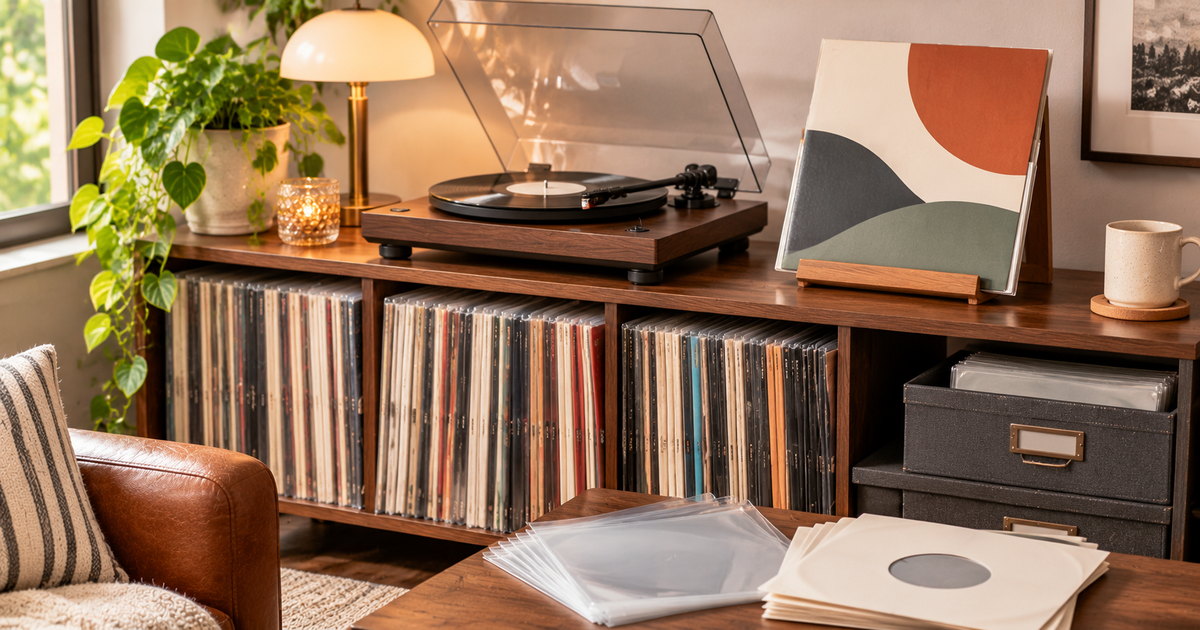
This guide is for home collectors building or improving a vinyl setup in the United States. It covers common 12-inch LPs, storage furniture, sleeves, display accessories, everyday handling and basic dust removal. Seven-inch singles, ten-inch records, box sets and unusually thick gatefolds need separate sizing checks. Product examples are exact Amazon US identifiers selected to illustrate different jobs; their specifications are listing or manufacturer claims, not hands-on test results. TestedWise has not purchased or physically tested these products. Confirm the selected variation, dimensions, current package contents and seller before ordering.
1. The five rules of safe vinyl storage
Vinyl is not as fragile as glass, but a record is a precision playback surface. Its grooves can be scratched or abraded, and the disc can deform when exposed to excessive heat or uneven pressure. The paper jacket and printed inner sleeve have their own problems: corners crush, seams split, paper absorbs moisture, and artwork fades. A good storage system protects both parts rather than treating the record as the only valuable item.
| Rule | What to do | Why it matters |
|---|---|---|
| Store upright | Stand records on their edges, like books, in a stable row. | Flat stacks put weight on the records at the bottom and can contribute to warping or jacket damage. |
| Support the whole row | Use dividers or a snug shelf so records do not lean at a sharp angle. | A leaning row concentrates pressure on edges and jackets instead of supporting the records evenly. |
| Do not overpack | Leave enough clearance to slide one record out without forcing it. | Friction can scuff jackets, tear sleeves and make handling clumsy. |
| Protect each record | Use a suitable inner sleeve for the disc and an outer sleeve for the jacket. | Inner sleeves reduce direct contact with dust and rough paper; outer sleeves reduce everyday jacket wear. |
| Control the location | Choose a clean room with stable conditions, away from sunlight, heat and damp. | Environmental extremes can warp vinyl, encourage mold on paper sleeves and accelerate deterioration. |
Why vertical storage matters
Store records on edge, not in a horizontal pile. When a stack lies flat, the records at the bottom carry the weight of everything above them. The pressure is not evenly distributed across the disc, and the stack is awkward to browse without lifting several records at once. The U.S. National Archives specifically advises shelving LPs, 45s and 78s vertically in their sleeves or albums and not stacking them on top of one another.
Vertical storage is not simply a matter of standing records against a wall. A row that is allowed to lean can still put uneven pressure on the jackets and discs. The Library of Congress recommends sturdy shelving and dividers that support the face of the disc in its sleeve. Its collections guidance describes dividers at regular intervals for grooved discs; in a home setup, the practical lesson is to break a long row into supported sections rather than letting dozens of records tip together.
Keep the row upright, but not crushed
A record should be supported without being wedged tightly between its neighbors. If you have to pull hard to remove an album, the row is too tight or the shelf is too full. If records fall sideways whenever you remove one, the row needs a divider or a better-fitting storage section. Both extremes make handling harder and can damage jackets over time.
Use bookends or dividers that are broad and stable enough to support the jackets, not a narrow metal edge that presses into one point. Adjustable dividers are useful when a collection grows unevenly, but check that they cannot tip or slide when you browse. For a short row, a properly sized bookend can work. For a long shelf, fixed sections are more dependable.
Do not mix every record size in one compartment
Most record furniture is designed around 12-inch LP jackets. Seven-inch singles, ten-inch discs, box sets and unusually thick gatefold albums may need different compartments. A small record can slide or tilt in a tall LP row, while a large box set can take up the space of several ordinary albums. Separate formats so each one is supported properly and so you do not have to force an oversized jacket into a tight opening.
2. Temperature, humidity, light and room choice
The room matters as much as the shelf. A well-built cabinet cannot compensate for a hot attic, a damp basement or a sunny window. Vinyl records and their paper packaging react differently to environmental conditions, so aim for a location that stays reasonably cool, dry and stable throughout the year.
Temperature: avoid heat and sudden swings
High temperatures can soften vinyl and increase the risk of warping, especially when a record is already under pressure or stored at an angle. Keep the collection away from radiators, fireplaces, heating vents, space heaters and direct afternoon sun. Do not leave records in a parked car, near a hot window or in a garage that becomes very warm in summer.
Published recommendations vary because archival institutions and home-audio manufacturers are addressing different storage situations. The National Archives describes stable storage around 55–70°F for audio materials, while U-Turn Audio recommends 60–75°F for home vinyl collections. These are useful reference points, not a reason to keep a household at an uncomfortable temperature. The more important home rule is to avoid heat, large fluctuations and prolonged exposure to hot spots.
Humidity: keep the paper dry and the room stable
Excess moisture can encourage mold on jackets, paper sleeves and other organic materials. A damp room can also make stored collections smell musty and can leave paper packaging stuck together. The Library of Congress describes a relatively dry home environment, around 35–40% relative humidity, for audiovisual materials; the National Archives gives a broader 30–55% range for stable audio storage. For a home collection, a reasonably stable middle range is a practical target, but do not chase a single number while ignoring leaks, condensation or poor ventilation.
Basements are not automatically safe just because they are cool. They may have higher humidity, plumbing risks or occasional flooding. Attics and garages often have the opposite problem: large temperature swings and poor climate control. If a basement is the only available space, measure humidity over time, keep records off the floor and away from exterior walls, and use a dehumidifier only if the room genuinely needs it. A sealed plastic tote in a damp room is not a substitute for controlling the room itself.
Light: protect jackets and vinyl from direct sun
Direct sunlight can heat a record and fade printed artwork. A display wall may look attractive in a bright room, but do not put valuable jackets or records where the sun hits them for hours each day. A shaded wall, a cabinet away from the window or a display rotation is safer. If you frame album art, choose a frame with suitable UV-filtering glazing and keep it out of direct sun anyway; UV protection reduces one risk but does not remove heat exposure.
Dust, smoke, cooking residue and household air
Keep the collection away from kitchens, fireplaces, smoking areas and dusty workshops. Grease and airborne particles can settle on jacket surfaces and make records dirtier when they are removed from their sleeves. Do not store albums next to cleaning products, paint, solvents or strong-smelling chemicals. Choose a room that is easy to keep clean and where the records can stay in their sleeves when not being played.
3. Choose a record shelf, cabinet or crate
There is no single best vinyl storage cabinet for every collection. The right choice depends on how many records you own, how often you browse them, whether the turntable will sit on the same piece of furniture and how much floor space you can spare. A record player stand is convenient for a small everyday collection, while a larger cabinet is usually easier to expand. A portable crate works for a short selection or temporary transport, not necessarily as the only long-term home for hundreds of records.
| Storage type | Best for | Advantages | Limitations to check |
|---|---|---|---|
| Record cabinet or cube shelf | A growing collection with a dedicated place in the room | Stable sections, easy browsing, room to add dividers and organize by category | Weight capacity, shelf span, internal clearance, back panel and wall anchoring |
| Record player stand | A compact listening station with the turntable above the records | Keeps playback gear and frequently played albums together | Turntable footprint, top-shelf load limit, shelf height and actual record capacity |
| Wood or metal crate | A small collection, a frequently played group or a portable batch | Easy to move and browse from above; can sit beside a turntable | Handle strength, base support, record height clearance and whether the crate is stable when partly full |
| Wall-mounted display shelf | Showing a few album covers face-out | Uses wall space and makes cover art easy to change | Wall type, anchors, load rating, sunlight and whether the record is actually protected |
| Small “Now Playing” stand | Displaying one album jacket or the current selection | Compact, inexpensive and easy to move | It is a display accessory, not a storage system for a collection |
Measure the furniture before buying
Record capacity claims are not universal measurements. A seller may count thin single LPs, while your collection includes gatefolds, double albums, thick jackets, protective outer sleeves and box sets. Those take up more space. Measure the usable interior width and height, not just the outside dimensions of the furniture. Check that a standard 12-inch jacket can stand upright with a little clearance and that a thick gatefold can be removed without catching on a shelf lip.
Look at shelf depth and the way the record sits. A record jacket should be fully supported rather than hanging over the front edge. Check the clear opening between the shelf and the next shelf above it; a cabinet can have enough total height but still be awkward if the opening is too short. If you plan to store records in outer sleeves, include the extra thickness and slight change in dimensions.
Do not underestimate the weight
Vinyl collections get heavy faster than they look. The Library of Congress notes that grooved discs can average more than 35 pounds per shelf-foot in collection storage. That figure is an archival planning reference rather than a precise weight for every home LP row, but it is a useful warning: a long shelf full of records is not the same load as a few books or decorative objects.
Check the manufacturer's load rating for each shelf, not just the overall cabinet. A record player on the top shelf adds another concentrated load. If the furniture has a wide unsupported span, a thin back panel or a lightweight floating design, do not assume it is suitable for a dense record collection. Follow the assembly instructions, tighten the hardware, place the unit on a level floor and anchor tall furniture to the wall when the manufacturer recommends it. Do not overload a shelf because the product title says it holds a certain number of albums.
Why adjustable dividers are useful
Dividers keep records upright and make sections easier to browse. They are especially helpful when you organize by genre or artist and one section is much smaller than another. A broad divider supports the jacket face; a narrow rod or thin tab may only stop a few records from sliding and can create pressure at a small point. For a long row, use several supports instead of one bookend at each end.
Do not leave a partly filled shelf with records leaning at a steep angle. Add a stable spacer or divider so the records remain upright. As the collection grows, move the divider rather than pushing new records into a crowded row.
Crate or cabinet: which one should you choose?
A crate is useful when you want to browse a short group from above, move a few records between rooms or keep a small selection beside the turntable. It is not automatically archival storage. Check the crate's inside dimensions, base strength, handle attachment and stability. Some decorative crates are built for magazines or books and may not have the depth or height needed for a full-size LP jacket.
A cabinet is a better primary home for a larger collection because it can provide a stable, continuous row and sections that keep records upright. But do not buy a cabinet based on its appearance alone. Check the shelf load, the inside dimensions and whether the unit can be safely anchored. If a furniture listing gives a capacity of 100 albums, treat it as a seller estimate and compare it with the actual size of your jackets.
4. Inner sleeves vs outer sleeves: what protects what?
People often use the word “record sleeve” for two different products. An inner sleeve holds the vinyl disc itself. An outer sleeve goes around the album jacket. They solve different problems, and a good collection often uses both.
| Type | What it protects | What to look for | What it cannot do |
|---|---|---|---|
| Inner sleeve | The record surface while it is stored and handled | Clean, smooth, non-PVC material; polyethylene or HDPE; anti-static construction; correct 12-inch size | It does not protect the printed jacket from shelf wear or spills |
| Outer sleeve | The jacket, artwork, corners and seams | Polyethylene or polypropylene; clear material; enough room for single, double or gatefold jackets | It does not replace a clean inner sleeve around the disc |
| Original printed inner sleeve | Artwork, lyrics, credits and collectible packaging | Keep it with the album; inspect for loose paper fibers, tears or acidic deterioration | It may not be the best direct-contact sleeve for a valuable record |
Choosing an inner sleeve
For everyday home storage, look for inner sleeves made from polyethylene or high-density polyethylene (HDPE), or a well-made anti-static composite that identifies its materials. Some collector sleeves combine a smooth plastic layer with rice paper or another paper layer to make the sleeve easier to handle. The important details are the material, the inside surface, the fit and whether the sleeve sheds fibers or creates unnecessary friction.
The Library of Congress recommends high-density polyethylene sleeves for grooved discs and notes that some sleeves can fit inside original paper sleeves when the printed original needs to be retained. The University of Illinois Preservation Self-Assessment Program lists polyethylene, polypropylene and polyester among suitable stable plastics for enclosures and warns against PVC and acetate. These are preservation-oriented recommendations, but they are useful when choosing protective sleeves for a valuable home collection.
Paper-only factory sleeves vary. A clean, smooth paper sleeve may be fine for ordinary short-term use, but rough seams can scuff a disc and older paper can shed fibers or become brittle. If the original sleeve has lyrics, artwork or label information, do not throw it away just because you want a better disc sleeve. Keep the original with the jacket and use a suitable replacement for the record itself. Check that the new sleeve fits without forcing the record into the jacket.
Choosing an outer sleeve
Outer sleeves protect the jacket from dust, fingerprints, rubbing and everyday shelf wear. Polyethylene and polypropylene are common choices. Polypropylene is often clearer and stiffer; polyethylene is generally softer and more flexible. Both can be suitable when the product identifies the material and is designed for record jackets. Avoid PVC and unknown plastics, especially if the sleeve feels tacky, oily or unusually sticky.
Thickness is usually advertised in mils. A 3 mil sleeve is thicker than a 2 mil sleeve, but thickness alone does not tell you everything about fit or quality. Look at the sleeve dimensions and decide whether it must fit a single LP, a double album or a gatefold. A tight sleeve can be frustrating to use and may put pressure on the jacket corners. An oversized sleeve can slide around and make browsing awkward. Measure a few of your thickest jackets before buying a bulk pack.
Should the record sit inside or behind the jacket?
Many collectors place the disc in its inner sleeve behind the jacket but inside the outer sleeve. The idea is to reduce pressure from the disc edge against the jacket seams, particularly with heavy records or gatefold packaging. It also makes it easy to remove the record without opening the jacket. This is a practical collector convention rather than a universal preservation rule; the best arrangement depends on sleeve size and the jacket's condition.
If you use this method, make sure the outer sleeve is large enough for both the jacket and the inner-sleeved record. Do not force a tight package into a sleeve that is too small. Keep the record and its jacket together so the disc does not become separated from the correct artwork, and take care not to bend the inner sleeve while inserting or removing it.
Do not discard original inserts
Printed inner sleeves, lyric sheets, posters, obi strips, download cards and other inserts may be part of the album's collectible value. Store them with the correct record and avoid placing loose paper against a damp or dirty disc. If an original inner sleeve is brittle or visibly shedding fibers, keep it as part of the package but consider placing the disc in a new protective sleeve. For rare or historically important material, follow specialist conservation advice rather than improvising with unknown plastics.
5. How to display album covers without risking the records
Album art is one of the pleasures of collecting vinyl. A face-out display makes it easy to rotate favorite covers and gives a listening corner some personality. The trick is to separate display from storage. A wall shelf that shows one cover is not a substitute for a cabinet that safely supports the collection, and a record left out of its sleeve for decoration is exposed to dust and handling.
Use a wall shelf for a small rotating selection
Clear acrylic picture ledges and record-specific wall shelves can show one or a few album covers without taking up floor space. Check that the shelf is deep enough for the jacket and has a front lip or other feature that stops it sliding off. Follow the installation instructions for the actual wall material. A drywall anchor is not interchangeable with a stud, masonry fixing or plaster-wall fixing; use the hardware specified for your wall and the expected load.
Keep displayed covers away from direct sunlight, radiators and damp exterior walls. A display shelf is best used for a rotating selection rather than a permanent wall of valuable records. If you are displaying a particularly rare album, consider displaying a duplicate or a print of the cover and keeping the original in a protected cabinet.
Use a “Now Playing” stand for one album
A small tabletop stand is designed to show the album you are listening to or plan to play next. It is convenient beside a turntable and can keep the current selection from lying flat on a table. It does not hold a large collection and should not be used to leave the actual disc exposed for days. When the side finishes, return the record to its inner sleeve and jacket.
Protect the record while displaying the jacket
For most collectors, the safest display is the jacket in an outer sleeve, with the vinyl stored in its inner sleeve in the cabinet. If the record is on the turntable, use a clean platter and keep the dust cover closed when practical. Do not leave a record standing bare on a display stand, leaning against a speaker or sitting on a windowsill. A display accessory should make browsing easier, not add another place for a record to be scratched or knocked over.
Wall-mounted displays need careful installation
Do not assume a small acrylic shelf can hold a row of LPs just because the product photo shows several albums. Read the per-shelf load rating, check the mounting hardware and use the correct fixing for the wall. If the shelf is meant to display the front cover of one album, do not turn it into a deep storage rack. A shelf mounted above a turntable should not be positioned where a falling album could damage the stylus or platter.
6. How to handle and clean records
Good storage begins when you take a record out. Clean hands, a steady grip and a clean playback area reduce the amount of dirt that reaches the grooves. The Library of Congress advises handling grooved discs by the edge and label areas only, keeping fingers off the playing surface, and keeping playback equipment clean and maintained.
How to remove a record from its sleeve
- Wash and thoroughly dry your hands before handling records. Avoid hand lotion, food residue and drinks near the collection.
- Hold the jacket with one hand and gently open the sleeve mouth without bending the cardboard.
- Support the disc by its outer edge and center label area. Do not press fingers onto the grooves.
- Slide the record out slowly. If it catches, stop and check the sleeve rather than pulling harder.
- Place the record on a clean platter or a dedicated clean surface. Do not set it directly on a table, carpet or another record.
- After playback, return it to the inner sleeve and jacket before putting it back on the shelf.
Routine dust removal: use a light touch
A carbon-fiber record brush is a simple tool for removing loose surface dust before playback. Use it gently and follow the brush maker's instructions. Do not press down hard or scrub across the grooves. A dry brush is for loose dust, not fingerprints, oily residue, mold or dirt embedded in the grooves. Clean the brush itself as directed and keep it covered or stored away from dust when not in use.
Do not use a paper towel, household duster, shirt sleeve or rough microfiber cloth as a substitute for a record brush. Materials that seem soft on a countertop can still drag particles across the groove surface. Avoid spraying household cleaners, glass cleaner, alcohol or furniture polish onto a record. If a record needs a deeper clean, use a dedicated vinyl-record cleaning method and a solution designed for records, and allow the disc to dry fully before returning it to a sleeve.
When a deeper wet clean is needed
A record with fingerprints, dried residue or visible grime may need more than a quick dust brush. Use a purpose-made record cleaning system or a carefully chosen vinyl-safe cleaning solution, and follow the product's instructions. Keep liquid away from the label, use a clean applicator and do not return a damp record to a sleeve. A record-cleaning machine can be useful for a larger collection, but it is not a necessary first purchase for someone with a few clean, new records.
Do not assume every cleaning kit is equally suitable for every disc. Check whether the solution is designed for vinyl and whether the manufacturer provides clear instructions. The Library of Congress notes that cleaning procedures differ by audio format and that more specialized cleaning should be handled by knowledgeable professionals. If a record has mold, unusual residue, a fragile lacquer surface or significant historical value, do not experiment with household treatments.
Keep the turntable and stylus clean too
A clean record can pick up dust again from a dirty platter, mat or stylus. Follow the turntable and cartridge manufacturers' instructions for cleaning the stylus and maintaining the playback equipment. Use a stylus brush or cleaner only if it is compatible with the cartridge and move it in the direction specified by the manufacturer. Do not use the record brush on the stylus, and do not improvise with a fingernail or cotton swab.
7. How to organize a growing vinyl collection
Organization should make records easier to find without making the shelf difficult to use. Choose a system you can maintain after a new record arrives. If you have only 20 albums, alphabetizing by artist may be enough. If you have several hundred, you may want sections by genre and then artist, with separate spaces for soundtracks, compilations, singles and box sets.
Choose one primary sorting rule
Pick a main order before buying dividers. Common systems include:
- Artist or band: Useful for a collection built around albums and discographies. Decide whether solo work is filed under the artist's surname or grouped with a band.
- Genre, then artist: Useful when you browse by mood or style. Keep the genre categories broad enough that you are not constantly debating where an album belongs.
- Alphabetical by title: Works for a small collection or for soundtracks and compilations where the artist is not the obvious starting point.
- Format first: Separate 12-inch LPs, 10-inch records, 7-inch singles and box sets, then sort each section consistently.
- Listening rotation: Keep a small “currently playing” section separate from the main collection so favorites are easy to reach without disrupting the full shelf.
There is no universally correct alphabetization rule. Some collectors ignore “The” when filing band names; others keep the full name together. The important thing is to choose a rule and use it consistently. A simple label on the divider can remind everyone in the household how the collection is arranged.
Use dividers that are easy to read
Alphabet tabs, genre cards and blank dividers can all work. Choose a material that will not scratch the jacket or shed loose fibers. Avoid sharp metal edges and dividers that are so narrow they dig into the records. For a large collection, use broad supports between sections and smaller labels at the front. A divider should help locate an album, not carry the weight of a whole row by itself.
Keep a basic inventory
A spreadsheet or collection app can be useful once you own more records than you can remember. Start with a few fields: artist, title, label, catalog number, format, year, condition, storage location and whether you own more than one copy. For expensive or rare records, add pressing details, matrix/runout information, purchase date and notes about condition. Do not spend hours building a database before you have a consistent shelf system; the inventory should reflect how you actually store and find the albums.
Separate duplicates, new arrivals and records needing attention
Keep a small temporary section for new purchases until you have checked the jacket, disc and inner sleeve. A record that arrives dusty or with a damaged sleeve should not be pushed straight into the clean collection. Separate duplicates so you do not accidentally buy the same pressing again. Put albums that need a new inner sleeve, a jacket protector or a deeper clean in a clearly marked section, then deal with them before they become part of the regular rotation.
Do not use a display row as overflow storage
When the main cabinet fills up, it is tempting to place extra records on the floor, in a leaning stack or on top of the turntable stand. That is usually a sign that the storage plan needs another supported section. A short-term overflow box is fine if records remain upright and protected, but it should not become a permanent pile. Reassess the collection and decide whether to add a shelf, reduce duplicates or move a rarely played group to a separate but suitable storage area.
8. Seven vinyl storage and display products to compare
The examples below cover seven different jobs: a combined turntable stand and storage unit, a lidded record box, a wall display shelf, a single-album display stand, inner sleeves, outer sleeves and a daily dust brush. They are not a ranked list of seven things every collector needs. Choose only the pieces that solve a real problem in your setup. Product capacity and material descriptions are taken from current product records or manufacturer pages; they are not independent test findings.
Best for a compact listening station with storage
1. VASAGLE 3-Tier Record Player Stand — ULET275W01
This VASAGLE stand combines a top surface for a turntable with two open shelves for albums. The listing describes capacity for up to 100 records and a three-tier layout with removable U-shaped dividers. The published dimensions are approximately 11.8 inches deep, 16.9 inches wide and 27.1 inches high. The product instructions list different load limits for the shelves, including a 44-pound limit for the top and bottom shelves and 22 pounds for the middle shelf.
Its main advantage is convenience: the turntable and the records you play most often can live in one compact footprint. The open shelves make browsing easier than a closed cabinet, and the dividers allow some separation between groups. The trade-off is that it is a small side table, not a full-size record cabinet. Check the turntable's footprint and the actual opening dimensions before buying, and do not treat the advertised 100-album capacity as a guarantee for thick gatefolds or outer-sleeved records.
- Good fit: A small room or listening corner where the turntable and a modest collection need to share one piece of furniture.
- Less suitable: A large or heavy collection that needs long continuous shelves or closed dust protection.
- Verify: Color/variation, shelf clearance, the exact load limits, turntable dimensions and whether your records fit upright without leaning.
Review the VASAGLE ULET275W01 dimensions and assembly information.
Best for a small, easy-to-browse group of records
2. ZICOTO Decorative Vinyl Record Storage Box
The ZICOTO box is a lidded, linen-covered organizer intended for a smaller group of records. The seller describes capacity for 50 or more single LPs, a flip-top lid, metal side handles, a label card slot and a design that can be stacked or collapsed when not in use. The lid helps keep ordinary room dust off the jackets when the box is closed, which is useful if you do not want an open crate beside the turntable.
Use a box like this for a modest collection, a temporary overflow group or records that need a lid between listening sessions. The listing data gives exterior dimensions of about 15.98 × 13.07 × 10 inches, while product-page dimensions may be presented in a different order or format. Check the live listing carefully and confirm the usable interior height before buying: a 12-inch LP jacket needs more than 12 inches of clear space in the direction it stands. The product record also identifies the box as not water-resistant, so it is not a substitute for a dry room or protection from leaks.
- Good fit: A modest collection that benefits from a lid, handles and a label slot.
- Less suitable: A large collection, damp storage areas or anyone who needs water-resistant protection.
- Verify: Usable interior clearance, the selected size, lid fit, handle construction and the seller's current capacity statement.
Review the ZICOTO storage box's capacity and product details.
Best for displaying album covers on a wall
3. upsimples 8-Pack 12-Inch Vinyl Record Wall Mount Shelves
This set uses clear acrylic ledges to show album covers face-out. The product record describes eight wall-mounted shelves with a 12-inch display area and included mounting hardware. Each shelf is listed with a 5-pound load limit. The transparent design keeps the focus on the jacket artwork and makes it easy to change the display when you want a different album on the wall.
These are display ledges, not deep record-storage shelves. Treat them as a place for a few selected jackets, not a substitute for a cabinet holding the collection. The load rating applies to the shelf as installed; the wall material, anchor type and installation quality matter just as much. Use the fixings appropriate for your wall, keep shelves away from direct sun and avoid placing them where a falling jacket could hit the turntable or stylus.
- Good fit: A collector who wants a rotating wall display without using a large amount of floor space.
- Less suitable: Bulk storage, heavy box sets or a wall where the correct anchors cannot be installed securely.
- Verify: Shelf depth, front lip, hardware, per-shelf load limit and compatibility with your wall type.
Best for showing the album currently playing
4. PUERSI Wooden “Now Playing” Vinyl Record Stand
The PUERSI stand is a small wooden X-frame holder for one record or album jacket. Its listed dimensions are about 8.86 × 5.12 × 7.4 inches, with a stated load capacity of 4.5 pounds. It takes up little space on a console or shelf and gives the current album a dedicated place instead of leaving it flat on a table.
This is a display accessory, not a storage crate. It is useful for the jacket of the record you are listening to or the next album in the queue. Keep the vinyl itself in its inner sleeve when it is not on the turntable, and do not leave an unprotected disc standing in the display. The stand's small footprint also means you should check that the jacket sits securely and is not easily knocked over in a busy listening area.
- Good fit: A simple tabletop “Now Playing” display beside a turntable.
- Less suitable: Storing multiple LPs, supporting a large box set or protecting a record from dust and sunlight.
- Verify: The selected color, dimensions, base stability and the way the jacket rests in the holder.
Best for replacing worn or rough inner sleeves
5. Hudson Hi-Fi 12-Inch Anti-Static Inner Sleeves
Hudson Hi-Fi's 50-pack inner sleeves use a three-layer HDPE-and-paper construction, according to the manufacturer's product information. The sleeves are designed for standard 12-inch records and combine a smooth anti-static interior with a paper layer that gives the sleeve more structure. They are a practical option when original paper sleeves are torn, rough or shedding fibers.
Keep original printed sleeves and inserts if they contain lyrics, artwork or collectible information. The new inner sleeve is for protecting the disc; it does not replace the jacket or the outer sleeve. Before buying a bulk pack, check the selected size and package count, and make sure the sleeve fits the record without forcing it. The manufacturer offers multiple pack sizes, so confirm that the Amazon variation matches the product you intend to order.
- Good fit: Collectors replacing worn paper inners or resleeving a group of standard 12-inch LPs.
- Less suitable: Seven-inch singles, ten-inch records or unusual formats unless a matching size is selected.
- Verify: HDPE/paper construction, 12-inch sizing, pack quantity and the selected variation.
Check Hudson Hi-Fi's inner sleeve materials and size options.
Best for protecting album jackets in a large batch
6. Invest In Vinyl 100-Pack 3-Mil Outer Sleeves
This 100-pack is designed for the outside of 12-inch LP jackets. Invest In Vinyl lists a 3-mil polyethylene material and dimensions of approximately 12.75 × 12.5 inches, intended to fit single LPs, double albums and many gatefold jackets. A clear outer sleeve lets you see the artwork while reducing everyday rubbing, dust and handling marks on the jacket.
Outer sleeves are not one-size-fits-all. A thick gatefold, a box set and a standard single jacket have different dimensions. If your collection includes many double albums, compare the sleeve opening and width with the thickest jackets before ordering 100 at once. Polyethylene is a suitable material family for record enclosures, but the fit and construction still matter: avoid sleeves that are too tight, tacky or difficult to open.
- Good fit: A collector who wants to protect a batch of standard 12-inch jackets and keep cover art visible.
- Less suitable: Seven-inch singles, oversized box sets or unusually thick jackets without checking dimensions first.
- Verify: 3-mil thickness, polyethylene material, 12.75 × 12.5-inch size and whether the pack is the 100-count option.
Check Invest In Vinyl's outer sleeve dimensions and material.
Best for quick, dry dust removal before playback
7. Boundless Audio Carbon Fiber Record Cleaning Brush
This brush uses two rows of conductive carbon-fiber bristles to lift loose dust from a record before playback. Boundless Audio describes it as a dry-cleaning tool that does not require liquid or gel. The company also explains that the aluminum body helps discharge static when the brush is held as directed.
Use a carbon-fiber brush with a light touch. It is intended for loose dust, not dried spills, fingerprints or mold. Do not press the bristles hard into the grooves or use the brush as a substitute for a deeper record-cleaning method when a disc is visibly dirty. Keep the brush clean and follow the manufacturer's instructions for handling and storing it.
- Good fit: Regular listeners who want a quick dry dusting step before playing an LP.
- Less suitable: Deep cleaning, mold remediation, sticky residue or damaged records that need specialist attention.
- Verify: The exact brush model, bristle condition and current cleaning instructions.
9. Build a setup for 25, 100 or 300 records
A collection of 25 albums does not need the same furniture as a collection of 300. Start with the number of records you own now, then leave some room for growth. Buying a cabinet that is exactly full on day one creates pressure to squeeze new records into any available gap. A little spare space makes it easier to browse and reorganize.
For around 25 records
A sturdy crate or a small shelf section may be enough. Keep the records upright with a divider or bookend so the row does not fall sideways. Add inner sleeves if the original sleeves are rough, and use outer sleeves for jackets that you want to keep clean. A small “Now Playing” stand can hold the current album, but the rest of the collection should remain on the supported shelf.
Do not buy a large record cabinet simply because it looks like a complete setup. If a crate is your first purchase, check that its base is stable, the jackets fit vertically and the handle can carry the weight. A crate that is too shallow or too short may be attractive but awkward for full-size LPs.
For around 100 records
At this size, a dedicated record player stand or a low cabinet with multiple supported sections starts to make sense. Separate the collection into a few broad categories and use dividers to stop each section leaning. Keep the turntable on a level, stable top surface with the load limit in mind. If you use a cabinet with open shelves, dust the area regularly and return records to their sleeves after each play.
Measure the full row of records rather than relying only on the capacity printed in the product title. Gatefolds and outer sleeves take up more room than thin single jackets. If the unit claims to hold 100 LPs, check whether that assumes records without outer sleeves and whether the shelves remain easy to browse when full.
For around 300 records
A larger, sturdy cabinet with several shelf sections is usually more practical than a collection of small crates. Pay close attention to shelf load ratings, the length of each unsupported span and the quality of the dividers. A large collection creates concentrated weight; use furniture designed for heavy storage and follow the manufacturer's wall-anchoring instructions for tall units.
Consider splitting the collection across more than one cabinet if one long shelf would carry too much weight or if the available wall is exposed to sunlight or moisture. Keep the most frequently played records at a comfortable height and reserve less accessible sections for albums you play less often. A simple inventory helps you find records across multiple shelves without pulling out every jacket.
Capacity planning without guessing
To estimate the storage you need, measure a representative group of your own records, including a few gatefolds and double albums. Stand them upright and measure the row width. Multiply that by the number of groups you expect to store, then add spare space for new purchases and dividers. This gives you a more realistic estimate than a seller's maximum capacity claim, which may be based on a particular record thickness or a tightly packed sample.
When you add new shelves, distribute weight across the furniture instead of loading one end first. Keep the row supported and avoid a large empty space where records can fall sideways. If you have to force the last album into a section, the section is full. Do not treat a shelf's advertised album count as permission to compress the records.
10. Moving, packing and storing records temporarily
Moving a record collection is a different task from displaying it at home. Records can shift during transport, boxes can be dropped and a vehicle can become hot. Pack records so they remain upright and supported, and avoid oversized cartons that become too heavy to lift safely.
Pack records upright in small, sturdy boxes
Use boxes or crates designed for records or other heavy media, with reinforced bottoms and sides. Pack albums upright, not flat, and use clean padding or dividers to stop them moving. The row should be snug enough to remain upright but not compressed. Do not fill a very large carton with records until it becomes difficult to lift; smaller boxes are easier to handle and less likely to fail at the bottom.
Keep boxes off wet floors and away from direct sun during loading. Label the top and sides clearly so movers know which way the records should remain oriented. Do not stack heavy furniture or other boxes on top of a record carton. If a move takes several hours, avoid leaving the collection in a hot vehicle or storage trailer.
Protect the jackets and discs separately when needed
For valuable or tightly packed albums, some collectors remove the disc in its inner sleeve from the jacket and store it behind the jacket inside the outer sleeve during transport. This can reduce pressure on jacket seams, but only if the package remains secure and the disc cannot slide out. For a short move with well-fitting outer sleeves, keeping the record in its usual sleeve may be simpler. Whichever method you choose, keep each disc associated with its correct jacket and do not let bare records rub against one another.
Temporary storage is not the same as climate-controlled storage
If records must be stored for a few weeks, choose a dry indoor space with stable temperatures and low risk of leaks. Avoid an attic, garage, shed or damp basement. Keep boxes raised off the floor and away from exterior walls that may collect condensation. Do not wrap records in plastic and then leave them in a hot or humid environment; the wrapping does not correct the conditions around them.
11. Common vinyl storage mistakes
- Stacking LPs flat: The bottom records carry the weight of the stack. Store them vertically instead.
- Letting records lean: A row that tips sideways is not properly supported. Add stable dividers or bookends.
- Overfilling a shelf: If records are difficult to remove, the row is too tight. Leave browsing clearance.
- Using a decorative crate as a permanent cabinet: Check the actual interior dimensions, base and load rating before trusting it with a full collection.
- Ignoring shelf load: Records are heavy. Read the load rating for each shelf and anchor furniture as instructed.
- Leaving records in direct sun: Sunlight can heat vinyl and fade jackets. Move the display or rotate the covers.
- Storing records in a damp basement or hot attic: The location can cause more harm than the storage box can prevent.
- Using PVC or unknown plastic sleeves: Choose known polyethylene, polypropylene or polyester materials and avoid sticky or tacky sleeves.
- Confusing inner and outer sleeves: An outer jacket protector does not replace a protective sleeve around the disc.
- Discarding original inserts: Printed inner sleeves and inserts can be part of the album. Preserve them with the jacket.
- Cleaning with household products: Glass cleaner, furniture polish and rough paper towels are not record-care products.
- Leaving the current record out: Return the disc to its inner sleeve after listening instead of leaving it exposed on a table or display stand.
12. Vinyl storage buying checklist
Use this checklist before ordering a shelf, crate, sleeve pack or display accessory. A product can look right in a listing photo and still be unsuitable for your collection if the dimensions, material or load rating do not match your needs.
- Measure the records: Check standard LP jackets, thick gatefolds, double albums and any box sets you own.
- Measure the usable space: Confirm interior height, depth, width and shelf opening—not only the furniture's outside dimensions.
- Check the load rating: Look for a per-shelf limit and the manufacturer's assembly and anchoring instructions.
- Plan upright support: Choose dividers or sections that keep records from leaning without crushing them.
- Choose the right sleeve: Inner sleeve for the disc; outer sleeve for the jacket. Check material and size separately.
- Preserve original packaging: Keep printed inner sleeves, lyric sheets and inserts with the correct album.
- Think about the room: Avoid heat, direct sunlight, damp, leaks and large temperature swings.
- Separate storage from display: Use wall ledges and “Now Playing” stands for selected covers, not the whole collection.
- Check product variations: Verify the selected pack size, color, dimensions, material and included hardware on the live listing.
- Buy in stages: Fix unsafe storage first; add display accessories only after the collection is protected.
For the next part of the decision, see trading-card storage and binder layouts.
Music-themed display ideas is covered in music-themed display ideas.
13. Vinyl record storage FAQs
Should vinyl records be stored vertically or horizontally?
Store LPs vertically on their edges, in their sleeves, with support so they do not lean. Do not stack records flat on top of one another. The National Archives specifically recommends vertical shelving for LPs, 45s and 78s.
How tightly should vinyl records be packed on a shelf?
They should stand upright and stay supported, but you should be able to slide one record out without forcing it. If the row collapses when you remove an album, add a divider. If the jackets scrape or the records are wedged together, reduce the number in that section.
What temperature is best for storing vinyl records?
A stable, cool room away from heat sources is the most useful home rule. Published guidance varies: the National Archives gives a 55–70°F reference range for audio storage, while U-Turn Audio recommends 60–75°F for home vinyl. Avoid direct sun, radiators, hot cars, attics and large temperature swings.
What humidity is best for vinyl records?
Keep the collection in a relatively dry, stable room. The Library of Congress describes around 35–40% relative humidity for home audiovisual storage, while the National Archives gives a broader 30–55% range. Avoid damp rooms, condensation and sudden changes rather than treating one exact number as a guarantee.
Are basements or attics safe places to store records?
They are usually poor first choices. Basements can be damp or flood-prone, while attics and garages often experience high temperatures and large swings. A normal interior room with stable conditions is generally easier to manage. If you must use a basement, monitor humidity and keep records off the floor.
Are PVC sleeves safe for vinyl records?
It is safer to avoid PVC and unknown plastic materials for long-term record storage. Preservation guidance identifies polyethylene, polypropylene and polyester as suitable stable plastic families for enclosures. Choose a sleeve that clearly states its material and does not feel tacky or sticky.
What is the difference between an inner sleeve and an outer sleeve?
An inner sleeve holds the vinyl disc and protects its playing surface from dust and contact with rough paper. An outer sleeve fits around the album jacket to reduce rubbing, dust and handling wear. They protect different parts of the album, so many collectors use both.
Should I keep the original paper inner sleeve?
Yes, if it contains artwork, lyrics, credits or other collectible information. Keep it with the jacket. If it is rough, brittle or shedding fibers, use a suitable new inner sleeve for the record and preserve the original separately or around the new sleeve if the fit allows.
Is rice paper better than a plain paper sleeve?
“Rice paper” is often used in product descriptions for a paper layer in a multi-layer inner sleeve. Do not choose by the label alone. Check the full construction, the material touching the record, the fit and whether the sleeve is designed to reduce static and friction. A smooth HDPE or well-made anti-static composite is a practical option.
Should the record be stored inside or outside its jacket?
Both arrangements are used. Some collectors place the disc in its inner sleeve behind the jacket but inside the outer sleeve to reduce pressure on jacket seams. Others keep it inside the jacket. Use whichever arrangement fits securely without forcing the package, and keep the disc and jacket together.
Can I display vinyl records on a wall?
Yes, for a small rotating selection. Use shelves designed for the size and weight, install them with fixings suitable for your wall and keep them away from direct sunlight and heat. A wall ledge is for displaying selected covers, not for storing a full collection.
Can I leave a record on a “Now Playing” stand?
Use the stand for the album jacket or a protected current selection, not as a place to leave a bare disc exposed. After listening, return the record to its inner sleeve and jacket. A small display stand is not a substitute for proper storage.
Can I clean vinyl records with a microfiber cloth?
A clean, purpose-made record brush is better for routine loose dust. Avoid wiping grooves with a paper towel, shirt sleeve or rough cloth, which can drag particles across the surface. For fingerprints or heavier contamination, use a record-specific cleaning method and follow its instructions.
How many records can a shelf hold?
It depends on shelf width, record thickness, gatefolds, outer sleeves and the furniture's load rating. Treat seller capacity figures as estimates. Measure a representative group of your own records, leave room to browse and do not exceed the stated load limit.
What is the safest way to move a vinyl collection?
Pack records upright in sturdy, manageable boxes, use padding or dividers to stop movement and keep the cartons away from heat and moisture. Do not stack heavy items on top. For valuable or tightly packed albums, consider separating the inner-sleeved disc from the jacket during transport while keeping them together in the same outer sleeve or package.
Do new records need to be cleaned before the first play?
Inspect the record and remove loose dust with a suitable brush before playback. A new record does not automatically need an aggressive wet clean. If it has visible residue or contamination, use a vinyl-specific cleaning method rather than household products, and let it dry completely before storage.