
A basement that smells a little musty after rain and a basement with water seeping through the walls may have the same square footage, but they don't have the same moisture problem. A dehumidifier removes water vapor from the air. It cannot repair a leaking pipe, stop groundwater or dry a continuously flooded wall. Fix the source of liquid water before choosing a machine.
Pints per day are not bucket size
Dehumidifier capacity refers to the amount of water collected over 24 hours under specified test conditions. A 50-pint rating does not mean it can store 50 pints in the bucket, or that it will collect 50 pints every day in your basement. The actual amount depends on temperature, relative humidity, incoming air and how much moisture is being released by surfaces and activities.
When replacing an older unit, compare test conditions rather than assuming that equal pint numbers mean equal capacity. ENERGY STAR explains that the newer DOE test conditions changed the capacity values used on consumer labels. A lower current rating can therefore be comparable to an older higher one. Verify the test basis on unusual 80-pint or larger retail claims before treating them as stronger than a modern 50-pint unit.
An initial sizing range by moisture load
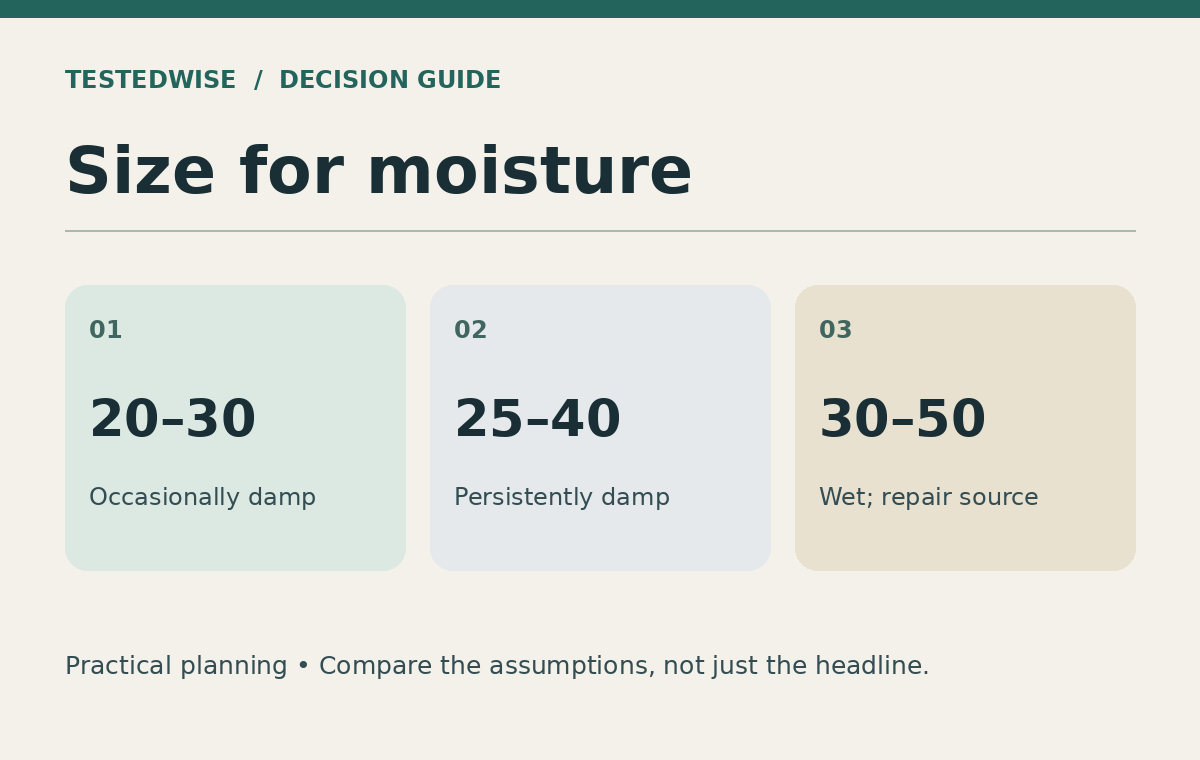
ENERGY STAR provides a starting range for portable units based on both room size and moisture conditions. For spaces below 2,000 square feet, its suggested range is roughly 20–30 pints/day for intermittent dampness, 25–40 for persistent dampness, and 30–50 for wet conditions. For larger spaces it gives higher starting capacities (30+, 40+, and 50+ respectively). These are not measured requirements for a specific property, and a room at the boundary needs judgment. A wet space first requires repair of moisture entry.
| Example situation | Practical first step |
|---|---|
| Small laundry room, occasional dampness | Address venting and check a smaller rated unit |
| Finished basement, persistent musty smell | Measure humidity over several days; consider a midrange capacity |
| Large basement, high moisture after storms | Fix seepage or drainage first, then assess a larger unit and continuous drain |
| Multiple closed rooms | Measure each space and assess airflow rather than counting all floor area as one room |
Measure relative humidity away from the direct outlet stream. Take readings after a wet day and during ordinary conditions. EPA's general guidance is to keep indoor RH below 60% and, if feasible, around 30–50%. Avoid assuming a single fixed setpoint fits every building; watch condensation and comfort in addition to the displayed number.
Plan the drain before the capacity
A full bucket typically stops the unit. Suppose your room actually yields 16 pints per day and the bucket holds 8 pints. Without a hose you'd empty it about twice a day during those conditions, even if the unit carries a 50-pint/day label. A gravity drain requires the correct hose routing to a suitable lower drain. If the destination sits above the outlet, check a compatible pump and the manual's lift limit; don't assume a built-in pump works at any height.
Use the approved connection, keep the hose free from kinks, and make sure overflow won't damage the room. Inspect filters and drainage regularly. Choose a location that allows circulation and access for cleaning rather than hiding the machine behind stacked boxes.
Temperature and energy can change the result
Cool basements are harder for many refrigerant dehumidifiers. Check the operating temperature range and defrost behavior. ENERGY STAR notes that coil icing can reduce performance in cooler spaces. If the basement routinely sits below the manufacturer's specified range, a larger model of the same type may not solve the problem. Consult an appropriate HVAC professional for persistent cold-space or whole-house moisture issues.
Compare rated energy efficiency in liters per kWh where the same test basis applies. A unit rated at 2 L/kWh would theoretically use 3 kWh to collect 6 liters under those conditions. At an illustrative $0.18/kWh that's $0.54. Actual energy use varies with temperature, cycling, fan and humidity. A larger unit that runs intermittently may use less or more energy than a small one running constantly; measure after installation rather than inferring from pints alone.
Frequently asked questions
Is a 50-pint unit too big for a bedroom?
It may be unnecessary if the room is small and only slightly damp. Compare humidity control, cycling behavior, noise, size and drain routine. Start with the moisture load, not the biggest advertised machine.
Can a dehumidifier remove existing mold?
No. It can help control the humidity that supports growth, but existing mold and moisture sources need appropriate cleanup and repair. Seek professional help for extensive damage or contaminated water.
What if the humidity never reaches the target?
Check sensor position, doors and windows, drain, filter, temperature and ongoing moisture sources. If the unit is running continuously within its specified range and the humidity stays high, reassess capacity or seek professional evaluation. See the related model comparison once you know the capacity class and drainage arrangement you need.