
Best Dehumidifiers for Basements and Large Rooms: 5 Models Compared
A basement dehumidifier has one job that matters more than a long feature list: it needs to remove enough moisture for the conditions in your space, then get that water out of the machine without becoming another chore. A compact unit can be perfectly adequate in a small finished room, while a damp basement with a laundry area, concrete walls, and frequent humidity swings may need a larger compressor and a reliable drainage plan.
Affiliate disclosure: This article contains affiliate links. TestedWise may earn a commission if you purchase through them, at no additional cost to you. Read the full disclosure.
We compared five Amazon US listings against manufacturer specifications, ENERGY STAR records, and independent laboratory testing. This is a research-led buying guide, not a hands-on moisture-removal test by TestedWise. Where a published test covers an older model variant, we identify that distinction rather than treating the result as if it applied to every newer listing with a similar name.
Quick answer: The LG PuriCare Sonoran 50-Pint is the strongest starting point if you want a model with independent lab testing and smart controls. Choose the Midea Cube 50-Pint if a built-in pump and its lift-and-twist tank design solve a real drainage problem. The AEOCKY Rhea-001 and Waykar JD025CE-80 advertise much higher maximum removal rates for very humid conditions, but their 80-pint figures use hotter, wetter test conditions and should not be compared directly with a 50-pint DOE rating. The Midea Cube 20-Pint is for a smaller or less damp space, not a large wet basement.
Dehumidifier comparison
| Model | Published capacity | Water removal | Best fit | Main trade-off |
|---|---|---|---|---|
| LG PuriCare Sonoran DT501BKR0 | 50 pints/day under DOE Appendix X1 | Drain hose; no built-in pump | Finished basements where tested performance and app control matter | Gravity drainage needs a suitable drain location |
| Midea Cube 50-Pint MAD50PS1QWT-A | 50 pints/day, manufacturer rating | Built-in pump plus bucket | Basements where water must be pushed up or across to a drain | Heavier, more complex design than a basic bucket unit |
| AEOCKY Rhea-001 | Up to 80 pints/day at 95°F / 95% RH | Continuous gravity drain | Large, very humid spaces | Maximum-capacity figure is not the same test basis as a 50-pint DOE rating |
| Waykar JD025CE-80 | Up to 80 pints/day at 95°F / 90% RH | 1.14-gallon bucket or gravity drain | Large areas where a straightforward drain hose is practical | No built-in pump; EPA's DOE-condition figure is much lower than the headline maximum |
| Midea Cube 20-Pint MAD20S1QWT | 20 pints/day, manufacturer rating | Bucket or gravity drain; no pump | Smaller rooms or a mildly damp, finished basement | Not sized for a large, persistently wet basement |
The first decision is not which model has the biggest number on its box. It is whether the published capacity is measured under comparable conditions, whether the unit can drain where you need it to, and whether the actual moisture load in your basement matches the machine's intended use.
The five dehumidifiers worth comparing

Best independently tested starting point for a finished basement
1. LG PuriCare Sonoran 50-Pint Smart Dehumidifier
The PuriCare Sonoran is the clearest choice in this group for buyers who want a recognizable manufacturer model with a published test basis. LG lists a 50-pint daily removal capacity under DOE Appendix X1 conditions at 65°F and 60% relative humidity, and the company says the DT501BKR0 was evaluated by a third-party testing institution. It is ENERGY STAR certified, supports LG ThinQ Wi-Fi control, and offers manual, auto, continuous, and one-hour boost modes.
RTINGS also evaluated the PuriCare Sonoran in its basement dehumidifier work. That independent test is useful context for the model, but it is not a promise that the unit will remove the same amount of water in every basement. Room temperature, air leakage, moisture entering through walls or floors, and the humidity target all affect real-world output.
- 50-pint/day rating under DOE Appendix X1 conditions, according to LG.
- ENERGY STAR certification and LG ThinQ app control.
- Drain-hose operation; it does not have the Midea Cube's built-in condensate pump.
View the current Amazon listing · LG product details · RTINGS basement testing

Best for a basement that needs pumped drainage
2. Midea Cube 50-Pint Dehumidifier with Built-In Pump
The Midea Cube solves a practical problem that a higher pint rating cannot: getting collected water to a drain when gravity alone will not do it. The MAD50PS1QWT-A version is listed by Midea as a 50-pint/day model for spaces up to 4,500 square feet, with a built-in pump, smart control, wheels, and a lift-and-twist design that can be used in extended or nested form. The pump can send water out through a hose to a window or sink, subject to the installation limits in the manual.
That flexibility is valuable if the only floor drain is not directly below the unit or if you do not want to empty a bucket every day. It also means there are more parts and connections to set up. Check the exact suffix on the Amazon listing: Midea has several Cube variants, and a 50-pint model with a pump is not the same product as the 20-pint Cube or an older Cube generation.
- 50-pint/day manufacturer rating and up to 4,500-square-foot coverage claim.
- Built-in pump, continuous drainage, app control, and lift-and-twist tank design.
- Confirm hose routing, lift height, and exact model suffix before purchase.
Best high-capacity option for a very humid, open basement
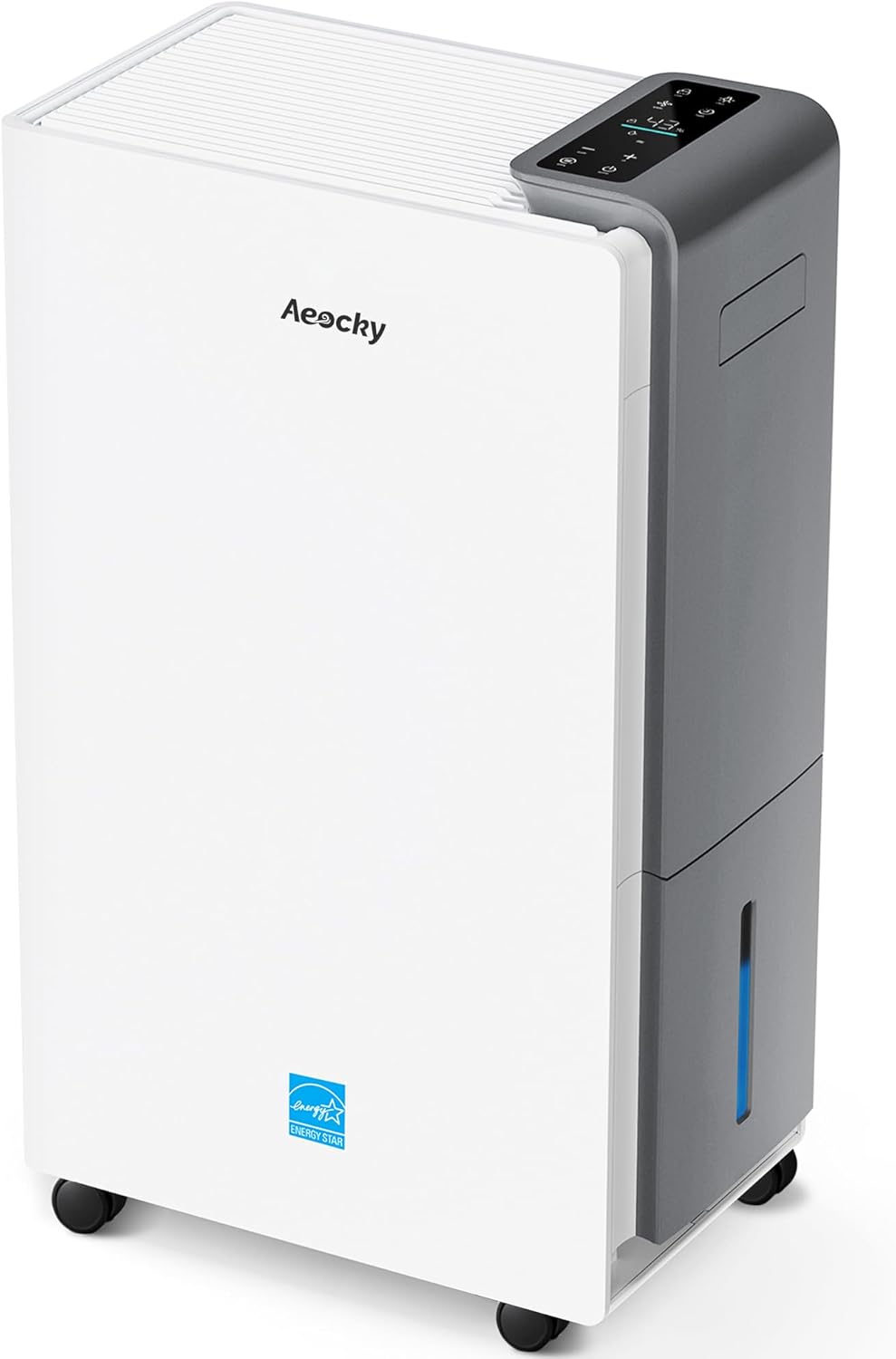
3. AEOCKY Rhea-001 80-Pint Dehumidifier
AEOCKY rates the Rhea-001 for up to 80 pints per day at 95°F and 95% relative humidity, with a coverage claim of up to 5,500 square feet. The brand also markets this exact model as ENERGY STAR Most Efficient 2025, and lists smart auto-humidity control and continuous gravity drainage. The important detail is the test condition: 95°F and 95% RH describes an extremely warm, saturated environment, not a typical finished basement.
This can still be a sensible model for a large, damp space, but the 80-pint headline should not be read as meaning it removes 60% more water in normal home conditions than a 50-pint DOE-rated model. Compare the exact model's ENERGY STAR record and Integrated Energy Factor as well as its maximum capacity. The Rhea family includes different versions, so the certification and performance of Rhea-001 should not automatically be assigned to Rhea-002 or Rhea-003.
- Up to 80 pints/day at 95°F / 95% RH; manufacturer coverage claim up to 5,500 sq. ft.
- Continuous gravity drain and smart humidity control.
- Manufacturer lists Rhea-001 as ENERGY STAR Most Efficient 2025; verify the exact model code in the EPA directory.

Best straightforward high-capacity model with gravity drainage
4. Waykar JD025CE-80 80-Pint Dehumidifier
The Waykar JD025CE-80 is another large-space model with a headline maximum of 80 pints per day, measured by the manufacturer at 95°F and 90% RH. It is listed for spaces up to 5,000 square feet and has a 1.14-gallon bucket, a 3.3-foot gravity-drain connection, auto defrost, and a stated noise level of 42 dB. It is ENERGY STAR certified, but the EPA product record does not list it as ENERGY STAR Most Efficient.
The EPA record is especially useful here because it reports a 24.93-pint/day water-removal figure under the standardized DOE conditions, rather than the 80-pint maximum used in the warmer, wetter marketing test. That does not make the Waykar a poor choice; it shows why a buyer should compare test conditions and efficiency data rather than sorting models by the largest number on the carton. It has no built-in pump, so the drain hose needs a suitable downward path.
- Up to 80 pints/day at 95°F / 90% RH; up to 5,000 sq. ft. claimed by Waykar.
- ENERGY STAR certified; EPA record lists 24.93 pints/day under DOE conditions and IEF 1.7.
- 1.14-gallon bucket and gravity drain; no built-in condensate pump.
View the current Amazon listing · Waykar product details · EPA ENERGY STAR record

Best for a smaller room or a mildly damp finished basement
5. Midea Cube 20-Pint Dehumidifier
The 20-pint Cube is included because buying too much capacity can be as unhelpful as buying too little. Midea rates this version for 20 pints per day and spaces up to 1,500 square feet. It keeps the Cube's lift-and-twist design and app control, but it does not have a built-in pump. A drain hose can be used where gravity drainage is possible.
RTINGS has tested the MAD20S1QWT model and treats it as a smaller-space option, not a substitute for a full-size basement unit. If the basement is persistently wet, has a musty smell, or has water entering through the foundation, the 20-pint version is unlikely to be the right starting point. Its value is in a smaller finished area where the moisture load is modest.
- 20-pint/day rating and up to 1,500-square-foot manufacturer coverage claim.
- Smart control and lift-and-twist design; no built-in pump.
- Better suited to a smaller room than a large, very damp basement.
View the current Amazon listing · Midea product details · RTINGS model review
How to read dehumidifier pint ratings
A pint-per-day rating is only useful when you know the temperature and relative humidity used to measure it. A dehumidifier removes more water from warmer, wetter air than it does from a cool, moderately damp basement. That is why some product pages advertise 75 or 80 pints per day at 95°F and very high humidity, while newer DOE Appendix X1 ratings are measured at 65°F and 60% RH. Those numbers are not interchangeable.
The LG Sonoran's 50-pint rating is explicitly tied to DOE Appendix X1 conditions. The Waykar JD025CE-80's 80-pint headline is measured at 95°F and 90% RH, while its EPA ENERGY STAR record lists 24.93 pints/day under standardized conditions. AEOCKY's 80-pint maximum is measured at 95°F and 95% RH. When two brands do not disclose the same test basis, do not rank them by the headline number alone.
ENERGY STAR's dehumidifier guidance and the EPA product finder are useful for checking certified models and efficiency. For a basement, compare the standardized water-removal figure, Integrated Energy Factor, noise, operating temperature range, drainage design, and warranty—not just the square-footage claim.
How to choose a dehumidifier for a basement
1. Start with the moisture problem, not the floor-area claim
Square-footage coverage is a rough marketing guide. A 1,500-square-foot basement with a dry slab and good ventilation may need less capacity than a 700-square-foot basement with damp block walls, a laundry area, and frequent outside-air infiltration. Think about how often the unit will run, whether the room smells musty, whether condensation appears on pipes or windows, and whether moisture is coming from a leak or seepage.
If water is entering through a wall, floor, window well, or plumbing leak, fix that source first. A portable dehumidifier can manage humidity in the air; it cannot repair a foundation, stop groundwater, or make a wet building envelope safe. The EPA's moisture and mold guidance explains why controlling the source of moisture matters.
2. Decide whether you need a pump
A gravity drain is simple and has fewer moving parts, but the hose needs a continuous downward route to a floor drain or other suitable outlet. A built-in pump is useful when the water has to travel upward or across to a sink or window. Check the manufacturer's maximum lift height, hose diameter, and permitted hose length. A pump does not remove the need to keep the hose clear and inspect the connection.
3. Check the operating temperature range
Basements can be cool, especially in winter. Compressor dehumidifiers may need to defrost and can become less effective as the air temperature drops. Check the operating-temperature range and auto-defrost design in the manual. If the space regularly stays below the manufacturer's minimum, a standard compressor unit may not be the best tool for that room.
4. Treat ENERGY STAR as one input, not the whole decision
ENERGY STAR certification is a useful efficiency screen, but it does not tell you whether the tank is easy to empty, the pump reaches your drain, or the unit is quiet enough for a finished living space. Confirm the exact model number in the EPA directory. Certification can differ between two products in the same family, and a manufacturer's broad product page may show several variants together.
5. Think about the bucket and filter routine
A larger tank means fewer trips to empty it, but it does not automatically make the unit more efficient. A removable filter should be easy to access and clean. If you plan to use continuous drainage, confirm whether the hose is included and whether the unit can run safely without the bucket in place. Check how the unit behaves after a power interruption and whether it restarts with your preferred humidity setting.
Drainage, placement, and maintenance
Place the dehumidifier on a level surface with the clearances required by the manual. Do not push it tight against a wall or hide it behind stored boxes; the air intake and outlet need room. Keep doors and windows closed while it is running unless the manufacturer's instructions say otherwise. A dehumidifier trying to dry a basement while humid outdoor air keeps entering will run longer and may never reach the target.
For a gravity hose, route it downhill without kinks, loops that trap water, or a raised section that blocks flow. For a pump model, use only the hose and lift arrangement the manufacturer permits. Check the drain outlet after the first few hours of operation, then inspect it periodically. A blocked or disconnected hose can put water back on the floor.
Start with a reasonable humidity target rather than forcing the unit to run continuously. The EPA recommends keeping indoor relative humidity below 60%, ideally between 30% and 50%, where practical. In many homes, a setting around 45% to 50% is a useful starting point. Clean the filter on the schedule in the manual, keep the intake free of dust, and empty or clean the bucket before storing the unit.
Buying mistakes to avoid
- Comparing 80-pint and 50-pint labels as if they used the same test. Check the temperature and humidity conditions behind the rating.
- Buying a large unit before fixing water entry. A dehumidifier is not a substitute for drainage, leak repair, or foundation work.
- Assuming every drain hose can pump uphill. A gravity-drain model needs a downhill route; a pump model has a maximum lift limit.
- Choosing only by the square-footage claim. Actual moisture load, temperature, and air leakage matter.
- Assuming every model in a product family has the same certification. Match the exact model number in the EPA directory.
- Ignoring noise and filter access. A unit that is difficult to maintain or too loud for the room may be a poor daily fit.
For the next part of the decision, see robot vacuums for routine floor maintenance.
Frequently asked questions
Is a 50-pint dehumidifier enough for a basement?
It can be, especially if the basement is finished, moderately damp, and not unusually cold. A large or persistently wet basement may need more capacity or a different drainage setup. Compare ratings under the same test conditions and consider the actual moisture source rather than relying on square footage alone.
Is an 80-pint dehumidifier always stronger than a 50-pint model?
Not necessarily in normal home conditions. Some 80-pint labels are maximum-removal figures measured at 95°F and very high humidity, while 50-pint DOE ratings use a cooler, less extreme test. The figures cannot be compared directly unless the test basis is the same.
Do I need a dehumidifier with a built-in pump?
You need one if the water must be moved uphill or to a drain that is not lower than the unit. If a floor drain is nearby and the hose can run downhill, a gravity-drain model is simpler. Check the pump's maximum lift and hose requirements before buying.
What humidity should I set in a basement?
A setting around 45% to 50% is a practical starting point for many homes. The EPA recommends keeping indoor relative humidity below 60%, ideally between 30% and 50%. The right setting depends on the building, season, and comfort needs; avoid trying to force an unnecessarily low number if it makes the unit run constantly.
Can a dehumidifier stop basement mold?
It can help control the humidity that supports mold growth, but it cannot remove an existing mold problem or repair the source of water. Fix leaks and seepage, dry wet materials promptly, and use qualified remediation when the affected area or material requires it. A dehumidifier is one part of moisture control, not a complete mold-remediation plan.
If you are comparing indoor air products, remember that a dehumidifier controls moisture while an air purifier targets airborne particles. Our air purifier comparison covers the other side of that decision.