
Best Robot Vacuums for Pet Hair, Carpets & Hard Floors: 5 Models Compared
If you share your home with a dog or cat, a robot vacuum can take a real chore off your list. The difference between a useful one and an expensive frustration usually comes down to a few practical details: whether the brush resists hair wrap, how often you have to empty it, how it handles rugs and thresholds, and whether its navigation can cope with the clutter that pets leave behind.
Affiliate disclosure: This article contains affiliate links. TestedWise may earn a commission if you purchase through them, at no additional cost to you. Read the full disclosure.
We compared five popular Amazon US listings across premium vacuum-and-mop docks, self-emptying value models, bagless bases, and lower-cost 2-in-1 cleaners. This is a specification-led buying guide, not a hands-on lab test. Suction figures are manufacturer claims and should not be treated as directly comparable performance scores.
Quick answer: The Roborock Qrevo S Pro is the most hands-off option if you want vacuuming and active mopping with a wash-and-dry dock. The Roborock Q7 M5+ is the better value choice if self-emptying matters more than automatic mop care. Choose the Shark AV2501AE if you want a bagless base and no mop, or the ROPVACNIC if your budget is the main constraint.
At a glance: which robot vacuum fits your home?
| Model | Best fit | Published suction | Dock and mop setup | Main trade-off |
|---|---|---|---|---|
| Roborock Qrevo S Pro | Low-maintenance vacuuming and mopping | 18,500 Pa | Auto-empty, hot-water mop wash, warm-air dry, spinning pads | More equipment and maintenance than a basic robot |
| Roborock Q7 M5+ | Value self-emptying vacuum | 10,000 Pa | Auto-empty; removable flat mop | Mop care is manual |
| Shark AI Ultra AV2501AE | Bagless base and allergen containment | Shark does not publish a comparable Pa figure | Bagless self-empty base; no mop | Not a vacuum-and-mop combo |
| ROPVACNIC 5200Pa | Entry-level scheduled cleaning | 5,200 Pa | Basic 2-in-1 mop; no self-empty dock | More frequent bin and pad cleaning |
| Dreame D20 Air Plus | Large dust bag and vacuum-first cleaning | 20,000 Pa | Auto-empty with 4 L bag; flat mop | 120-day interval is a lab-based estimate |
The models were selected from current Amazon US robot-vacuum listings and category activity, then checked against manufacturer specifications where available. Amazon rankings, stock, and product variants change; the links below lead to the current listings rather than a fixed price snapshot.
The five robot vacuums worth comparing

Best for a hands-off vacuum-and-mop routine
1. Roborock Qrevo S Pro
The Qrevo S Pro is the most complete option in this group if you want the robot to handle more of the maintenance as well as the floor cleaning. Its listed 18,500 Pa suction is paired with an all-in-one dock that empties the dust bin, washes the mop pads with hot water, and dries them with warm air.
For pet households, the dual anti-tangle brush design and the dock matter as much as the headline suction figure. The listing describes a sealed 2.7 L dust bag with a typical 7–9 week emptying interval, plus dual spinning mop pads and a low-profile body around 3.8 inches high.
- 18,500 Pa claimed suction; dual anti-tangle design.
- Multifunction dock: auto-empty, 167°F mop washing, and 113°F warm-air drying.
- Dual spinning mop pads and smart obstacle detection.

Best value if self-emptying matters more than active mop washing
2. Roborock Q7 M5+
The Q7 M5+ keeps the features that make a daily robot vacuum useful: 10,000 Pa claimed suction, PreciSense LiDAR mapping, a dual anti-tangle brush system, carpet boost, and a self-empty dock. The 2.7 L sealed bag is listed for up to 7–9 weeks between changes, although pet count, floor area, and cleaning frequency can shorten that interval.
Its mop is a simpler removable pad with three water-flow settings. That is useful for a light maintenance pass on hard floors, but it is not a substitute for the spinning, washing, and drying system on the Qrevo.
- 10,000 Pa claimed suction and LiDAR room mapping.
- Dual anti-tangle brush system and automatic carpet boost.
- Self-empty dock; basic removable mop pad rather than an active mop-washing dock.

Best if you prefer a bagless base and do not need mopping
3. Shark AI Ultra AV2501AE
Shark takes a different route: the AV2501AE is a vacuum-only robot with a bagless XL self-empty base advertised for up to 60 days of debris. That avoids buying disposable dust bags, and the base includes HEPA filtration that Shark says captures 99.97% of dust and allergens down to 0.3 microns. One caveat is worth knowing: RTINGS testing of the closely related AV2501S platform found that it handled pet hair on bare floors and high-pile carpet better than on low-pile carpet, and long hair could still wrap around the brushroll. The AV2501AE adds the larger base; that does not change the robot’s floor-pickup design.
Its 360-degree LiDAR mapping and Matrix Clean pattern are useful for methodical coverage. The self-cleaning brushroll is designed for pet hair, but you still need to remove wrapped hair and clean the robot periodically. If you want a robot mop, this is not the model to choose.
- Bagless self-empty base with up to 60 days of capacity (manufacturer claim).
- LiDAR mapping, Matrix Clean passes, and a self-cleaning brushroll.
- HEPA filtration in the base; vacuum-only design with no mop.
Best low-cost entry point for scheduled maintenance cleaning
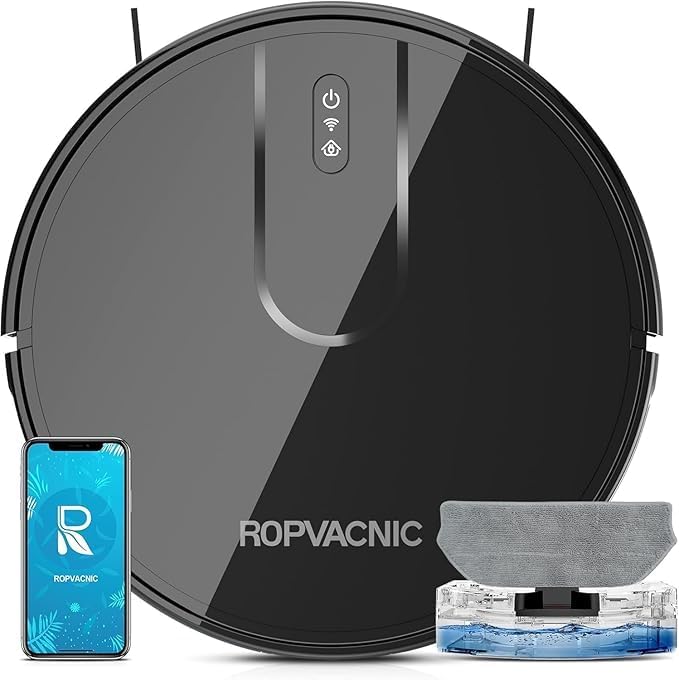
4. ROPVACNIC S1 5200Pa Robot Vacuum and Mop Combo
This is the simplest way into a robot vacuum-and-mop routine among the five. The Amazon listing describes 5,200 Pa suction, electronically controlled mopping with adjustable water flow, app and voice control, scheduled cleaning, obstacle sensing, and automatic return to the charging dock.
The trade-off is the level of automation. It does not have the sealed self-empty dock or the more advanced mop station found on the Roborock and Dreame models, so you should expect to empty the bin, clean the brushes, and wash the mop pad yourself.
- 5,200 Pa claimed suction with a 2-in-1 vacuum-and-mop setup.
- Adjustable water flow, app control, and automatic recharging.
- A budget design that requires more frequent hands-on maintenance.

Best for a large dust bag and high listed suction
5. Dreame D20 Air Plus
Dreame lists 20,000 Pa maximum suction, a 4 L dust bag, a detangling side brush, and a flat mop. The manufacturer describes up to 120 days of hands-free dust collection, but that figure is based on an in-house calculation; a home with several pets or frequent cleaning will usually fill the bag sooner.
The D20 Air Plus is a good fit if you want a strong vacuum-first robot with an auto-empty station and a light mopping pass. Its flat mop is simpler than the Qrevo’s spinning pads, and the large dust-bag interval should be treated as a best-case estimate rather than a promise.
- 20,000 Pa maximum suction and a 4 L dust bag.
- Detangling side brush, LiDAR navigation, and a basic flat mop.
- Up to 120 days of dust collection is a manufacturer lab calculation, not a guaranteed interval.
How to choose a robot vacuum for pet hair, carpets, and hard floors
1. Look at the brush system before the suction number
Long hair winds around brushrolls, side brushes, and axles. A dual anti-tangle design can reduce the amount of hair you cut away by hand, but it does not make a robot maintenance-free. If your dog sheds heavily, check whether the main roller is easy to remove, whether replacement rollers are available, and whether the side brush can be swapped without tools.
Published Pa figures are useful as one specification, but they are not a standardized cross-brand test. A robot with a larger number is not automatically better at lifting embedded hair from carpet. Brush contact, airflow, floor-head design, carpet detection, and navigation all affect the result.
2. Decide how much dock automation you will actually use
A self-empty base is valuable when the robot runs frequently or collects a lot of pet hair. A multifunction dock adds more convenience by washing and drying mop pads, but it also adds water tanks, filters, trays, cleaning solution, and more parts to maintain. If your home is mostly carpet, paying for a mop station may not make sense.
Bagless bases avoid recurring dust-bag purchases, but emptying a bagless base can expose you to dust. A sealed bag is usually tidier for people who want to minimize contact with collected debris. Compare the cost and availability of replacement bags, filters, brushes, and mop pads before choosing.
3. Treat mopping as maintenance, not a replacement for scrubbing
A removable damp pad is useful for picking up fine dust after vacuuming. Spinning mop pads or a powered roller can do more for everyday marks, but even those systems have limits. Sticky spills, dried food, muddy paw prints, and greasy kitchen marks may still need a manual clean. Check whether the robot lifts its mop over carpet and whether you can set no-mop zones around rugs.
4. Navigation matters more in a lived-in home
LiDAR mapping is useful for room maps, repeatable routes, and no-go zones. Obstacle recognition can help with shoes, toys, and furniture legs, but no consumer robot should be trusted to identify every charging cable, sock, pet toy, or accident. Clear small objects before a scheduled run, especially around feeding stations and litter trays.
5. Measure the furniture clearance and door thresholds
Measure the gap under sofas and beds rather than relying on the product photo. A low-profile robot can reach more of the floor, but the dock still needs a practical place with enough clearance and access to a power outlet. Check the height of thresholds between rooms; a robot that repeatedly gets stuck is not saving time.
Buying mistakes that are easy to avoid
- Buying on Pa alone. Treat suction as one clue, not a universal performance score.
- Assuming every mop is a real mop. A damp pad is mainly for light maintenance; it will not scrub like a person.
- Ignoring consumables. Check replacement filters, bags, rollers, side brushes, and mop pads before you buy.
- Expecting perfect pet-waste avoidance. Pick up pet accidents and loose toys before the robot runs. Obstacle detection is not a guarantee.
- Forgetting the dock footprint. Measure the floor space and access around the charging or wash station.
For the next part of the decision, see robot vacuum mapping and obstacle-avoidance features.
For the next part of the decision, see air quality considerations for pet households.
Frequently asked questions
Are robot vacuums worth it for pet hair?
They can be, especially when scheduled for frequent light cleaning. The best fit for a pet home usually has an easy-to-clean brush, a bin or dock that can keep up with daily hair, and navigation that works around furniture. A robot will not replace an occasional deep vacuum on upholstery, stairs, or thick carpet.
Is a 20,000 Pa robot vacuum automatically better than a 10,000 Pa model?
No. Pa figures are manufacturer-reported suction specifications, not a common independent pickup score. Brush design, airflow, carpet contact, and the robot's cleaning path matter too. Compare the full design and look for independent tests of the exact model when available.
Can a robot mop replace normal mopping?
Usually not. A flat pad is best thought of as a light dust-and-footprint maintenance pass. Spinning pads and roller mops can handle more routine soil, but dried spills and sticky marks may still need manual cleaning.
How often will I need to empty a self-emptying robot vacuum?
It depends on the home. Manufacturer estimates such as seven to nine weeks or 120 days are based on particular test conditions. A shedding pet, a larger floor plan, or multiple daily runs can fill the bag much sooner. Check it during the first few weeks and adjust the interval to your own home.
Can a robot vacuum safely clean up pet accidents?
Do not rely on it. Even models with obstacle recognition can miss or misidentify pet waste. Clean up accidents and remove small toys, cords, and feeding bowls before scheduling a run.
Bottom line
For a pet home that needs both vacuuming and regular mopping, the Qrevo S Pro offers the most complete dock. The Q7 M5+ is a sensible middle ground if you mainly want reliable mapping and less frequent bin emptying. Shark is the better fit for shoppers who want a bagless base and no mop, while ROPVACNIC keeps the entry price down. Dreame's D20 Air Plus stands out for its large dust bag and high published suction, but its long maintenance interval should be treated as a best-case estimate.
Before ordering, confirm the exact model number, dock included in the box, replacement-part availability, and the return policy on the live Amazon listing.