
Best Air Purifiers for Bedrooms and Large Rooms: 5 Models Compared
An air purifier can be useful in a bedroom, a home office, or a living room that collects dust, pet dander, or smoke. The hard part is choosing a model that is actually large enough for the room. Many product pages show a very large coverage number, but that number may assume the air is turned over only once per hour. It is not the same as a room-size rating based on more frequent cleaning.
Affiliate disclosure: This article contains affiliate links. TestedWise may earn a commission if you purchase through them, at no additional cost to you. Read the full disclosure.
This guide compares five popular Amazon US models across compact bedrooms, medium rooms, pet households, and open-plan spaces. The most useful numbers are the clean air delivery rate (CADR) and the room size associated with a stated air-change rate. We use AHAM's 4.8-ACH suggested room size where available, and we explain when a larger marketing figure is based on a slower one-ACH rate.
Quick answer: Choose the Levoit Core 300-P for a smaller bedroom, the Coway Airmega Mighty for a balanced medium-room option, the Winix 5530 or Levoit Vital 200S-P for a larger bedroom or pet household, and the Blueair 211i Max for a genuinely large living space.
Air purifier comparison: start with the room size
| Model | Smoke CADR | Suggested room size at 4.8 ACH | Best fit | Notable feature |
|---|---|---|---|---|
| Levoit Core 300-P | 143 CFM | 222 sq. ft. | Smaller bedroom or office | Compact, simple controls |
| Coway Airmega Mighty AP-1512HH | 233 CFM | 361 sq. ft. | Typical bedroom or living room | Auto and Eco modes |
| Winix 5530 | 253 CFM | 392 sq. ft. | Medium-to-large room | App control; filter marketed as True HEPA |
| Levoit Vital 200S-P | 250 CFM | 388 sq. ft. | Pet households and larger bedrooms | U-shaped inlet and washable pre-filter |
| Blueair Blue Pure 211i Max | 435 CFM | 674 sq. ft. | Large living room or open plan | High CADR and HEPASilent filtration |
CADR and room-size values are not always presented the same way by every retailer. Where a product page gives both a 4.8-ACH and a one-ACH room size, this table uses the 4.8-ACH figure so the comparison is more meaningful. Check the exact model and certification listing before ordering.
The five air purifiers worth comparing
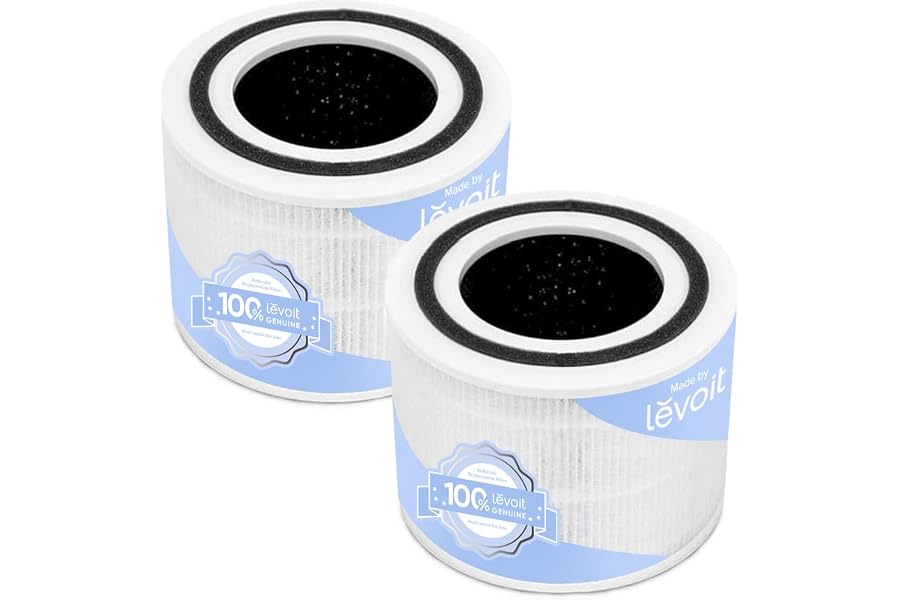
Best compact pick for a smaller bedroom
1. Levoit Core 300-P
The Core 300-P is the straightforward choice for a smaller bedroom or home office. Its published smoke CADR is 143 CFM and its AHAM suggested room size is 222 square feet at 4.8 air changes per hour. It has a compact footprint and a simple control layout, without the app features that appear on the larger smart models.
This is the one to consider when you want a unit sized for one room and do not need a large display or connected controls. It is not the right choice for an open-plan living room simply because a separate one-air-change-per-hour area claim looks large.
- Smoke CADR: 143 CFM; AHAM room size: 222 sq. ft. at 4.8 ACH.
- Compact format and straightforward controls.
- Best for one smaller room rather than a large open floor plan.
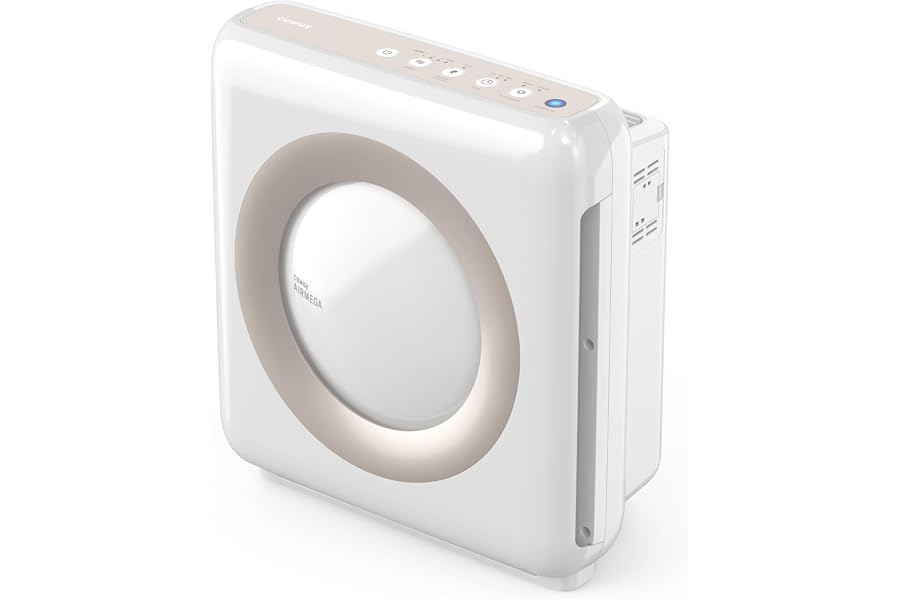
Best balanced option for a typical bedroom or living room
2. Coway Airmega Mighty AP-1512HH
The Airmega Mighty has been around long enough to have a well-understood filter and control setup. Coway lists CADR figures of 233 for smoke, 246 for dust, and 240 for pollen, with a suggested room size of 361 square feet at 4.8 ACH. Its automatic mode responds to the built-in air-quality sensor, and Eco mode can reduce fan operation when the air is clean.
The filter stack includes a washable pre-filter, deodorization filter, HEPA filter, and a bipolar device. If you prefer to avoid ionization features, read the current manual and confirm how the bipolar function is controlled before choosing this model.
- CADR: 233 smoke / 246 dust / 240 pollen.
- 361 sq. ft. suggested room size at 4.8 ACH; Auto and Eco modes.
- Four-stage filter system includes a bipolar device; check the controls if you prefer not to use ionization.

Best for a medium-to-large room with app controls
3. Winix 5530
The Winix 5530 is an AHAM-verified large-room model with a suggested room size of 392 square feet at 4.8 ACH. Its Amazon listing also advertises up to 1,882 square feet at one air change per hour. Those figures describe very different cleaning rates; use the 392-square-foot figure when comparing it with other AHAM-sized units.
The 5530 combines a washable pre-filter, pellet-based carbon, air-quality sensing, and app control. Winix markets its particulate filter as True HEPA, but RTINGS notes that the filter is not HEPA-certified; that distinction matters if formal HEPA certification is a requirement. Winix also includes PlasmaWave ionization, which can be switched off if you prefer to rely on the physical filter stages.
- AHAM-verified room size: 392 sq. ft. at 4.8 ACH.
- Winix markets the particle filter as True HEPA; RTINGS notes it is not HEPA-certified.
- The much larger 1,882 sq. ft. claim is based on one air change per hour, not 4.8 ACH.

Best for pet households and larger bedrooms
4. Levoit Vital 200S-P
The Vital 200S-P is the Levoit model to look at when the Core 300-P is too small. Its published CADR is 250 CFM for smoke, 254 for dust, and 289 for pollen, with an AHAM suggested room size of 388 square feet at 4.8 ACH. A U-shaped air inlet is designed to help draw in larger particles such as pet hair before they reach the main filter.
It adds app control, an air-quality monitor, and a washable pre-filter. Levoit describes its filtration as HEPA Sleep Mode rather than using the same wording as every other True HEPA product, so compare the exact filter claim and replacement filter you plan to buy.
- CADR: 250 smoke / 254 dust / 289 pollen.
- 388 sq. ft. suggested room size at 4.8 ACH; U-shaped inlet and washable pre-filter.
- Smart features and a larger filter make it a bigger, more involved purchase than the Core 300-P.

Best for a large living room or open-plan space
5. Blueair Blue Pure 211i Max
The 211i Max is the large-room choice in this group. Blueair lists CADR figures of 435 for smoke, 452 for dust, and 450 for pollen, with a suggested room size of 674 square feet at 4.8 ACH. The brand also publishes a much larger 3,235-square-foot figure at one air change per hour; that is not equivalent to the AHAM room-size figure.
HEPASilent filtration, an air-quality sensor, app controls, and auto mode make it a strong option for an open living area where a smaller purifier would need to run at a louder speed. The trade-off is the larger body, the ongoing cost of the replacement filter, and an electrostatic ionization stage that cannot be switched off. RTINGS notes that this system produces a small amount of ozone during operation. If you specifically want a purifier that relies only on mechanical filtration, choose a different model.
- CADR: 435 smoke / 452 dust / 450 pollen.
- 674 sq. ft. suggested room size at 4.8 ACH; HEPASilent filtration and app controls.
- A larger unit with a higher replacement-filter cost; size it to the room you actually use.
How to size an air purifier correctly
Start with the room you want to clean
Measure the length and width of the room and multiply them to get square footage. For an open-plan living room, kitchen, and dining area, think about the whole connected space rather than the corner where the purifier will sit. If the ceiling is higher than eight feet, or the room has a very open layout, choose a model with more capacity than the minimum estimate.
Use CADR, not a headline coverage number alone
CADR measures how much filtered air a unit delivers for particles such as smoke, dust, and pollen. AHAM's rule of thumb is to choose a smoke CADR at least two-thirds of the room's area for a typical eight-foot ceiling. For wildfire smoke, AHAM recommends a smoke CADR at least equal to the room's square footage. These are practical sizing rules, not a promise that every room will have identical air quality.
Pay attention to the air-change rate behind the coverage claim. A purifier advertised for 1,800 square feet at one air change per hour is not doing the same job as one rated for 390 square feet at 4.8 air changes per hour. A slower air-change rate may be fine for some situations, but it should not be compared as if it were the same performance target.
Remember that CADR is for particles, not every gas or odor
CADR is a particle-cleaning measure. If cooking smells, smoke odors, or some gases are a concern, look for an activated-carbon filter or another filter designed for gases. The amount of carbon matters; a thin carbon-coated sheet is not equivalent to a substantial carbon bed. EPA notes that no air cleaner removes every pollutant, and filters need regular replacement.
Filters, odors, noise, and running costs
Check the exact filter type and replacement part
HEPA terminology can be confusing. Some products use a True HEPA claim, while others describe a HEPA-grade or HEPA Sleep Mode filter. Read the exact claim for the model and filter you are buying. A marketing term is not the same as independent HEPA certification: RTINGS notes that the Winix 5530 and Blueair 211i Max are not HEPA-certified, despite the filter language used in their marketing. Also check the cost and availability of replacement filters before you choose; a low initial price can be offset by expensive or hard-to-find replacements.
Think about the speed you can tolerate at night
CADR is commonly measured at a high fan setting. If the purifier is too loud to run at that speed while you sleep, its real-world cleaning rate will be lower. A larger unit can be useful because it may deliver enough clean air at a quieter setting. Look for published noise levels at the fan settings you are likely to use, not just the lowest advertised number.
Be cautious with ionizers and ozone-producing features
Some purifiers add ionization, plasma, or other electronic features alongside mechanical filtration. EPA advises avoiding air cleaners that intentionally produce ozone because ozone is a lung irritant. The Winix 5530 lets you disable its PlasmaWave feature; the Blueair 211i Max uses an integral HEPASilent electrostatic stage that cannot be switched off. If you prefer a mechanical-filter-only setup, compare those details before buying. Do not assume every product using the word “plasma,” “ion,” or “HEPA” works the same way.
Placement matters
Give the intake and outlet room to breathe. Do not wedge a purifier behind a curtain, under a desk, or directly against furniture if that blocks airflow. Place it in the room where you spend the most time and run it consistently; a high-CADR model switched off most of the day is not doing much for the room.
Which one should you choose?
- Small bedroom: Levoit Core 300-P, provided the room is within its 222-square-foot AHAM size.
- Medium bedroom or living room: Coway Airmega Mighty for straightforward automatic operation, or Winix 5530 if you want app controls.
- Pet hair and a larger bedroom: Levoit Vital 200S-P, with its larger inlet and washable pre-filter.
- Large living room or open floor plan: Blueair 211i Max, because its 674-square-foot AHAM room size is the largest in this comparison.
Frequently asked questions
What size air purifier do I need for a bedroom?
Measure the room and compare it with the AHAM suggested room size at 4.8 air changes per hour. For an ordinary eight-foot ceiling, AHAM's two-thirds rule is a useful starting point: smoke CADR should be at least two-thirds of the room's square footage. Choose more capacity for higher ceilings or smoke events.
Is a higher CADR always better?
A higher CADR means more filtered air is delivered for the tested particles, but it is only useful if the unit fits the room, can run at a tolerable noise level, and has filters you can maintain. A much larger purifier may be unnecessary for a small bedroom.
Do air purifiers remove pet hair?
They can capture airborne pet dander and small particles, and a pre-filter may catch some larger floating hair. They do not replace vacuuming or cleaning surfaces where fur settles. For a pet household, consider both an air purifier and a regular floor-cleaning routine.
Does a HEPA filter remove odors?
A particle filter is designed for particles, not all gases or odors. For odors and some gases, look for a meaningful activated-carbon stage. The quantity and type of carbon matter, and no portable air cleaner removes every indoor pollutant.
Should I run an air purifier all day?
Continuous operation at a suitable fan speed generally filters more air than running the unit only occasionally. If noise is a problem, a larger model may let you use a quieter setting while still delivering useful CADR. Follow the manufacturer's maintenance and filter-replacement schedule.
Bottom line
The right air purifier is the one that can clean your actual room at a rate you will tolerate and maintain. Do not compare a large one-ACH coverage claim with an AHAM 4.8-ACH room size as if they were equivalent. For most shoppers, room size, smoke CADR, filter availability, and everyday noise matter more than a long list of app features.
If you are also working on everyday floor dust and pet hair, see our robot vacuum comparison for a complementary part of a home-cleaning setup.
Humidity is a separate problem from airborne particles. If your main issue is damp air in a basement or laundry room, compare our best dehumidifiers for basements and large rooms guide as well.