
Buying Guide · Home & Kitchen
Best Portable Air Conditioners for Small Rooms & Apartments: 5 Models Compared
A portable AC can solve a real apartment problem when a window unit is not allowed or a room has no suitable sash window. The trade-offs are a floor footprint, an exhaust hose, more indoor noise, and cooling ratings that are easy to misread.
Affiliate disclosure: This article contains affiliate links. TestedWise may earn a commission if you purchase through them, at no additional cost to you. Read the full disclosure.
The short answer
For a small bedroom or office, the Dreo AC318S is the compact, lower-capacity option in this group. For a medium room, the Dreo 740S and Midea Duo MAP12S1TBL are useful dual-hose inverter options. The larger Midea Duo MAP14HS1TBL adds a heat-pump mode and more DOE SACC capacity. The LG LP1419IVSM is a single-hose inverter alternative.
Before comparing models, check the DOE SACC rating, the window kit, the exhaust-hose arrangement, and the manufacturer's room-size guidance. A listing that leads with a large ASHRAE BTU number can make a portable AC look more powerful than its SACC rating suggests.
Portable air conditioners compared
| Model | Cooling rating | Hose / compressor | Best fit | Trade-off |
|---|---|---|---|---|
| Dreo AC318S | 5,000 BTU SACC / 8,000 BTU ASHRAE | Single hose; fixed-speed | Small bedroom or office | Not enough capacity for an open-plan space |
| Dreo 740S | 10,000 BTU DOE / 14,000 BTU ASHRAE | Dual hose; inverter | Medium room where quieter operation matters | Room-size claim depends on layout and heat load |
| Midea Duo MAP12S1TBL | 10,000 BTU DOE / 12,000 BTU ASHRAE | Dual hose; inverter | Medium-to-large room without a heat-pump requirement | Large, heavy cabinet; verify window fit |
| Midea Duo MAP14HS1TBL | 12,000 BTU DOE / 14,000 BTU ASHRAE | Dual hose; inverter; heat pump | Larger room and year-round use | Heavy, larger footprint, higher purchase cost |
| LG LP1419IVSM | 10,000 BTU SACC / 14,000 BTU ASHRAE | Single hose; dual inverter | Buyers who want inverter control and app features | Single-hose design can be less efficient in some rooms |
Rating rule: compare SACC with SACC. Do not rank a 14,000 BTU ASHRAE product above a 10,000 BTU SACC product without checking both rating systems. Our explainer, Portable AC BTU Explained: DOE SACC vs. ASHRAE, walks through the difference.
The five portable air conditioners

Best for a small room
1. Dreo Smart Air Conditioner 318S
The 318S is the small-room option here, with a 5,000 BTU DOE SACC rating and an 8,000 BTU ASHRAE rating. Its compact capacity makes it a more sensible starting point for a closed bedroom, home office, or other small room than a large 14,000 BTU-class unit that takes up more floor space and draws more power.
Dreo lists a quiet operating mode and app-based controls. Those conveniences can be useful in a bedroom, but the room still needs a suitable window for the exhaust kit. A single-hose portable AC also pulls some indoor air through the exhaust system, so the room can draw replacement air through gaps around doors and windows.
- Good for: smaller enclosed rooms where a window unit is not practical.
- Why it makes the list: a genuinely lower-capacity option rather than five models that all claim to cool a large room.
- Trade-off: 5,000 SACC is not the right size for a sunny living room or open-plan apartment.

Best mid-size dual-hose option
2. Dreo Portable Air Conditioner 740S
The 740S is listed at 14,000 BTU ASHRAE and 10,000 BTU DOE, with a dual-hose design and inverter compressor. Dreo advertises operation as low as 42 dB and smart controls through its app and voice assistants. That combination makes it worth considering for a bedroom or medium-size living space where the AC may run for long stretches.
The dual-hose arrangement is a practical difference, not just a spec-sheet flourish. One duct brings in outside air for the condenser and the other exhausts hot air, which can reduce the negative-pressure effect found in many single-hose designs. Still, check the exact window kit and hose length against the room before ordering.
- Good for: medium rooms and buyers who want inverter control with a dual-hose layout.
- Why it makes the list: it offers a different cooling architecture from the small single-hose Dreo 318S.
- Trade-off: a dual-hose unit still needs a well-sealed window opening and enough space for the appliance.

Best balanced dual-hose option
3. Midea Duo MAP12S1TBL 12,000 BTU ASHRAE Portable Air Conditioner
The MAP12S1TBL is listed at 12,000 BTU ASHRAE and 10,000 BTU DOE SACC. It uses Midea's dual-hose arrangement and inverter compressor, and the manufacturer positions it for rooms up to about 450 square feet. This is the standard Duo configuration for shoppers who want the dual-hose layout but do not need a heating function.
The main advantage is the combination of a 10,000 SACC rating and a dual-hose design. That gives it a stronger starting point for a medium-to-large room than a compact 5,000 SACC unit. The trade-off is physical: it is a large, heavy appliance, and the window kit needs enough room to fit properly.
- Good for: medium-to-large rooms where a dual-hose inverter model is preferred.
- Why it makes the list: a well-established Midea Duo configuration with a clear DOE SACC rating.
- Trade-off: it is heavy and takes up meaningful floor space; measure the window and storage route before ordering.
Best for larger rooms and year-round use
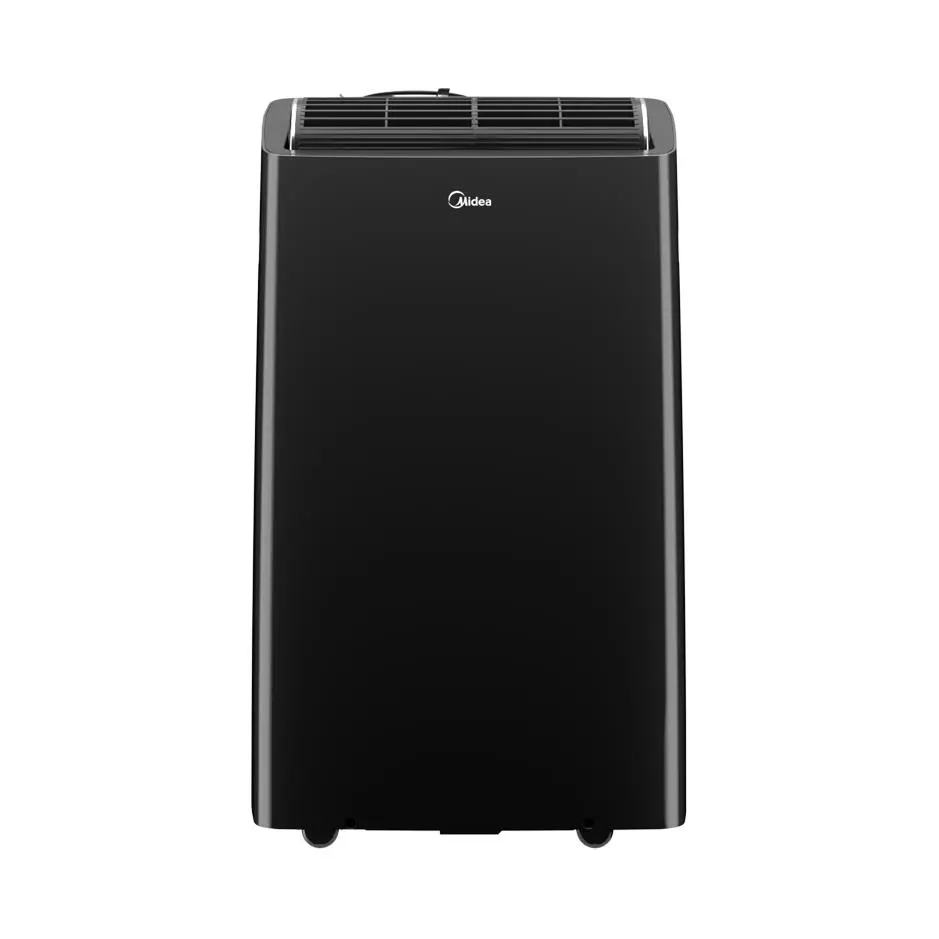
4. Midea Duo MAP14HS1TBL 14,000 BTU ASHRAE Portable AC with Heat
The MAP14HS1TBL is a 14,000 BTU ASHRAE / 12,000 BTU DOE SACC model with a dual-hose design, variable-speed inverter compressor, and heat-pump function. Midea lists cooling, heating, ventilation, and dehumidification modes, with operation as low as 42 dBA. The manufacturer positions it for spaces up to 550 square feet.
This is the most capable and most substantial machine in this comparison. It makes sense if you need more cooling capacity and will use the heat mode in shoulder seasons. It is also a heavy unit, at roughly 77 pounds, so plan where it will sit before buying. Portable does not mean effortless to move up stairs.
- Good for: larger rooms, apartments that cannot use a window AC, and buyers who value a heat-pump mode.
- Why it makes the list: higher SACC capacity, dual-hose design, and inverter operation in one model.
- Trade-off: weight, footprint, and installation are more demanding than a compact single-hose unit.

Best single-hose inverter alternative
5. LG 10,000 BTU Dual Inverter Portable Air Conditioner
This LG dual-inverter portable AC listing is marketed at 14,000 BTU ASHRAE and 10,000 BTU SACC. Its dual-inverter compressor is intended to regulate cooling more smoothly than a simple fixed-speed compressor, and the model includes smart control features. It is a single-hose portable AC, so do not assume the inverter label removes the airflow disadvantage of a single exhaust duct.
It is worth considering if you want LG's control ecosystem and a model with a long-established presence in the portable AC category. Before buying, check the exact product suffix and installation kit, because similarly named LG portable AC models can have different capacity and feature combinations.
- Good for: buyers who want an inverter compressor and smart controls in a single-hose format.
- Why it makes the list: a distinct alternative to the dual-hose Dreo and Midea designs.
- Trade-off: compare the 10,000 SACC figure, not the 14,000 ASHRAE headline.
How much cooling capacity do you need?
Start with the room's floor area, then account for heat gain. A closed, shaded bedroom is easier to cool than a top-floor room with large west-facing windows or an open kitchen. The manufacturer's room-size chart is a starting point, not a promise that the unit will maintain the same temperature during a heat wave.
Use the free Portable AC Room Size Calculator for a first-pass DOE SACC capacity band. It is based on a published manufacturer sizing table and flags sunny rooms and kitchens as reasons to consider the next size up. Always compare the exact model's SACC rating with its room-size guidance.
Do not buy a much larger machine just to be safe. Oversizing can lead to short cycling or poor humidity control in some conditions, and a portable AC still has to move its exhaust heat out through the window. If you are cooling several connected rooms, a single portable unit may not distribute air evenly.
Installation details people overlook
Measure the window before choosing a model
Portable ACs still need a window or another approved exhaust opening. Measure the clear opening, including the height or width available for the window kit. Casement, crank-out, and unusual windows may need a separate adapter. Check the included kit and do not assume a generic sliding-window bracket will fit.
Keep the exhaust hose short and unobstructed
Do not extend or sharply bend the hose unless the manufacturer explicitly permits it. A longer or kinked hose can reduce performance and may cause heat to build up around the unit. Leave the required clearance around air intakes and outlets.
Seal the window opening
Warm outside air leaking around the window panel works against the AC. Use the supplied seals and check for gaps after installation. A loose window kit can also let insects and outdoor humidity back into the room.
Plan for noise and drainage
The compressor is inside the room, unlike a window AC where much of the noise sits outside. If the unit is for a bedroom, look at the lowest published noise mode and where the exhaust hose will sit. Some models evaporate most condensate during normal cooling; high humidity or other modes can still require drainage. Read the manual before placing the unit on carpet or near furniture.
Portable AC vs. window AC
A portable AC is easier to move and may be allowed by a lease or building rule that prohibits window units. It also keeps the compressor inside the room, takes up floor space, and needs an exhaust hose through the window. A well-sized window unit is often more efficient and quieter in the room, but it may not be allowed or may not fit the window.
If a window unit is permitted and the window dimensions work, compare it before spending more on a portable model. If a portable AC is your only practical option, prioritize the SACC rating, hose design, window fit, and noise level rather than the biggest BTU number in the listing.
For the next part of the decision, see single-hose vs. dual-hose portable AC designs.
Frequently asked questions
Is 10,000 BTU enough for a bedroom?
It can be more than enough for a small or medium bedroom, but the relevant figure is DOE SACC, not just the ASHRAE headline. Check room area, sun exposure, insulation, ceiling height, and the manufacturer's sizing chart.
Are dual-hose portable air conditioners better?
A dual-hose design can reduce the negative-pressure effect of a single-hose unit and may improve efficiency in some rooms. It is not the only factor. Compare SACC, compressor type, noise, installation, and the exact room size.
Do portable ACs need to be drained?
Some models evaporate much of the water during normal cooling, while others may need manual or continuous drainage in high humidity or certain modes. Check the exact manual before choosing where to place the unit.
Can I use a portable AC without a window?
Not as a normal air conditioner. It needs to exhaust heat outside through an approved window kit or other manufacturer-approved opening. Running the exhaust hose into the same room defeats the cooling process.
Are portable ACs noisy?
They can be. The compressor is indoors, so even quiet models are audible in the room. Look for a published dBA figure and remember that the quietest mode may not deliver maximum cooling.
Sources and model checks
- Wirecutter: portable air conditioner testing
- RTINGS: portable AC comparisons and hose-design discussion
- Midea: MAP14HS1TBL product specifications
- LG: LP1419IVSM specifications
- Amazon: Midea Duo MAP12S1TBL
- Amazon: Dreo 318S
- Amazon: Dreo 740S
- Amazon: Midea Duo MAP14HS1TBL
- Amazon: LG LP1419IVSM
Sources & further reading
Content reviewed: Nov 19, 2026