
Build a Home Coffee Bar: Beginner Espresso & Coffee Essentials
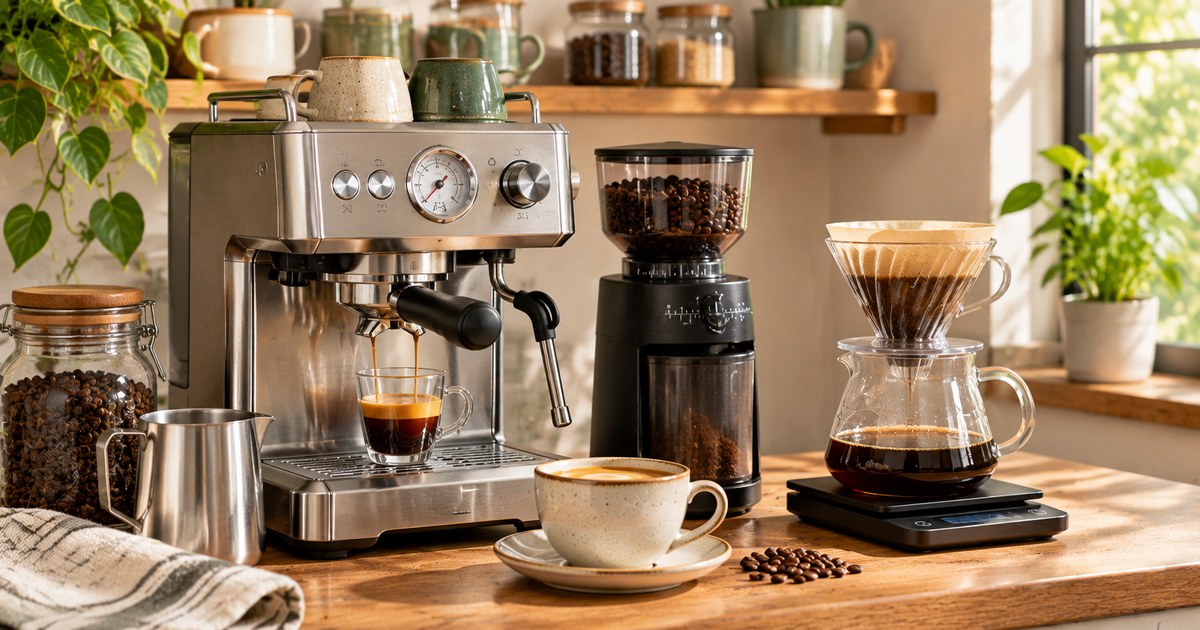
A practical home coffee bar setup does not need a wall of gadgets or a commercial espresso machine. It needs equipment that matches the drinks you actually make: an espresso machine and espresso-capable grinder if you love lattes and straight shots, or a dependable drip brewer or pour-over setup if you prefer a regular cup of coffee. This guide explains what each piece does, compares five beginner-friendly products, and shows how to build a station that is easy to use, clean and upgrade without buying everything at once.
Affiliate disclosure: This article contains affiliate links. TestedWise may earn a commission if you purchase through them, at no additional cost to you. Read the full disclosure.
1. Quick answer: what belongs in a beginner coffee bar?
The right starter setup depends on whether you want espresso-based drinks, a pot or mug of drip coffee, or a slower pour-over routine. Those methods use some of the same tools, but they do not need the same equipment. A grinder that can make a fine espresso grind is a different purchase decision from a basic grinder for drip coffee, and a steam wand is useful only if you plan to texture milk.
| Your daily drink | Start with | Useful next purchase | What you can skip for now |
|---|---|---|---|
| Latte, cappuccino or straight espresso | Espresso machine, espresso-capable burr grinder and scale | Milk pitcher if not included, tamp mat or knock box if the workflow needs them | Separate drip machine, expensive distribution tools and decorative storage jars |
| One or two mugs of regular coffee | Drip coffee maker or pour-over dripper, burr grinder and scale | Gooseneck kettle for manual pour-over; airtight bean storage | Espresso machine, tamper, milk pitcher and knock box |
| A full pot for more than one person | Automatic drip brewer, coffee grinder and scale | Thermal carafe or a second brew basket if your model supports it | Espresso accessories and a precision gooseneck kettle |
| Both espresso and filter coffee | Espresso machine, a grinder with a real filter range, and a scale | One filter brewer that fits your routine: drip or pour-over | Buying two grinders immediately; learn the limits of one dual-purpose grinder first |
A good buying order: decide on the brew method, reserve money for the grinder, add a scale, then buy only the accessories your routine calls for. A coffee bar is a small workflow, not a collection of matching containers. If the setup takes too long to prepare or clean, it will probably spend more time looking nice than making coffee.
2. Choose your coffee routine before buying equipment
Start with the cup you order most often, not the machine that looks best in a product photo. Espresso, drip coffee and pour-over can all produce excellent drinks, but the daily effort, learning curve and counter space are different.
Espresso: concentrated coffee and milk drinks
Espresso is brewed by pushing hot water through a compact bed of finely ground coffee under pressure. The result is a small, concentrated drink that can be served on its own or used as the base for an Americano, latte, cappuccino or flat white. It is the most equipment-sensitive of the three routines: grind size, dose, distribution, tamping and extraction all affect the result.
Choose an espresso setup if you enjoy the process as much as the drink and expect to make espresso-based drinks several times a week. A semi-automatic machine gives you room to learn, but it does not remove the need to grind fresh coffee, prepare the puck and clean the machine. If you want a latte at the touch of one button with very little practice, a superautomatic or a machine with assisted milk texturing may suit you better than a manual steam wand.
Automatic drip: repeatable coffee with less technique
A drip brewer heats water and distributes it over a bed of ground coffee. You add the grounds and water, start the cycle and let the machine handle the flow. It is a sensible choice when you make coffee for more than one person, want a mug ready with minimal attention, or prefer a familiar black coffee to espresso drinks.
The important buying details are not just the advertised cup count. Look at brew temperature and consistency, the size of the smallest batch, the filter basket, the carafe, how easy the water tank is to fill and whether the machine has a timer. A thermal carafe avoids leaving brewed coffee on a hot plate, but its lid and interior may take more effort to wash than a simple glass jug.
Pour-over: one cup and more control
Pour-over uses a dripper, paper filter, ground coffee and hot water poured by hand. A Hario V60 is compact and inexpensive compared with an espresso machine, but the person brewing controls the pour. Grind size, pouring speed, water temperature and the way the coffee bed drains all influence the cup.
Choose pour-over if you usually make one or two servings and enjoy a few minutes of hands-on preparation. It is not automatically easier than a drip machine: you need a kettle, a scale and a little practice. A gooseneck kettle makes it easier to control the water stream, but it is an upgrade for technique rather than a requirement for every coffee method.
| Method | Hands-on time | Learning curve | Best fit |
|---|---|---|---|
| Espresso | Several short steps for each drink | Highest: grind, dose, tamp and milk texture | Espresso, Americanos, lattes and cappuccinos |
| Automatic drip | Low once the basket is loaded | Low: measure, select batch size and brew | Daily mugs, shared pots and convenience |
| Pour-over | Active pouring for a few minutes | Moderate: grind, bloom and pour control | Single cups, smaller kitchens and a hands-on ritual |
3. The essential jobs: machine, grinder, scale and coffee
It is easier to build a useful station when you think about what each tool contributes. Some products do more than one job, while others are simply convenient extras.
The brewer creates the extraction
An espresso machine, automatic drip maker and pour-over dripper are not interchangeable. The brewer determines how water meets the coffee: under pressure, through an automatic showerhead, or through a manually controlled pour. Buy the one that makes the drinks you actually want. Do not buy an espresso machine just because it looks like the centerpiece of a coffee bar.
The grinder controls particle size
A burr grinder produces a more consistent range of particle sizes than a basic blade chopper. That matters because very fine and very coarse particles extract at different rates. If the grind contains a wide mix of sizes, a cup can taste both harsh and thin, and adjusting the brewer cannot fully correct the uneven grounds.
Espresso is especially demanding. It needs a fine grind and small adjustments that change how quickly water passes through the puck. A grinder intended only for coarse French press or filter coffee may not have the range or adjustment precision needed for espresso. If you plan to make both espresso and drip coffee, choose a grinder that explicitly supports both and expect to re-dial the settings when you switch methods.
The scale makes a recipe repeatable
A scale helps you compare one brew with the next. For espresso, weigh the coffee dose and the espresso in the cup. For drip and pour-over, weigh the coffee and the water. A scale that reads in 0.1-gram increments is useful for espresso; a basic gram scale can still improve filter coffee considerably. A built-in timer is convenient, but it is not a substitute for accurate weighing.
Fresh coffee is an ingredient, not an accessory
Buy whole beans when possible and grind shortly before brewing. Choose a bag with a roast date if one is available, buy an amount you can use while it still tastes fresh, and store it in an airtight container away from heat, moisture and direct light. A fancy bean canister will not make stale coffee fresh again, so start with a bag size that matches how often you brew.
4. Five home coffee bar products to compare
The five products below cover the main decisions in a beginner station: a compact espresso machine, a grinder that can move between espresso and filter settings, an automatic drip brewer, a manual pour-over kit and a scale. They are examples of different roles, not a shopping list that every reader needs to buy in full. Product specifications were checked against manufacturer information where available and matched to the named Amazon US product identifiers. TestedWise has not physically tested these products.
Compact semi-automatic espresso machine
1. Breville the Bambino Espresso Machine (BES450BSS)
The Bambino is a practical starting point for someone who wants real espresso without giving up a large section of the counter. Breville lists a 54 mm portafilter, a 47 fl oz removable water tank, a ThermoJet heating system that reaches its stated operating temperature in about three seconds, low-pressure pre-infusion and a 9-bar extraction stage. The machine has a manual steam wand, so you control the milk texture rather than selecting an automatic milk program.
One useful detail for beginners is the pair of basket types. Breville supplies single-wall baskets for freshly ground coffee and dual-wall baskets for pre-ground coffee. The machine also comes with a 54 mm tamper, milk jug, portafilter, steam-wand cleaning tool and descaling powder. That means you do not need to buy a separate pitcher or tamper just to make your first drink. You do still need a grinder if you want to use whole beans, and the machine does not grind coffee for you.
- Good fit: Someone who wants espresso, Americanos and milk drinks, and is willing to learn a manual steam wand.
- Less suitable: Anyone who expects a fully automatic latte or wants a built-in grinder and one-box workflow.
- Check before buying: The selected listing should be the BES450 model and the correct 120 V US version. Accessories and finish can vary by bundle.
Check Breville’s Bambino specifications and included accessories.
Dual-purpose espresso and filter grinder
2. Baratza Encore ESP Coffee Grinder (ZCG495BLK)
If you want one electric grinder to serve an espresso machine and a filter brewer, the Encore ESP is a useful entry-level option to compare. Baratza divides its 40 settings into two ranges: settings 1–20 use smaller steps for espresso adjustment, while 21–40 cover filter coffee, French press and coarser methods. Its operations manual gives suggested starting settings of 15 for espresso, 25 for Hario V60, 28 for an automatic brewer and 32 for French press. Those are starting references for a specified dose and roast, not universal recipes; beans, basket, dose and taste will move the final setting.
The manufacturer lists 40 mm conical steel burrs and a dosing cup. The cup is designed to transfer grounds to a 54 mm or 58 mm portafilter using the included adapter arrangement, which is useful with the Bambino’s 54 mm portafilter. Check the adapter instructions rather than forcing a cup onto the portafilter. A dual-purpose grinder saves a second purchase, but switching between espresso and filter still means changing settings and learning the new grind for each coffee.
There is a practical trade-off. Owner discussions often mention retained grounds, static or a chute that needs occasional cleaning; the Encore ESP is not a zero-retention single-dose grinder. That does not make it unusable, but it is worth knowing if you expect every gram poured into the hopper to appear instantly in the cup. Keep the burr area and chute clean, and use the grinder as the manufacturer describes.
- Good fit: A beginner who wants to learn espresso and also brew drip or pour-over without buying two grinders.
- Less suitable: Someone who wants stepless espresso adjustment, very low retention or a quiet grinder for a shared sleeping space.
- Check before buying: Confirm the model says Encore ESP, not the standard Encore. They are different grinders with different adjustment ranges.
Read Baratza’s Encore ESP product details · See the official Encore ESP operations manual.
Straightforward automatic filter coffee
3. OXO Brew 8-Cup Coffee Maker (Model 8718800)
The OXO Brew 8-Cup is for the person who wants a good everyday pot without learning espresso technique or standing over a kettle. OXO lists BetterBrew temperature and brew-cycle control, a Rainmaker showerhead intended to distribute water over the grounds, and a double-wall thermal carafe. The model has 2–4 cup and 5–8 cup brewing settings, so it can handle a smaller batch as well as a fuller carafe. The Specialty Coffee Association awarded the original 8-Cup model its Certified Home Brewer mark.
The thermal carafe is a practical advantage if you do not want coffee sitting on a hot plate. The trade-offs are less glamorous: the water reservoir is fixed rather than removable, and the machine does not offer a programmable wake-up timer or a long menu of strength controls. Tom’s Guide’s hands-on review praised its simple operation and coffee quality but also called out the fixed tank and lack of programming. If you want to fill a tank at the sink or schedule tomorrow’s brew, those omissions may matter more than the SCA mark.
- Good fit: Households that want a simple brewer for a few mugs or a shared pot, with a thermal carafe and uncomplicated controls.
- Less suitable: Buyers who need a removable reservoir, automatic scheduling or extensive temperature and strength adjustments.
- Check before buying: Confirm the listing is model 8718800 and check whether any single-serve accessory shown in the product photos is actually included. Accessories and newer variants can differ.
Check OXO’s 8-Cup product information · Read the SCA certification announcement.
Manual brewing kit for one or two people
4. Hario V60 Pour Over Coffee Starter Set 02
The V60 Starter Set is a compact way to try manual coffee without choosing a dripper, server and filters separately. Hario’s Size 02 set includes a plastic V60 dripper, a heatproof glass server and 40 paper filters; the server capacity is 700 ml. The plastic dripper is lighter and less fragile than a ceramic model, while the glass server gives you a simple place to collect and pour the finished brew.
The V60 is not an automatic brewer. Water passes through one large opening at the bottom of the cone, and the user controls the flow by pouring. That gives you room to change the recipe, but it also means that pouring too quickly, grinding too fine or using an inconsistent kettle stream can change the result. The kit does not include a grinder, scale or gooseneck kettle. You can start with a normal kettle and a careful pour, but a gooseneck makes the technique easier to repeat.
- Good fit: Someone who usually makes one or two cups, enjoys a hands-on brewing routine and wants a compact kit.
- Less suitable: Anyone who wants to press one button and walk away, or regularly needs a full pot for several people.
- Check before buying: Confirm Size 02, the color and the exact package contents. Hario’s current set page lists a dripper, server and 40 filters; marketplace bundles may use different colors or filter counts.
Check Hario USA’s V60 Starter Set 02 contents and materials.
One scale for espresso and filter brewing
5. TIMEMORE Basic 2.0 Coffee Scale with Timer
A scale is one of the most useful upgrades for a beginner because it turns “a scoop of coffee” into a recipe you can repeat. TIMEMORE’s Basic 2.0 is specified for readings from 0.1 g up to 2 kg, with a stated minimum detection weight of 0.5 g. The manufacturer lists a timer, tare function, water-flow-rate display, rechargeable battery and silicone protective pad. Those features make it suitable for weighing an espresso dose and yield or measuring coffee and water for pour-over.
The extra flow-rate display is optional information, not something you need to master to make a good cup. Tom’s Guide’s review praised the scale’s 0.1 g readings and built-in timer, but found the touch controls easy to trigger accidentally and the flow-rate monitor less useful in practice. If you prefer physical buttons and only need grams, a simpler scale can do the job. Also check the dimensions against your espresso machine’s drip tray before ordering; a scale that fits under a V60 server may be too large for a compact espresso setup.
- Good fit: Someone who wants a single rechargeable scale for espresso and manual filter brewing.
- Less suitable: Buyers who prefer physical buttons, need a very small espresso-tray footprint or do not care about a timer.
- Check before buying: Verify the model is Basic 2.0, the color and the included silicone pad. The scale is splash-resistant at its dial surface, not a device to immerse or rinse under a tap.
Check TIMEMORE’s Basic 2.0 specifications · Read the independent scale review.
5. How to choose a beginner espresso machine
Espresso machines are often compared by pump pressure, boiler type, heat-up time and the number of buttons on the front. Those specifications are useful, but they do not tell the whole story. For a first machine, focus on whether it accepts a suitable grinder, whether the basket matches the dose you can prepare, how you will steam milk and how much cleaning the routine involves.
Manual, semi-automatic or superautomatic?
| Machine type | What you do | Who it suits | Trade-off |
|---|---|---|---|
| Manual lever | Control pressure and extraction with a lever | People who enjoy experimenting and want hands-on control | More technique; usually no automatic milk steaming |
| Semi-automatic | Grind, dose, distribute and tamp; the machine manages the pump cycle | Beginners who want to learn espresso and adjust the recipe | Needs a separate grinder unless one is built in; milk steaming may be manual |
| Superautomatic | Load beans and choose a drink; the machine grinds and brews internally | People who value convenience and repeatable one-touch drinks | Higher purchase and maintenance complexity; less control over puck preparation |
| Pod espresso-style system | Insert a capsule and start the drink | Very low-effort single servings | Capsule format limits bean choice and may not produce traditional espresso workflow |
The Bambino is semi-automatic. You grind the coffee, prepare the portafilter and start the shot. Its steam wand is manual, so milk texture is a skill you develop with practice. That is a good fit for someone who wants to learn, but not necessarily for someone who wants an automatic latte before work.
Do not confuse pump rating with extraction pressure
Product listings often advertise a “15-bar pump.” That is not the same thing as saying the coffee puck is extracted at 15 bar. Breville describes the Bambino as using low-pressure pre-infusion followed by 9-bar extraction, driven by a pump rated at 15 bar. Read the manufacturer's explanation rather than comparing machines by the largest pressure number printed in a listing.
Check the basket and portafilter size
The Bambino uses a 54 mm portafilter and comes with single-wall and dual-wall baskets. Breville says the single-wall baskets are for freshly ground beans; the dual-wall baskets are intended for pre-ground coffee. That distinction matters when choosing accessories. A 58 mm tamper, dosing funnel or portafilter accessory will not automatically fit a 54 mm machine. Check the exact diameter and basket style before ordering upgrades.
Think about milk before paying for features
If you drink espresso black or make Americanos, milk automation is not a priority. If you make lattes every day, a steam wand and pitcher are important, but there is still a difference between manual and automatic texturing. A manual wand is flexible and teaches you how milk behaves; automatic texturing reduces the learning curve but adds features and usually cost. The Bambino includes a milk jug, so a new owner can start steaming without immediately buying another pitcher.
Measure the counter, including the space above it
Measure width, depth and height before you order. Leave room to remove the water tank, fit the portafilter handle, place a cup on the drip tray and swing the steam wand into a pitcher. A machine may fit under a cabinet but become awkward if you cannot lift the tank lid or refill it. Keep the grinder close enough that you can transfer grounds without carrying an open portafilter across the kitchen.
6. Why the grinder deserves its own budget
For espresso, the grinder is not an optional accessory. The coffee has to be fine and consistent enough to create the resistance the machine needs. A blade grinder chops beans into a mix of sizes and does not provide the fine, repeatable adjustment that espresso requires. A burr grinder is the safer starting point.
Espresso and filter coffee need different grind ranges
Espresso usually needs a much finer grind than drip or pour-over. On the Encore ESP, Baratza reserves settings 1–20 for espresso micro-adjustments and settings 21–40 for filter and coarser brewing. The operations manual gives suggested starting points for common methods, but it also explains that roast, dose and recipe can move the setting. Do not treat a grinder number as a universal setting for every bag of beans.
| Brewing method | Encore ESP manual starting point | How to use it |
|---|---|---|
| Espresso | 15 | Starting reference for medium roast and an 18 g dose; adjust to the shot |
| Hario V60 | 25 | Use as a first trial, then adjust by drawdown and taste |
| Automatic drip | 28 | Starting point for a typical automatic brewer |
| French press | 32 | Coarser starting point for immersion brewing |
These figures come from Baratza’s manual, not from a guarantee that the same setting will work with every coffee. A light roast, dark roast, different basket or different dose can need another setting. Make one small adjustment at a time and write down the result.
Can one grinder do espresso and drip?
It can, if it has a real espresso range and enough adjustment for filter brewing. That is the reason the Encore ESP is a reasonable one-grinder example for a mixed home coffee bar. You can move between the espresso and filter ranges, but you will need to re-dial each method. If you make espresso in the morning and V60 in the afternoon, remember the setting you used for each coffee and give the grinder time to clear old grounds when changing methods.
There is a difference between “can grind for both” and “is equally optimized for both.” The ESP is an entry-level dual-purpose grinder, not a stepless, low-retention specialist. Some owners discuss static, retained grounds and occasional chute cleaning. If you want to single-dose different beans several times a day with almost no retention, a grinder built specifically around that workflow may be a better long-term purchase.
When a standard filter grinder makes more sense
If you never make espresso, you do not need to pay for espresso micro-adjustments. A grinder designed for drip, pour-over and French press may be a better match for the budget. Conversely, if espresso is the main reason you are building a coffee bar, do not choose a grinder only because its listing says “burr grinder.” Check whether its manufacturer explicitly supports espresso and whether the adjustment steps are fine enough for dialing in a shot.
7. Drip coffee maker or pour-over: which is easier?
Both make filter coffee, but the work happens in different places. An automatic drip machine controls water delivery for you; a pour-over brewer leaves the water stream in your hands. The OXO and Hario products in this guide are not competing versions of the same appliance. They fit different mornings.
Choose an automatic drip maker for routine and batch size
The OXO Brew 8-Cup is a sensible example if you want to make a few cups with minimal attention. It has a thermal carafe, 2–4 cup and 5–8 cup settings, a Rainmaker showerhead and an SCA-certified design. The SCA certification is a useful signal that the model passed the association’s home-brewer evaluation; it is not a promise that every coffee bean or grind setting will taste perfect.
Its biggest practical drawback is the fixed water tank. Tom’s Guide also notes that it is not programmable. Those are everyday usability details, not minor footnotes. If you want to fill the tank at the sink or wake up to a scheduled pot, look for a different brewer with a removable reservoir or timer. If you want a simple machine that brews when you press the button, the OXO’s limited controls may actually be an advantage.
Choose V60 for a smaller, more deliberate brew
The Hario V60 Starter Set 02 gives you a dripper, server and filters in one package. Size 02 is a flexible home size, but the amount you brew still depends on your recipe and the dripper's practical capacity. It is a good option for a single mug or a couple of servings, especially if you want to experiment with different beans and pouring styles.
The V60 needs a separate kettle. A gooseneck kettle is helpful because its narrow spout makes a controlled pour easier, but it is not part of the starter set. You also need a grinder and a scale if you want to repeat the same recipe. The dripper itself is inexpensive; the complete workflow includes the items around it.
What SCA certification does and does not tell you
The Specialty Coffee Association’s Certified Home Brewer program evaluates home brewers against standards for brewing quality and performance. It is useful when comparing automatic machines because it indicates that a model has been independently assessed against the program’s criteria. It does not compare an automatic brewer with a manual V60, and it does not remove the need to choose a suitable grind, dose and water.
For a manual pour-over starting point, the SCA’s two-cup brewing guide uses 22 g of coffee with 400 g of water at about 200°F / 93.5°C, followed by a 30-second bloom and a controlled pour. That is a reference recipe, not the only correct way to brew. Use it as a baseline, then change one variable at a time.
8. Scales, coffee beans and water: the small details that matter
Use a scale instead of relying on scoops
A scoop is convenient, but the weight changes with bean size, roast, grind and how tightly the scoop is filled. Weighing coffee makes it easier to repeat a recipe. For espresso, weigh the dose in the portafilter or dosing cup and the liquid espresso in the cup. For filter coffee, weigh the dry coffee and the water added to the brewer.
A 0.1 g display is helpful when measuring espresso doses and small yields. For a larger drip batch, whole grams are usually enough to keep the recipe consistent. A timer is useful for recording the V60 drawdown or espresso shot, but you can use a separate phone timer if your scale does not have one.
Buy beans that suit the brew method
Espresso blends are often developed to work well in concentrated drinks and with milk, but there is no rule that espresso must use a dark roast. A medium roast is a forgiving place to start because it can work across espresso and filter methods. Very light roasts can be more demanding to extract, while very dark beans can leave more oily residue in some grinders and machines. Choose a coffee you enjoy drinking, then adjust the grind and recipe rather than assuming a particular roast is mandatory.
Check the roast date when the roaster provides one. Buy a bag size you can finish while the coffee still tastes lively, keep it sealed between uses and avoid leaving beans in direct sun or beside a hot appliance. Harvard’s coffee guidance recommends an airtight, opaque container at room temperature away from heat, moisture and light. You do not need a clear glass display jar on the counter to make a coffee bar look finished.
Water changes the cup and the machine
Coffee is mostly water, so unpleasant tap-water flavors can show up in the cup. Use fresh, clean water and follow the brewer manufacturer’s instructions about filtration and hardness. The OXO manual recommends filtered water and says not to use distilled water. Espresso machines also need water that is appropriate for the machine’s materials and maintenance instructions; do not assume that distilled or heavily softened water is automatically the best choice.
Hard water can leave mineral scale inside a machine. If you know your tap water is hard, check the manufacturer’s water guidance and descaling schedule before the first brew. A filter pitcher may improve taste, but it does not necessarily remove every mineral that contributes to scale. Do not improvise with additives or household cleaning chemicals inside a coffee machine.
9. Coffee bar accessories: buy now, buy later or skip
Accessory bundles can make a beginner feel as though every tool is essential. Most are not. Start with the parts required by the brewing method, then add a tool when it solves a real problem in your routine.
| Accessory | Priority | What it does | Buying note |
|---|---|---|---|
| Scale | Buy early | Measures coffee dose, water and espresso yield | Choose a stable platform that fits your machine or dripper |
| Tamper | Required for traditional espresso puck prep | Compresses the coffee bed evenly in the basket | The Bambino includes a 54 mm tamper; match any replacement to the basket |
| Milk pitcher | Only for milk drinks | Holds milk while the steam wand textures it | The Bambino includes a jug; size the replacement to the amount of milk you steam |
| Gooseneck kettle | Useful for pour-over | Gives better control over the water stream | Not needed for an automatic drip brewer |
| Knock box | Buy later | Collects spent espresso pucks | A small container can work at first; buy one when cleanup becomes annoying |
| WDT tool or distribution tool | Optional | Helps break up clumps and distribute grounds | Do not pay for a large accessory kit before learning a basic puck-prep routine |
| Tamp mat | Optional convenience | Protects the counter and stabilizes the portafilter while tamping | A folded clean towel or stable work surface can be enough initially |
| Bean canister | Optional | Limits exposure to air, light and moisture | Use an opaque airtight container; avoid buying several decorative jars |
| Knock drawer, dosing funnel and puck screen | Later upgrades | Can make an espresso workflow cleaner or more repeatable | Check fit and compatibility with the exact portafilter and basket size |
Do not buy a 58 mm accessory for a 54 mm portafilter
Accessory compatibility is one of the easiest mistakes to make because product photos rarely show the measurements clearly. The Bambino uses a 54 mm portafilter. Its included tamper is already sized for the machine, and the Encore ESP dosing cup uses an adapter arrangement for different portafilter diameters. Before buying a precision tamper, funnel, puck screen or bottomless portafilter, confirm the exact machine model and basket dimensions.
Keep cleaning tools near the machine
A small brush, microfiber cloth and the cleaning products approved by the machine manufacturer are more useful than a drawer full of gadgets. A steam wand should be wiped and purged after milk use. A drip tray should be emptied before it overflows. Grounds should not be left to cake around the grinder chute or group head. Good maintenance is part of the workflow, not a task to save for the weekend.
10. Three practical home coffee bar setups
There is no single correct budget because coffee habits differ. The examples below show what to prioritize, not fixed shopping totals. Current prices and product bundles can change, so compare the live listing and the total cost of the equipment you actually need.
Setup A: filter coffee first
Start with: an automatic drip brewer or a V60 kit, a burr grinder suitable for filter coffee, a scale and fresh beans. Choose the OXO if you want a button-operated brewer and a thermal carafe. Choose the Hario if you mostly make one or two cups and like pouring by hand.
Add later: a gooseneck kettle if you choose pour-over, an opaque airtight bean container if the original bag does not reseal well, and a second dripper or server only if you regularly brew for more people.
Skip for now: an espresso machine, tamper, milk pitcher and knock box. None of them improves a standard drip or V60 brew.
Setup B: espresso first
Start with: the Breville Bambino, an espresso-capable grinder such as the Baratza Encore ESP, a scale and fresh beans. Use the supplied tamper, portafilter, baskets and milk jug before buying upgrades. The first goal is to make one repeatable espresso recipe, not to create a perfect latte-art station on day one.
Add later: a knock box, tamp mat, WDT tool or a more specialized grinder if you discover a real limitation. If you make milk drinks daily, learn to texture milk with the included pitcher before buying a larger or smaller one.
Skip for now: a separate drip machine, expensive bottomless portafilter, multiple tampers and decorative accessory bundles. You can add a filter brewer once the espresso routine is established.
Setup C: one grinder, two brewing styles
Start with: a dual-purpose grinder such as the Encore ESP, a scale and one primary brewer. Add either the Bambino or a filter brewer first, then add the other method only if you will use it. The Encore ESP's two adjustment ranges make this combination possible, but you still need separate grind settings and a little patience when switching.
Plan the counter: Put the grinder between the espresso machine and the filter brewer if the layout allows it. Store the V60 server, filters and kettle together. Keep the espresso tools near the machine and cleaning supplies within reach. Leave enough room to remove the water tank and empty the drip tray without moving every object on the counter.
Skip for now: buying two grinders simply because espresso and filter use different grind sizes. One capable grinder can cover both for many beginners; a second grinder is a workflow upgrade, not a starting requirement.
Small-counter layout checklist
- Measure the appliance footprint and the vertical clearance needed to fill the hopper or remove the water tank.
- Keep a clear landing space for the portafilter, scale, dripper or carafe.
- Place beans and filters away from the sink splash zone and direct sunlight.
- Keep the grinder close to the brewer to reduce spills while transferring grounds.
- Leave space to wipe the counter and remove the drip tray or carafe for cleaning.
- Keep electrical cords and plugs away from wet areas and arrange them so they cannot be pulled by a child or snagged during cleanup.
If your coffee station shares a narrow breakfast counter, compare the dimensions of nearby appliances before settling on a layout. Our 2-slice toaster comparison is another useful reference when you are planning a compact morning setup.
11. Beginner recipes for espresso and filter coffee
A recipe gives you a starting point. It does not override the machine manual or guarantee the same result with every bean. Keep the coffee, dose and water consistent while you learn; change one variable at a time so you can tell what improved the cup.
A simple espresso starting point
- Warm and rinse the machine: Follow the Bambino manual for the first-use and daily warm-up steps. Run water through the group head and warm the cup if needed.
- Weigh the dose: Start around 18 g in the double basket, using the dose range and basket guidance in the machine manual. The exact dose depends on the basket and coffee.
- Grind and distribute: Grind fresh, break up visible clumps and distribute the grounds evenly before tamping.
- Tamp level: Use the correct-size tamper and press evenly. A level puck matters more than trying to press as hard as possible.
- Weigh the espresso: A common learning reference is about 36 g of espresso from 18 g of dry coffee, roughly a 1:2 dose-to-yield ratio. Record the time, but treat the result as a starting point rather than a universal target.
- Taste before changing everything: If the shot runs very quickly and tastes sharp or thin, try a finer grind. If it drips slowly and tastes harsh or dry, try a coarser grind. Change one step at a time and record the result.
Do not assume a 15-bar pump rating means you should aim for a 15-bar shot. Follow the machine's designed extraction process. The Bambino's manufacturer describes low-pressure pre-infusion followed by 9-bar extraction.
A repeatable drip coffee starting point
- Start with a coffee-to-water ratio around 1:16 to 1:18 by weight. For example, 30 g of coffee with 500 g of water is a practical first batch.
- Use a medium grind as a first trial and the brewer's recommended filter basket and batch setting.
- Use fresh, clean water and add only the amount required for the batch you are making.
- Taste the result before changing the ratio. If it is too strong, use slightly less coffee next time; if it is thin, use slightly more.
- If the cup tastes harsh or bitter, check grind size and brew time before changing the coffee itself.
The OXO manual provides its own dosing table and recommends approximately 8 g of medium-ground coffee per 5 fl oz cup. Use the model's instructions as the first reference, then adjust to the size of your mug and your preferred strength. The SCA home-brewer standard uses approximately 55 g of coffee per liter as a reference ratio for brewer evaluation, which is close to 1:18.2.
A two-cup V60 starting point
- Place a Size 02 paper filter in the dripper and rinse it with hot water. Discard the rinse water and preheat the server.
- Add 22 g of medium-ground coffee and tare the scale.
- Start the timer and pour 50 g of water to wet the grounds evenly.
- Let the coffee bloom for about 30 seconds.
- Continue pouring gradually until the scale reaches 400 g, keeping the water stream controlled rather than dumping it all at once.
- Let the bed drain, then taste. If the brew is too slow and bitter, try a slightly coarser grind; if it drains very quickly and tastes weak, try a finer grind.
This 22 g to 400 g recipe follows the SCA's published two-cup pour-over guide. It is a useful baseline for learning the V60, not a rule that every coffee must follow.
12. Cleaning, maintenance and common first-month problems
Even a good coffee setup becomes frustrating if grounds, milk and mineral deposits are allowed to build up. A short daily routine prevents most avoidable problems and helps you notice changes before they become expensive repairs.
After every espresso session
- Knock out the used puck and rinse the basket and portafilter according to the machine manual.
- Wipe the steam wand immediately after steaming milk, then purge it as directed so milk does not dry inside the tip.
- Empty and rinse the drip tray when needed. Do not let old coffee and milk residue sit in it.
- Wipe splashes from the counter and machine body with a soft cloth.
On a regular schedule
- Clean the grinder burr area and chute according to Baratza's instructions; unplug the grinder before cleaning.
- Wash the milk jug and any removable parts after use. Do not leave milk residue to dry in the pitcher.
- Run the espresso machine's cleaning and descaling cycles when its indicator or manufacturer schedule calls for them.
- Wash the drip brewer's basket and carafe as directed. The OXO manual warns that its thermal carafe is not dishwasher-safe.
- Rinse and dry the V60 dripper and server after brewing. Replace paper filters for every brew.
Common beginner problems
| What you notice | Likely place to check | First adjustment |
|---|---|---|
| Espresso gushes through quickly | Grind may be too coarse, dose may be low or puck preparation uneven | Check dose and tamp, then move one grind step finer |
| Espresso barely drips | Grind may be too fine, dose too high or basket overloaded | Check the basket dose and move one grind step coarser |
| Milk is bubbly rather than silky | Too much air introduced or milk not textured with a controlled vortex | Practice with cold milk and the machine's wand instructions; clean the tip after use |
| Drip coffee tastes weak | Too little coffee, grind too coarse or a brew recipe that uses too much water | Weigh the coffee and water, then adjust the ratio slightly |
| V60 drains too slowly | Grind may be too fine, pouring may disturb the bed or the filter may be clogged | Try a slightly coarser grind and a gentler pour |
| Grinder output seems inconsistent | Old grounds, static, a dirty chute or an unstable grind setting | Check the setting and clean the grinder as instructed |
| Machine flow or steam performance changes | Mineral buildup, blocked steam tip or a cleaning cycle due | Follow the manufacturer's cleaning and descaling procedure; do not poke or force parts beyond the manual |
Do not try to fix a machine by using vinegar, household descaler or a cleaning tablet that the manufacturer does not approve. Different machines use different materials and cleaning cycles. If a warning light appears, consult the manual for that exact model rather than copying a cleaning routine from another brand.
13. Frequently asked questions
What do I need to start a home coffee bar?
Start with one brewing method, a suitable brewer, coffee, and a way to measure the recipe. For espresso, add an espresso-capable burr grinder and a scale; use the machine's included tamper and milk jug if supplied. For drip or pour-over, choose a filter grinder, a brewer or dripper, and a scale. Add milk tools only if you make milk drinks.
Is a home espresso setup worth it for a beginner?
It can be worthwhile if you enjoy espresso-based drinks and are happy to learn grinding, puck preparation and milk steaming. It is not the cheapest or simplest way to make a regular mug of coffee. If you mostly drink black coffee, an automatic drip brewer or pour-over setup is usually a more direct place to start.
Should I spend more on the espresso machine or grinder?
Do not spend the entire budget on the machine. The grinder controls how finely and consistently the coffee is prepared, and espresso needs fine adjustment. A capable entry-level machine paired with a grinder that can actually dial in espresso is generally a more balanced first purchase than an expensive machine fed by a blade grinder or a filter-only grinder.
Can the Baratza Encore ESP make both espresso and drip coffee?
Yes. Baratza divides its settings into an espresso range from 1–20 and a filter range from 21–40. The manufacturer gives different starting settings for espresso, V60, automatic drip and French press. You still need to adjust the grinder for each coffee and method; the same number will not work for every bean.
Do I need two grinders for espresso and pour-over?
No. A dual-purpose grinder can cover both methods for a beginner. Two grinders can make the workflow faster if you switch often or want different beans ready at different settings, but that is a convenience upgrade. Learn one grinder first and decide whether switching settings is genuinely inconvenient.
Can I use pre-ground coffee in the Breville Bambino?
Breville supplies dual-wall baskets for pre-ground coffee and single-wall baskets for freshly ground beans. Pre-ground coffee can help you learn the machine, but it removes the ability to adjust grind size for each shot. If you want to develop a more consistent espresso routine, a suitable burr grinder is the more flexible option.
Does the Breville Bambino include a tamper and milk pitcher?
Breville lists a tamper and milk jug among the included accessories for the Bambino BES450. The machine also comes with its portafilter, filter baskets, steam-wand cleaning tool and descaling powder. Check the exact regional version and package contents before purchase, especially if you are comparing a bundle or refurbished listing.
Is a 15-bar espresso machine better than a 9-bar machine?
Not based on the pump number alone. A pump's advertised rating is not the same as the pressure at the coffee puck during extraction. Breville describes the Bambino as using a 15-bar pump with low-pressure pre-infusion and 9-bar extraction. Compare the manufacturer's actual brewing design rather than assuming the larger number makes better espresso.
Is drip coffee easier than espresso?
For most beginners, yes. A drip machine handles the water delivery and brew cycle, so you mainly measure the coffee and water and start the machine. Espresso requires a finer grind, careful puck preparation and more adjustments. Pour-over is also manual, but it does not require an espresso machine or espresso grind.
Is the Hario V60 good for beginners?
It can be, especially if you want a compact and inexpensive way to learn manual brewing. The V60 Starter Set 02 includes a dripper, server and filters, but you still need coffee, a grinder, a scale and a kettle. It has a learning curve because pouring speed and grind size affect how quickly the water drains.
Do I need a gooseneck kettle for pour-over?
You do not need one to begin, but a gooseneck kettle makes it easier to control where and how quickly water enters the coffee bed. A standard kettle can work if you pour carefully. It is a useful upgrade for someone who enjoys V60 or other manual pour-over methods, not an essential purchase for an automatic drip machine.
What is the best coffee-to-water ratio for beginners?
For filter coffee, a starting range around 1:16 to 1:18 by weight is practical. For example, 30 g of coffee with 500 g of water is about 1:16.7. The OXO manual provides its own dosing table, and the SCA's home-brewer standard uses about 55 g per liter as a reference. Adjust to your taste and the brewer's instructions.
What is a good starting espresso ratio?
A common starting reference is 18 g of dry coffee to about 36 g of espresso in the cup, or roughly a 1:2 ratio. It is not a universal rule. The coffee, roast, basket and taste preference all matter, so record the dose, yield and time and adjust one variable at a time.
How should I store coffee beans at home?
Keep beans in an airtight, opaque container at room temperature, away from heat, moisture and direct light. Buy a bag size you can use while it is fresh and grind just before brewing. A decorative clear jar beside a sunny window is not ideal storage.
How often should I clean an espresso machine?
Wipe and purge the steam wand after every milk drink, empty the drip tray as needed and rinse the portafilter and basket after use. Run the machine's cleaning and descaling cycles according to its indicator and manual. Water hardness and frequency of use affect how often descaling is needed, so do not rely on a generic schedule from another machine.
Bottom line: Build the coffee bar around the drinks you make most often. For espresso, budget for both the machine and a capable grinder, then use the included tools before buying upgrades. For regular coffee, choose either a simple automatic brewer or a manual pour-over kit and add a scale. A compact, well-organized setup with fresh beans and a repeatable recipe will serve you better than a counter full of accessories you rarely use.
Sources & further reading
- Amazon US — Breville the Bambino Espresso Machine BES450BSS, ASIN B0B1JPPG2L
- Breville — the Bambino BES450: 54 mm portafilter, 9-bar extraction, ThermoJet, manual steam wand and included accessories
- Breville — the Bambino instruction manual: basket use, first setup, cleaning and descaling
- Amazon US — Baratza Encore ESP ZCG495BLK, ASIN B0BW272XCV
- Baratza — Encore ESP: 40 mm conical burrs, 40 grind settings and included dosing cup
- Baratza — Encore ESP Operations Manual: espresso and filter ranges and suggested starting settings
- Amazon US — OXO Brew 8-Cup Coffee Maker, model 8718800, ASIN B07H9G93WK
- OXO — Brew 8-Cup Coffee Maker: BetterBrew, Rainmaker, thermal carafe and model specifications
- OXO — Brew 8-Cup Coffee Maker 8718800 instruction manual: batch settings, water and coffee ratio, cleaning
- Specialty Coffee Association — OXO Brew 8-Cup Coffee Maker receives SCA Certified Home Brewer mark
- Tom’s Guide — OXO Brew 8-Cup Coffee Maker hands-on review: fixed water tank, no programming and thermal carafe
- Amazon US — Hario V60 Pour Over Coffee Starter Set 02, ASIN B00JJIOJ7E
- Hario USA — V60 Pour Over Coffee Starter Set 02: dripper, server, filter count and materials
- Amazon US — TIMEMORE Basic 2.0 Coffee Scale with Timer, ASIN B0D144ND53
- TIMEMORE — Basic 2.0 Electronic Espresso Scale: 0.1 g resolution, 2 kg capacity, timer and flow-rate function
- Tom’s Guide — TIMEMORE Black Mirror Basic 2 review: scale accuracy, timer and touch-control trade-offs
- Specialty Coffee Association — Guidelines for Brewing with a Two-Cup Pour-Over Brewer
- Specialty Coffee Association — Minimum Certification Requirements for Home Coffee Brewers
- Harvard T.H. Chan School of Public Health — Coffee: storage and preparation guidance
- Reddit r/espresso — Beginner setup using the Breville Bambino and Baratza Encore ESP
- Reddit r/espresso — Bambino and Encore ESP quick-start discussion: baskets, scale and grinder setup
- Reddit r/espresso — Encore ESP owner discussion of grind retention and chute clogging
- Reddit r/espresso — First espresso setup discussion featuring the Bambino and Encore ESP
- BrewRatio — Beginner espresso guide: 18 g in, 36 g out and a 25–30 second starting reference
Content reviewed: Nov 19, 2026