
Best Espresso Machines for Home: 5 Compared for Beginners and Home Baristas
Buying an espresso machine is less about chasing the biggest pressure number and more about deciding how much of the coffee-making process you want to handle yourself. Some machines expect you to grind, dose, tamp, and steam milk. Others do nearly everything at the touch of a button. Neither approach is automatically better; the right one depends on your counter space, budget, patience, and the drinks you make most often.
Affiliate disclosure: This article contains affiliate links. TestedWise may earn a commission if you purchase through them, at no additional cost to you. Read the full disclosure.
We compared five popular Amazon US espresso-machine listings, from compact manual machines to a fully automatic bean-to-cup model. The guide uses current Amazon listings, manufacturer specifications, and independent published guidance. It is not a hands-on espresso taste test, and no product is described as lab-tested by TestedWise.
Quick answer: The CASABREWS CM5418 is the budget-friendly manual entry point, but it needs a separate grinder for fresh beans. The De’Longhi Classic Signature adds a pressure gauge and adjustable frother. The Breville Bambino is compact and heats quickly, while the Barista Express adds an integrated grinder and more control. Choose the De’Longhi Magnifica Duo if one-touch convenience matters more than manual technique.
Espresso machine comparison
| Model | Machine type | Built-in grinder | Milk system | Best fit |
|---|---|---|---|---|
| De’Longhi Classic Signature EM450M | Manual / semi-automatic | No | Two-setting steam wand | Simple manual espresso with pressure gauge |
| De’Longhi Magnifica Duo | Fully automatic | Yes | LatteCrema Hot & Cool | One-touch drink variety |
| Breville Barista Express | Manual / semi-automatic | Yes | Manual steam wand | Hands-on home barista setup |
| CASABREWS CM5418 | Manual / semi-automatic | No | Manual steam wand | Compact budget entry point |
| Breville Bambino | Manual / semi-automatic | No | Manual steam wand | Fast heat-up in a small footprint |
The main dividing line is not 15 bar versus 20 bar. It is whether the machine includes a grinder, how much control you have over the shot, and whether milk is steamed manually or automatically. Those differences affect the total cost and the daily routine more than a pump’s maximum pressure label.
The five espresso machines worth comparing
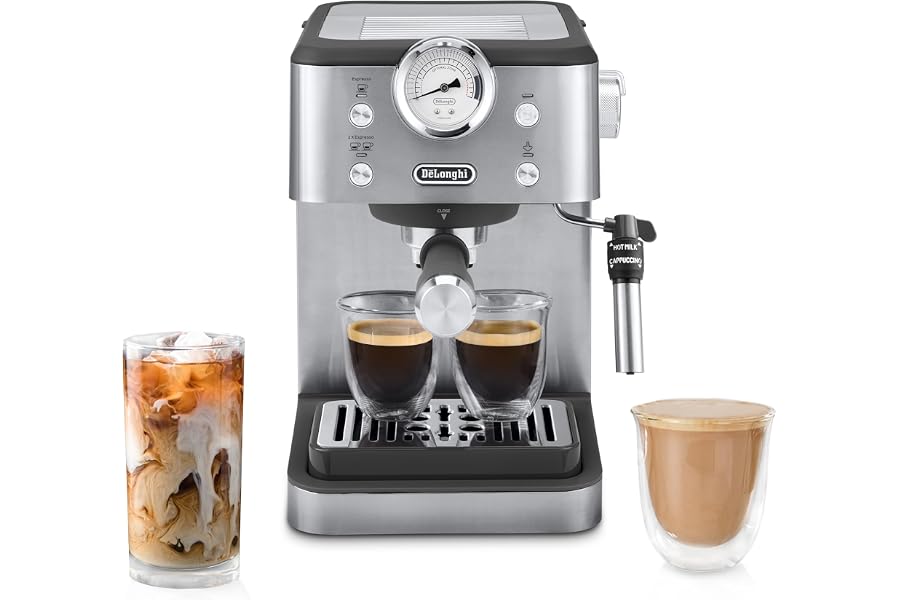
Best straightforward manual machine with a pressure gauge
1. De’Longhi Classic Signature EM450M
The Classic Signature is a manual espresso machine for someone who wants to learn the basics without moving straight to a separate grinder-and-machine setup. De’Longhi lists a 15-bar pump, thermoblock heating, customizable single- and double-shot presets, a chrome-detailed pressure gauge, and a two-setting steam wand for steamed or frothed milk. It is a two-drink machine rather than a one-touch bean-to-cup system.
The gauge can help you see what happens during extraction, but it is not a substitute for a good grind, dose, and tamp. You still need to learn how the coffee behaves and adjust your recipe. It is a more approachable manual route than a machine with a built-in grinder, but you should budget for a grinder if you plan to use fresh whole beans.
- 15-bar pump and thermoblock heating system.
- Customizable single- and double-shot presets with a visual pressure gauge.
- Two-setting steam wand; no built-in grinder.
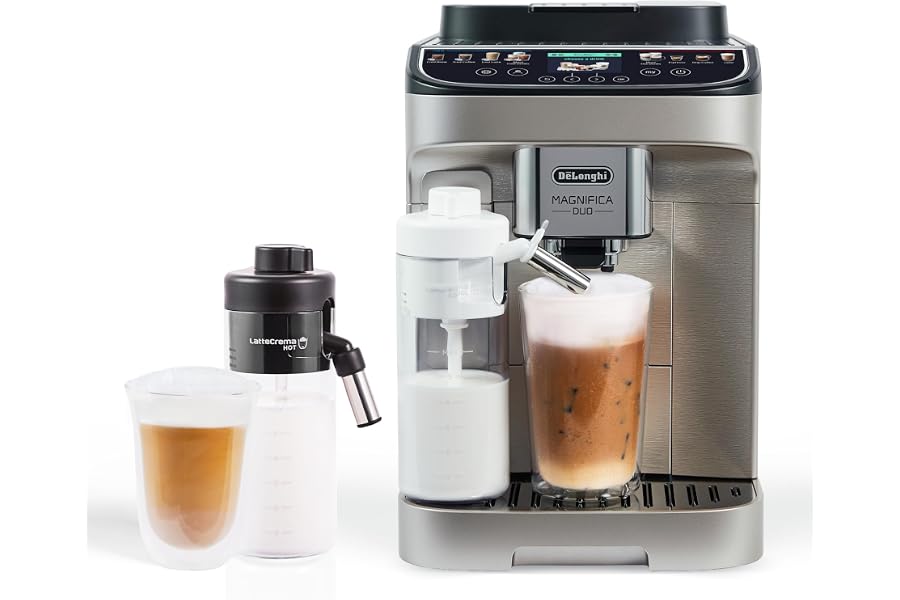
Best one-touch convenience for households that make several drink styles
2. De’Longhi Magnifica Duo Fully Automatic
The Magnifica Duo is the fully automatic option in this group. It grinds, doses, brews, and froths with one-touch controls, and De’Longhi lists 20 preset recipes across espresso, drip coffee, iced drinks, cold brew, and milk-based beverages. Its LatteCrema Hot and Cool systems make hot or cold milk foam automatically, so you do not need to texture milk manually with a steam wand.
That convenience comes with a larger footprint, a higher purchase cost, and more parts to rinse and maintain. The grinder and milk system need regular cleaning, and you give up some of the hands-on control that makes a semi-automatic machine appealing to people who enjoy dialing in a shot. It is best for a household that values variety and repeatability over barista practice.
- Fully automatic bean-to-cup system with integrated grinder.
- 20 preset recipes and LatteCrema Hot & Cool milk systems.
- More convenient than a manual machine, but larger and more involved to maintain.
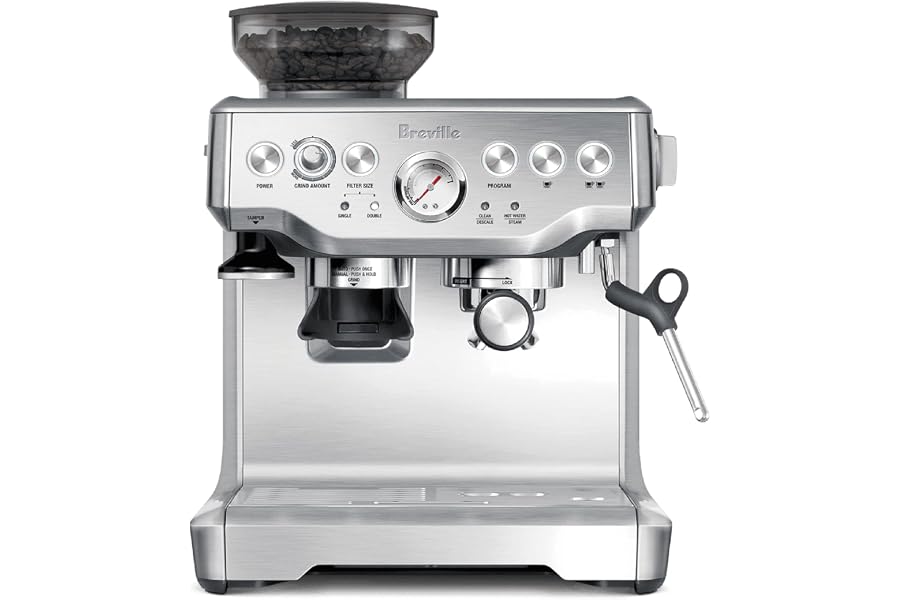
Best all-in-one manual setup for a home barista who wants to learn
3. Breville Barista Express BES870XL
The Barista Express combines an espresso machine and a conical burr grinder in one body. Breville lists 16 grind settings, dose control, an 18g dose through its 54mm portafilter, low-pressure pre-infusion, PID temperature control, and a manual steam wand for milk texture. The Amazon listing gives a 67oz water tank, a half-pound bean hopper, and 1,600W power.
It is a stronger fit for someone who wants to adjust grind size, dose, and extraction rather than press one button and walk away. The built-in grinder saves counter space, but it does not remove the learning curve: you still need to dial in the beans, distribute and tamp the coffee, and clean the grinder and steam wand.
- Integrated conical burr grinder with 16 settings.
- 54mm portafilter and 18g dose; PID temperature control and low-pressure pre-infusion.
- Manual steam wand, 67oz water tank, and 1,600W listed power.
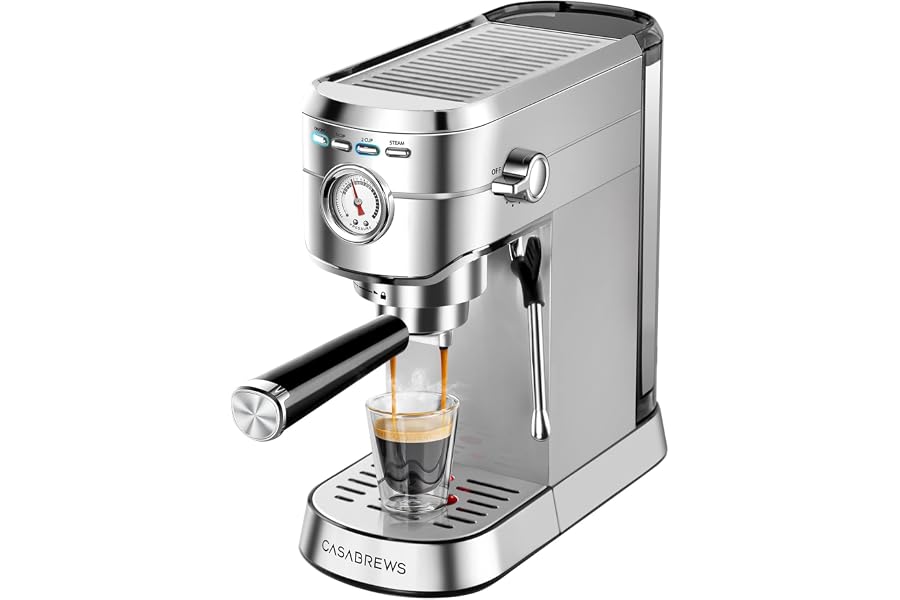
Best lower-cost compact machine if you already own a suitable grinder
4. CASABREWS CM5418 Compact Espresso Machine
The CM5418 is a compact manual machine with a stainless-steel finish, built-in pressure gauge, steam wand, and removable 34oz water tank. The Amazon listing advertises a 20-bar pump and 1,350W power; CoffeeNess identifies a 51mm portafilter and pressurized filter baskets, and lists no built-in grinder. That makes it more of an entry point for pre-ground coffee or a separate grinder than a complete bean-to-cup setup.
The 20-bar pump figure is not the pressure the coffee puck should experience during a normal shot. A pump’s maximum rating and the brew pressure at the group are different measurements. Treat the gauge as a visual aid, not proof that the machine extracts better than a 15-bar model.
- 20-bar pump rating, built-in pressure gauge, and 34oz removable water tank.
- 51mm portafilter and pressurized baskets; no built-in grinder.
- 1,350W listed power and manual steam wand; check the current color and variant.
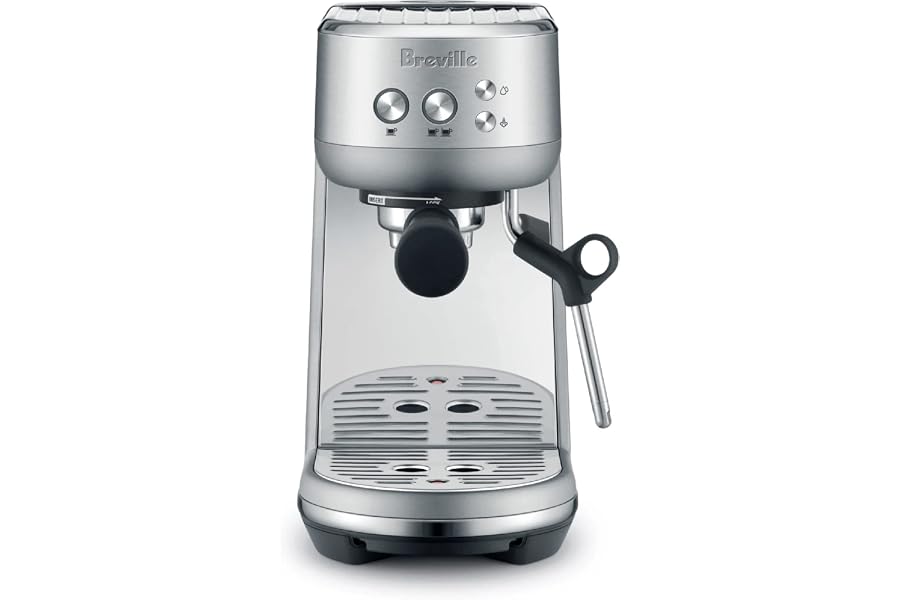
Best compact machine if you want fast heat-up and already have a grinder
5. Breville Bambino BES450BSS
The Bambino is designed for a smaller counter and a quick start. Breville’s official page lists its ThermoJet heating system as ready in about three seconds, a 54mm portafilter with an 18g dose, low-pressure pre-infusion, PID temperature control, and a powerful manual steam wand. The base Bambino does not include a grinder, so factor that into the total setup cost.
It is important not to confuse the Bambino with the Bambino Plus. Breville describes the base BES450 as having a manual steam wand; the Plus model is the one that adds an automatic steam wand. That distinction changes how much hands-on milk work you need to do.
- ThermoJet heat-up in about three seconds, according to Breville.
- 54mm portafilter designed for an 18g dose, with PID and low-pressure pre-infusion.
- Manual steam wand and no built-in grinder; do not confuse it with the Bambino Plus.
How to choose an espresso machine for home
1. Decide whether you want manual control or one-touch drinks
A semi-automatic machine gives you more control over the recipe. You grind the coffee, dose it into the portafilter, distribute and tamp it, start the shot, and stop it when you want. That takes practice, but it also lets you adjust the result as you change beans. A fully automatic machine handles more of those steps internally and is easier for a household where several people want a consistent drink without learning the process.
There is no shame in choosing convenience. A one-touch machine can be a better everyday purchase if you make several drinks before work and do not want to manage a grinder and portafilter. The trade-off is a higher purchase cost and more internal parts to clean, including the brew group and milk system.
2. Work out the grinder question before comparing machine prices
Freshly ground coffee is a major part of espresso quality. If a machine does not include a grinder, you need a separate burr grinder that can produce a consistent fine grind and make small adjustments. A basic blade grinder is not a substitute. That extra purchase can change which machine is the better value once you compare the full setup rather than the machine alone.
The Barista Express includes a conical burr grinder, which saves space and keeps the workflow together. The Bambino, De’Longhi Classic, and CASABREWS CM5418 do not include one. The Magnifica Duo has an integrated grinder and automates dosing as part of its bean-to-cup process.
3. Choose a milk system you will actually use
A manual steam wand gives you control over milk texture but takes practice and requires you to clean the wand after each use. Automatic milk systems are easier for repeatable cappuccinos and lattes, but they add a carafe or milk path that needs regular rinsing and deeper cleaning. If you mostly drink straight espresso or americanos, paying extra for an automatic milk system may not be worthwhile.
4. Check portafilter and basket style
Portafilter diameter affects accessory compatibility. Breville’s machines in this comparison use a 54mm portafilter; the CASABREWS CM5418 is commonly listed with a 51mm portafilter. Baskets also matter. Pressurized baskets can make pre-ground coffee more forgiving, while single-wall baskets give you more control when the grinder and grind size are dialed in. Before buying a tamper, dosing funnel, or replacement basket, confirm the exact diameter and basket type for your machine.
5. Measure the machine and allow room for the workflow
Do not measure only the machine body. You need room to remove the water tank, open the bean hopper, lift the lid, fit a mug, and use the steam wand. A machine with a side-loading water tank may be awkward under a low cabinet. A built-in grinder can save space, but the machine itself may be wider or deeper than a compact manual model.
Pump pressure, grinders, and milk: three specifications that are easy to misread
A 20-bar pump rating does not mean the coffee is brewed at 20 bar
Retail listings often highlight 15-bar or 20-bar pumps. Those are pump ratings, not a direct measure of the pressure the coffee bed experiences during a normal extraction. A machine’s internal design, pressure regulation, basket, grind, and puck resistance all influence the brew. A higher maximum pump number does not automatically produce better espresso. Seattle Coffee Gear’s pressure explainer is useful background if the numbers on a listing are confusing.
Fast heat-up is not the same as the whole machine being ready for every task
Breville advertises a three-second ThermoJet heat-up for the Bambino. That means the heating system reaches its brewing temperature quickly; it does not mean every part of the workflow is finished in three seconds. You still need to grind, prepare the puck, pull the shot, and steam milk if you want a latte. Speed is valuable, but it is only one part of the experience.
Automatic milk foam saves effort, not cleaning
A milk carafe can make drinks consistent, but milk residue needs attention. Rinse the milk system after use and follow the machine’s cleaning cycle. A manual wand has fewer internal milk passages, but it should be purged and wiped immediately after steaming. The easiest system is the one whose cleaning routine you will actually follow.
Buying mistakes that are easy to avoid
- Buying a machine before pricing the grinder. A separate grinder can be a significant part of a manual setup.
- Choosing by pump-bar number. A 20-bar label is not a guarantee of better extraction than a 15-bar machine.
- Confusing the Bambino and Bambino Plus. The base Bambino has a manual steam wand; the Plus adds automatic milk texturing.
- Assuming a built-in pressure gauge measures everything. It is a visual cue, not a complete assessment of grind, dose, and puck preparation.
- Ignoring milk-system maintenance. Automatic carafes and manual wands both need cleaning after use.
- Buying accessories before checking diameter. Portafilters and baskets are not all the same size.
For the next part of the decision, see a beginner home coffee bar setup.
A complementary countertop appliance comparison is covered in a complementary countertop appliance comparison.
Frequently asked questions
Do I need a separate grinder for an espresso machine?
If you buy a machine without a built-in grinder and want to use fresh whole beans, yes. Choose a burr grinder designed for espresso and fine adjustment. You can use pre-ground coffee with compatible pressurized baskets, but the result and flexibility are different from dialing in freshly ground beans.
Is a 20-bar espresso machine better than a 15-bar machine?
Not automatically. Pump maximum pressure and pressure at the coffee puck during extraction are different things. A higher number on the box is not a quality score. Look at the machine’s design, basket type, temperature control, grinder, and the consistency of the workflow.
What is the difference between semi-automatic and fully automatic espresso machines?
A semi-automatic machine expects you to prepare the coffee and control the shot. A fully automatic bean-to-cup machine grinds and brews at the touch of a button and may automate milk as well. Semi-automatic machines offer more hands-on control; fully automatic models prioritize convenience and repeatability.
Is the Breville Bambino a good first espresso machine?
It can be a good compact starting point if you already have, or plan to buy, a suitable grinder. The base Bambino heats quickly and uses a 54mm portafilter, but it does not include a grinder and its steam wand is manual. If you want automatic milk texturing, compare it with the Bambino Plus rather than assuming the two are identical.
Can I make espresso with pre-ground coffee?
Some machines include pressurized baskets that are more forgiving with pre-ground coffee. They can be convenient, especially at the beginning, but they do not give the same control as a grinder and single-wall basket. Check the accessories supplied with the exact machine and choose a grind intended for espresso.
Bottom line
For one-touch convenience and a wide drink menu, the Magnifica Duo is the clear automatic option. For a hands-on setup, the Barista Express includes the grinder, while the Bambino is a smaller machine that pairs well with a separate grinder. The De’Longhi Classic Signature adds a pressure gauge and straightforward milk wand, and the CASABREWS CM5418 keeps the entry cost lower if you are comfortable with its smaller portafilter and separate grinder requirement.
If you are building a complete coffee corner, our home coffee bar guide covers the grinder, scale, accessories, and storage that sit around the machine.