
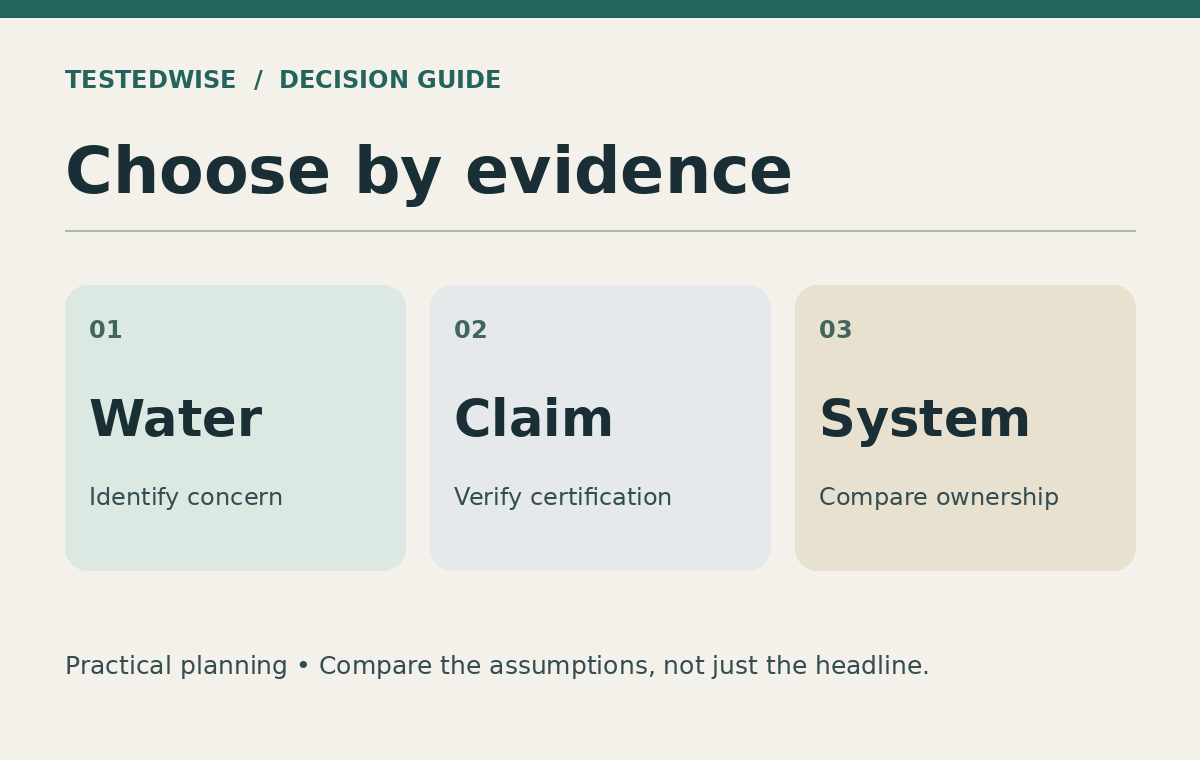
The expensive mistake in water filtration is buying a technology before identifying what you need it to remove. If your municipal tap water is safe and the complaint is chlorine taste, a certified carbon system may be quite enough. If a test identifies a dissolved contaminant that carbon doesn't adequately reduce, a membrane-based system with the right verified claim may be more appropriate. The label matters more than the number of stages.
How carbon and reverse osmosis differ
| Decision | Activated carbon | Reverse osmosis (RO) |
|---|---|---|
| Mechanism | Adsorption on carbon surfaces | Pressure drives water through a membrane |
| Typical use | Taste, odor and specified chemical reduction | Specified dissolved substances and other certified reductions |
| Waste stream | Ordinarily no continuous reject stream | Produces treated water plus reject water |
| Installation | Often inline with existing or separate faucet | Typically requires drain connection; some need tank or power |
| Maintenance | Replace cartridge on time or rated volume | Prefilters, membrane and sometimes postfilter |
A carbon block can also physically trap some particles, depending on construction. Its effectiveness differs by contaminant, flow and cartridge life. Reverse osmosis can reduce many dissolved substances, but the membrane is only one part of a system that must be maintained. Do not assume that any device with either technology is effective against every chemical or microorganism.
Start with the water problem
Obtain your utility's water quality report if served by public water, or arrange appropriate testing if you use a private well. A report describes the supply, not necessarily contamination introduced by plumbing in your home. If there is a lead concern, for example, tap-specific testing and professional advice may be necessary. A taste or a low TDS reading cannot establish that drinking water is safe.
| Concern | Next thing to verify |
|---|---|
| Chlorine taste or odor | A system listing the relevant aesthetic reduction claim |
| Lead | A certification for lead reduction on the exact model and cartridge |
| Nitrate, arsenic or fluoride | A verified reduction claim for the specific contaminant and water conditions |
| PFAS | Exact substances and claims in the current certification listing |
| Microbiological safety or boil-water notice | Local public health guidance; do not rely on a generic under-sink filter |
NSF/ANSI 42 addresses aesthetic effects; 53 addresses specified health-related reductions; 58 covers RO systems. A standard number alone doesn't prove a device removes every contaminant covered by that standard. Verify the listing for the exact system and compatible replacement cartridge. Follow the authority's instructions during a water emergency; this guide is for ordinary household selection, not emergency treatment.
Compare installation before you order
Look inside the cabinet with the door open. Record space for cartridge changes, shutoff access, a storage tank if needed, faucet connection and drain routing. A slim carbon system may suit a rental with permission for a reversible installation. Some RO systems are tankless and require electricity or a pump; others use a pressure tank. Check the water pressure, temperature and feed-water requirements in the manual. A qualified installer may be appropriate if plumbing modifications are needed.
Check the treated-water flow at the stated conditions. A large daily membrane production rating doesn't necessarily mean a fast glass fill; tank pressure and draw pattern matter. Compare actual faucet flow where available and whether the filter fits your daily cooking and drinking needs.
Estimate ownership cost over the same period
Suppose a carbon system costs $120 plus two $45 cartridges a year, and an RO system costs $280 plus $85 in annualized replacement parts. Three-year equipment and filter totals would be $390 and $535 respectively, before installation, water, electricity and repairs. Those are hypothetical amounts; look up actual replacement schedules and prices for your selected model. Include membrane replacements when due rather than spreading an arbitrary cost across each year.
RO recovery is the portion of incoming water delivered as treated water. A hypothetical 40% recovery unit supplying two gallons a day uses five gallons of feed water and rejects three. Actual ratings may use a different test condition or efficiency definition. EPA WaterSense identifies qualifying point-of-use RO systems that meet efficiency and performance criteria; compare the exact system's published efficiency rather than assuming all RO devices use the same water ratio. Our ownership cost calculator lets you enter the figures from your chosen model.
Frequently asked questions
Does carbon remove dissolved minerals or hardness?
Ordinary activated carbon isn't a general-purpose hardness treatment. If scale is the issue, identify hardness and the appropriate treatment separately. RO can reduce some dissolved minerals, but performance depends on the system and feed water.
Is reverse osmosis always better than carbon?
No. A certified carbon unit may address the specific concern at lower cost and complexity. RO is useful when its verified reduction claims match a need that simpler treatment does not meet.
Should I choose by TDS reduction alone?
No. TDS is an aggregate measurement of dissolved substances, not a contaminant-specific safety test. Check your water report, testing and the certification for the problem you are trying to solve.