
Buying Guide · Home & Kitchen
Best Under-Sink Water Filters: 5 Carbon & Reverse Osmosis Systems Compared
A useful under-sink filter is the one that matches the contaminants in your water, fits under your sink, and has a replacement schedule you will actually follow. These five systems cover the main choices: direct-connect carbon, multi-stage carbon, tank RO, and tankless RO.
Affiliate disclosure: This article contains affiliate links. TestedWise may earn a commission if you purchase through them, at no additional cost to you. Read the full disclosure.
There is no single under-sink filter that is automatically best for every kitchen. A family trying to reduce chlorine taste has a different problem from a household whose water report shows lead, nitrate, or PFAS. A five-stage reverse-osmosis system is not automatically a better purchase than a smaller carbon filter if the extra treatment is not needed.
We compared five models that represent genuinely different buying decisions. The focus is on exact model documentation, certification scope, flow and capacity, installation requirements, and the cost of keeping the system running. We did not treat a long list of marketing claims or a large number of filter stages as proof of performance.
Quick picks
- Best non-RO option with detailed reduction data: Aquasana Claryum 3-Stage Max Flow AQ-5300+.
- Best tankless RO layout: Waterdrop G3P600.
- Best traditional tank RO: APEC ROES-50.
- Best for remineralized RO water: iSpring RCC7AK-BN.
- Best simple direct-connect filter: Waterdrop WD-10UA, for taste and odor rather than a certified lead/PFAS use case.
The five systems at a glance
| Model | Filter type | Published capacity / flow | Certification detail | Best fit |
|---|---|---|---|---|
| Aquasana AQ-5300+ | 3-stage carbon | 800 gal; 0.72 GPM | NSF/ANSI 42, 53, 401 | Targeted reductions without RO |
| Waterdrop G3P600 | Tankless RO | 600 GPD rated; 2:1 pure-to-drain | IAPMO: 42, 53, 58; 372 low-lead materials | RO with a compact footprint |
| APEC ROES-50 | 5-stage tank RO | 50 GPD at 60 psi; 4-gal tank | WQA Gold Seal; manufacturer specifies TDS testing | Conventional RO layout |
| iSpring RCC7AK-BN | 6-stage alkaline RO | 75 GPD rated | iSpring lists NSF/ANSI 58 for the RCC7AK family | RO with a remineralization stage |
| Waterdrop WD-10UA | Direct-connect carbon | 8,000 gal on Amazon title / 11,000 gal on current manufacturer page; 12-month limit | NSF/ANSI 42 and 372 listing | Simple taste-and-odor filtration |
These figures are not interchangeable. A 600-GPD tankless RO rating and a 50-GPD tank RO rating are measured under different operating conditions and designs. The carbon filters' gallon limits are replacement-capacity limits, not daily production ratings. Always compare the exact model's performance sheet, not just the biggest number in a product title.
Five under-sink filters worth comparing
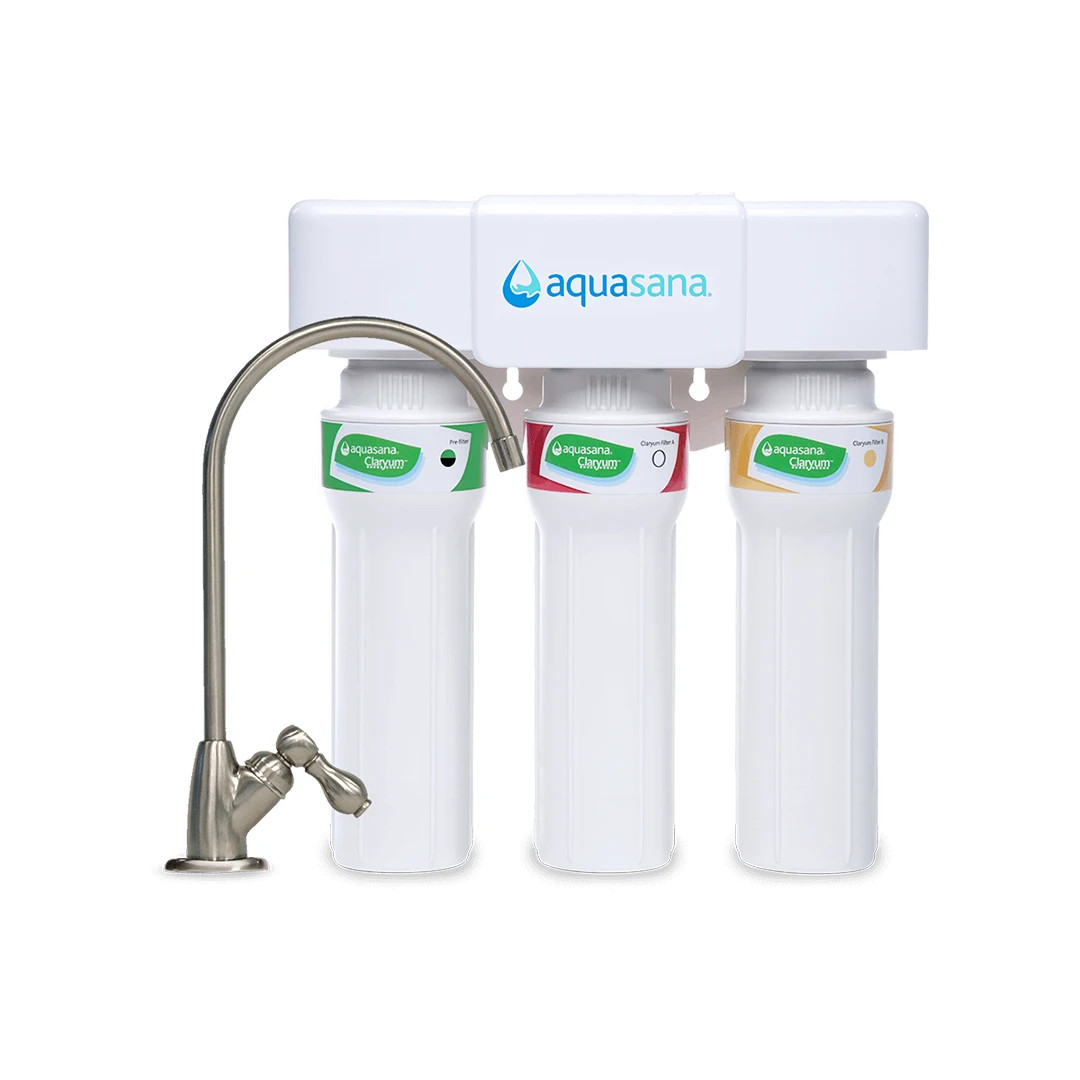
Best non-RO option for targeted contaminant reduction
1. Aquasana Claryum 3-Stage Max Flow (AQ-5300+)
The AQ-5300+ is the strongest choice in this group when you want a carbon-based system with a clearly documented list of reductions but do not want the water waste, storage tank, or power connection associated with reverse osmosis. It uses three filter cartridges and a separate drinking-water faucet.
Aquasana's current performance data sheet rates the system for 800 gallons and 0.72 gallons per minute. It lists testing to NSF/ANSI 42, 53, and 401, including chlorine, chloramine, lead, mercury, cysts, PFOA/PFOS, and a defined group of emerging compounds. Those are model-specific claims, not a promise that every Claryum product removes the same substances.
The main trade-off is maintenance: the rated capacity is 800 gallons or six months, whichever comes first. A household that uses the filtered tap heavily may reach the gallon limit before the calendar reminder. It also needs space for three cartridges and a hole or compatible opening for the dedicated faucet.
- Good for: Households that want a published, contaminant-specific performance sheet without switching to RO.
- Why it makes the list: The model's own data sheet gives measurable reduction results and a rated capacity, rather than relying only on broad front-of-box language.
- Trade-off: Three cartridges, a separate faucet, and a six-month/800-gallon replacement limit.
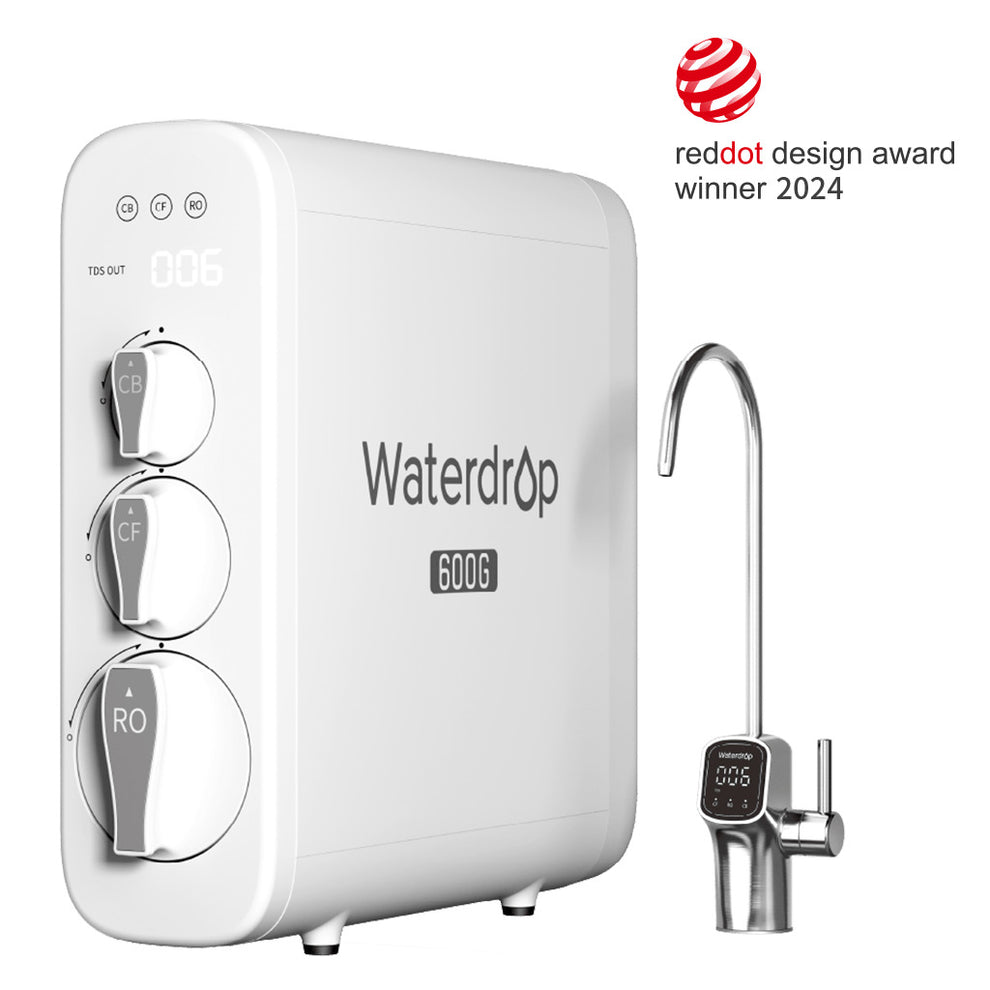
Best tankless reverse-osmosis system
2. Waterdrop G3P600 Tankless RO System
The G3P600 is the space-saving RO option. It removes the traditional pressurized storage tank and uses a powered, multi-stage unit with a smart faucet that displays water-quality information. Waterdrop rates it at up to 600 gallons per day and advertises a 2:1 pure-water-to-drain-water ratio.
The exact WD-G3P600 performance sheet hosted for the model identifies IAPMO R&T certification to NSF/ANSI 42, 53, and 58, plus NSF/ANSI 372 for low-lead materials. It lists chlorine and PFOA/PFOS reduction under the relevant standards, and TDS reduction under Standard 58. The same sheet separately lists laboratory results for some Standard 401-style emerging compounds; those extra results should not be described as NSF/ANSI 401 certification.
A tankless layout frees cabinet space and avoids waiting for a small storage tank to refill, but the unit needs an electrical outlet, a drain connection, and room for the filter housing. Waterdrop's replacement schedule lists different intervals for the carbon and RO elements, so the cost is not one simple annual cartridge purchase.
- Good for: People who want RO filtration, a tankless layout, and a fast rated production capacity.
- Why it makes the list: It combines a documented model-specific certification sheet with a clear tankless design and stated wastewater ratio.
- Trade-off: It needs power and a drain, and the replacement filters have different service intervals. The 600-GPD figure is a rated maximum, not a promise of that output under every home's pressure and temperature.

Best traditional tank-style RO system
3. APEC Water ROES-50 Essence 5-Stage RO System
The ROES-50 is a conventional five-stage reverse-osmosis system: sediment and carbon prefilters, an RO membrane, and a final carbon filter feed a pressurized storage tank and a dedicated faucet. APEC rates it at 50 gallons per day at 60 psi and includes a nominal four-gallon tank.
APEC describes the system as WQA Gold Seal certified and specifically says its certification testing covers TDS reduction. That is useful third-party evidence, but it is not a reason to assume that every contaminant in the manufacturer's broad marketing list has an individually certified reduction claim. For a contaminant such as PFAS, ask for the exact current certificate and performance sheet rather than relying on a general 'up to 99%' statement.
This design does not need electricity for normal operation, but the tank takes up cabinet space and the rated production rate is far below a tankless system's headline GPD figure. APEC's direct store showed the model as sold out during this review, while marketplace tracking continued to show an Amazon listing. Check the seller, warranty, and stock status before ordering.
- Good for: A household that prefers a familiar tank-based RO layout and standard replacement parts.
- Why it makes the list: The 50-GPD rating, tank size, stage layout, and WQA certification are documented by the manufacturer.
- Trade-off: It occupies more cabinet space, has a slower rated production rate, and direct-from-manufacturer availability can change.

Best for buyers who want remineralization
4. iSpring RCC7AK-BN 6-Stage Alkaline RO System
The RCC7AK-BN adds an alkaline remineralization stage after reverse osmosis. That stage is intended to add minerals back and adjust the taste of the water after the membrane has reduced dissolved solids. It is a preference feature, not a medical or nutritional reason to buy the system.
The RCC7AK family is listed by iSpring as a 75-GPD, six-stage system with NSF/ANSI 58 certification. It uses a storage tank and a separate faucet, so installation and cabinet-space requirements are closer to a traditional RO system than to a direct-connect carbon filter. The Amazon listing used for this comparison is the brushed-nickel-faucet RCC7AK-BN variant; check the suffix because faucet finish and bundle details can differ.
The extra stage is not free to maintain. Check the replacement schedule for the prefilters, membrane, post-carbon filter, and alkaline cartridge before deciding that remineralization is worth the extra recurring cost.
- Good for: People who prefer the taste of remineralized RO water and want a six-stage system.
- Why it makes the list: It offers a clearly defined 75-GPD RO platform with an added remineralization stage.
- Trade-off: More filter elements to track, a storage tank, and a need to verify the exact model suffix and replacement set.

Best simple direct-connect carbon filter
5. Waterdrop WD-10UA Under-Sink Direct-Connect Filter
The WD-10UA is the simplest installation in this comparison. It connects to the cold-water line and sends filtered water through the existing kitchen faucet, so there is no separate faucet, tank, power cord, or RO drain line. That makes it a practical option when the main goal is improving the taste and smell of municipal tap water.
The certification distinction matters. The model listing we checked identifies NSF/ANSI 42 for aesthetic effects and NSF/ANSI 372 for low-lead materials. Standard 372 is about the lead content of wetted components; it does not mean the filter is certified to remove lead from drinking water. We did not treat the product title's broader lead/PFAS wording as a substitute for a model-specific Standard 53 reduction claim.
There is also a capacity discrepancy worth checking: the Amazon listing title we reviewed says 8,000 gallons, while Waterdrop's current product page states up to 11,000 gallons or 12 months. Use the performance sheet and cartridge label supplied with the exact version you receive, and replace it at the earlier limit.
- Good for: A straightforward taste-and-odor upgrade on a compatible cold-water line.
- Why it makes the list: It is compact, does not require a dedicated faucet, and has a simple direct-connect layout.
- Trade-off: It is not an RO system and should not be chosen as a certified lead/PFAS solution without a separate, exact contaminant-reduction claim.
Carbon filtration or reverse osmosis?
For many municipal-water homes, a certified carbon filter is enough. Carbon media can improve chlorine taste and odor, and some systems have specific certifications for lead, cysts, PFOA/PFOS, or other named contaminants. The important phrase is specific certifications: a carbon filter certified only to Standard 42 should not be treated as a lead-removal system.
Reverse osmosis pushes water through a semi-permeable membrane and can reduce total dissolved solids along with the contaminants named in its performance data sheet. That broader treatment comes with trade-offs. Tank systems need room for a storage tank and usually a drain connection. Tankless systems save space but need electricity. Both create reject water, and RO membranes and prefilters need regular replacement.
Do not buy RO just because the number of stages sounds impressive. If your main complaint is chlorine taste, a direct-connect or multi-stage carbon filter may be simpler, waste less water, and cost less to maintain. If your water report points to a contaminant that the chosen carbon model is not certified to reduce, then a suitable RO system or a filter with an exact reduction claim may be the better route.
RO water efficiency is part of the buying decision
Reverse osmosis creates a treated-water stream and a reject-water stream. The U.S. EPA says a typical point-of-use RO system can send five gallons or more down the drain for every gallon of treated water. EPA WaterSense-labeled RO systems must meet a much tighter limit: no more than 2.3 gallons of reject water per gallon of treated water. That is a meaningful difference if your household uses several gallons of filtered water each day.
Do not assume that a manufacturer's advertised pure-to-drain ratio is the same thing as an EPA WaterSense label. For example, a stated 2:1 pure-water-to-drain-water ratio works out to 0.5 gallon of reject water per gallon of treated water, but it remains a model-specific manufacturer claim unless the exact system is independently listed as WaterSense labeled. Check the current performance sheet and the EPA's labeled-product information before treating the figure as verified efficiency. The Under-Sink Water Filter Cost Calculator now lets you estimate reject-water volume separately from cartridge costs.
For the meaning of the certification numbers, read NSF 42 vs. 53 vs. 58 vs. 401: How to Read Water Filter Certifications. To compare the cost of cartridges, membranes, and replacement intervals over time, use the Under-Sink Water Filter Cost Calculator.
Six checks before you order
- Start with your water report. If you use municipal water, read the latest Consumer Confidence Report and any local advisories. If you use a private well, arrange appropriate lab testing; a municipal report does not describe your well.
- Match the exact contaminant. For lead, look for a named lead-reduction claim under the relevant standard. For PFAS, look for PFOA/PFOS specifically. For nitrate, arsenic, or microbial concerns, do not assume a general carbon filter or generic RO label covers the issue.
- Verify the exact model in a certification directory. Product families can have multiple suffixes, faucet finishes, and replacement cartridges. The certification listing should match the model you are buying.
- Check the plumbing and cabinet space. A dedicated faucet needs an opening; a tank needs room; a tankless RO system needs a nearby outlet; every RO system needs a drain connection.
- Calculate the replacement cost. Compare the full replacement set, not just the first cartridge. If the system has a membrane, post-filter, or remineralization stage, include those parts and their different schedules.
- Check source-water conditions. Pressure, temperature, hardness, sediment, and well-water quality can affect performance and filter life. Follow the manufacturer's operating range and pre-treatment instructions.
A filter is not a substitute for fixing a contaminated water source. If your water has a boil-water notice, microbial contamination, or a contaminant outside the system's certified claims, follow the advice of your water utility or public-health authority first.
For the next part of the decision, see under-sink filter installation and maintenance.
Frequently asked questions
Are under-sink water filters better than pitcher filters?
They are more convenient for a kitchen that uses filtered water throughout the day, and many have higher capacity. A pitcher can still be a sensible lower-cost choice for a renter or a household that only filters a small amount. Compare the exact reduction claims and replacement cost rather than assuming one format is always safer.
Does NSF/ANSI 42 mean a filter removes lead?
No. Standard 42 covers aesthetic effects such as chlorine taste and odor and certain particulate claims. Lead reduction is a separate, health-effects claim that should be verified on the exact model's Standard 53 or other applicable certification listing.
Is reverse osmosis always the best option?
No. RO can be useful when the water report and the system's certified claims justify it, but it adds a drain line, reject water, membrane replacements, and sometimes a storage tank or power requirement. A carbon filter with the exact reduction claim may be the simpler fit.
Do under-sink filters remove PFAS?
Some do, but the claim must name the specific PFAS compounds and match the exact model's certification or performance data sheet. A product title that mentions PFAS is not enough on its own.
How often should I replace an under-sink filter?
Use the earlier of the rated gallon capacity and the calendar interval. A cartridge that is rated for 800 gallons or six months should not be left in service for a year simply because the household has not used 800 gallons.
Can I install an under-sink filter myself?
Many systems are designed for DIY installation, but the work still involves water-supply fittings, a drain saddle, and sometimes drilling a countertop or sink. If you are unsure about the plumbing, shutoff valves, or countertop material, use a qualified installer and check for leaks after installation.
Sources & further reading
- NSF: Drinking water treatment standards and certification guidance
- EPA: Home drinking water filtration fact sheet
- Aquasana AQ-5300+ Claryum 3-Stage Max Flow performance data sheet
- Waterdrop WD-10UA under-sink filter product information
- Waterdrop WD-G3P600 performance data sheet and model certification details
- APEC Water ROES-50 official product information
- iSpring RCC7AK 6-stage alkaline RO system product information
- Consumer Reports: Water filter testing and buying guidance
- Amazon listing: Waterdrop WD-10UA (ASIN B083NPW1DN)
- Amazon listing: Aquasana AQ-5300+ (ASIN B06XGZMTRH)
- Amazon listing: APEC ROES-50 (ASIN B00I0ZGOZM)
- Amazon listing: iSpring RCC7AK-BN (ASIN B005LJ8EXU)
- Amazon listing: Waterdrop G3P600 (ASIN B07P1XFYJP)
- U.S. EPA WaterSense: Point-of-Use Reverse Osmosis Systems and efficiency limits
Content reviewed: Nov 20, 2026