
A robot lawn mower can take the routine out of keeping grass short, but choosing one is less like buying a regular push mower and more like choosing a navigation system for your yard. Some models follow a physical boundary wire. Others use satellite positioning, cameras, LiDAR, or a combination of sensors. Those differences matter when your lawn has trees, narrow passages, slopes, garden beds, or more than one mowing zone.
Affiliate disclosure: This article contains affiliate links. TestedWise may earn a commission if you purchase through them, at no additional cost to you. Read the full disclosure.
For this guide, we compared five current Amazon US listings with manufacturer specifications and independent product testing from Reviewed and Bob Vila. The lineup includes a simple vision-only mower for a small lawn, a network-RTK all-wheel-drive model, a traditional boundary-wire option, a dual-LiDAR mower with an automatic edge trimmer, and a premium mower designed for steep terrain. This is a specification-led buying guide, not a TestedWise hands-on test. Where an independent publication tested a related predecessor rather than the exact current listing, that distinction is stated.
Robot lawn mower comparison: five different approaches
| Model | Published lawn area | Navigation | Slope rating | Best fit |
|---|---|---|---|---|
| Eufy E15 | 0.2 acre | Camera-based vision | 18° | Small, mostly flat lawns and simple setup |
| Segway Navimow i210 AWD | 0.25 acre | Network RTK + vision | 45% / about 24° | Small yards with slopes and clear Network RTK coverage |
| WORX Landroid L WR155 | Up to 0.5 acre | Physical boundary wire | 30% / about 17° | Tree-covered yards and buyers who accept wire installation |
| ECOVACS GOAT A3000 LiDAR PRO | 0.75 acre | Dual LiDAR + AI camera | Published figures conflict; verify the current manual | Large lawns where automated edge trimming matters |
| Mammotion LUBA 3 AWD 3000 | 0.75 acre | 360° LiDAR + NetRTK + dual-camera AI vision | 80% / about 38.6° | Steep, uneven, or complex larger lawns |
These lawn-area figures are manufacturer recommendations, not a promise that every yard of that size will be completed in one battery cycle. Trees, narrow corridors, several separate zones, steep sections, long grass, and frequent interruptions all reduce practical coverage. If your measured grass area is close to a model's maximum, compare the next size up before ordering.
Also keep in mind that a robot mower is a maintenance tool. It is designed to clip a little grass frequently, not to turn an overgrown lawn into a neat one in a single pass. If the grass is already tall, use a conventional mower first and let the robot maintain the height afterward.
The five robot lawn mowers worth comparing

Best for a small, mostly flat lawn
1. Eufy E15 Robot Lawn Mower
The E15 is the most approachable option here if you want to avoid both a perimeter wire and a separate RTK antenna. It uses camera-based visual navigation to map the lawn and identify its boundaries. Eufy recommends it for up to 0.2 acre, with an 8-inch cutting width, an adjustable 1-to-3-inch cutting height, and a maximum slope rating of 18 degrees. The official specification also lists IPX6 water resistance and a 90-to-110-minute charging time.
That simpler setup has a trade-off: the mower needs to interpret the lawn from what its cameras can see. Bob Vila's hands-on E15 test found setup straightforward and obstacle avoidance effective, but noted that it worked best on low-growing grass and struggled with thicker, taller fescue. The publication also reported a Wi-Fi range of about 50 feet in its test environment. Those are useful limitations to consider if your lawn has dense grass, complicated edges, or weak coverage near the far side of the yard.
The E15 is not an all-terrain mower. Its 18-degree limit is fine for gentle grades, but it is not the model to buy for a steep bank. It makes more sense for a compact, relatively open lawn where you value a simple mapping process over maximum acreage or climbing ability. Keep the grass within the mower's cutting-height range and expect to touch up some edges manually.
- Recommended lawn area: 0.2 acre; 8-inch cutting width.
- Camera-based mapping; no boundary wire or RTK antenna required.
- Best on lower-growing grass and gentle terrain; verify Wi-Fi coverage across the yard.
View the Eufy E15 Amazon listing · Eufy E15 official specifications · Bob Vila's E15 test notes
Best compact option for slopes and uneven ground
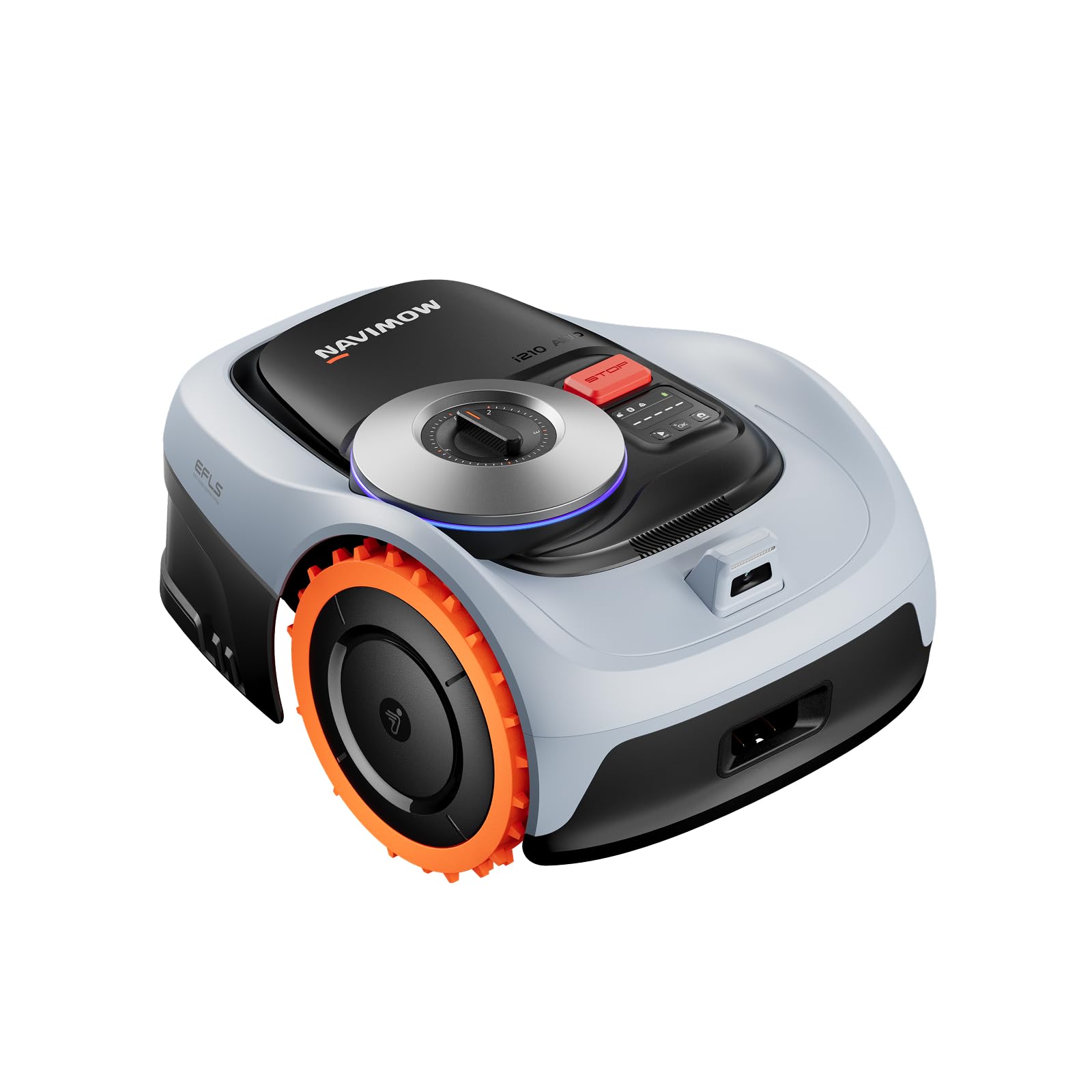
2. Segway Navimow i210 AWD
The Navimow i210 AWD is a stronger match than the E15 when the lawn is small but not perfectly flat. Segway rates it for up to 0.25 acre and a maximum 45% grade, roughly 24 degrees. All-wheel drive and all-terrain tires are designed to improve traction, while the mower combines Network RTK positioning with vision to map and follow virtual boundaries.
The important detail is the word Network. Segway says the i2 AWD can use Network RTK without a locally installed antenna where coverage is available, and that the required cellular data is included at no extra cost. Check the coverage tool for your address before buying. Antenna-free setup is not the same as satellite-free navigation: the mower still depends on GNSS correction and a usable network connection, with vision helping it maintain positioning around obstacles and in cluttered areas.
The i210 is the larger of the two i2 AWD models: the i206 is rated for 0.15 acre, while the i210 is rated for 0.25 acre. Do not confuse their listings or assume that the smaller model has the same battery and area capacity. Segway lists a 7.1-inch cutting width, a 5.1Ah battery for the i210, a 3-year product warranty, and 2-year battery coverage on its current product page.
Choose the i210 when your yard is within its area rating, has moderate slopes or uneven sections, and passes the Network RTK coverage check. If the yard sits under dense tree cover or beside tall buildings, inspect the exact signal conditions and map limitations before relying on a satellite-based system.
- Recommended lawn area: 0.25 acre; 7.1-inch cutting width.
- AWD, all-terrain tires, Network RTK + vision, and automatic mapping.
- 45% maximum grade is a manufacturer rating, not a guarantee on wet, loose, or damaged turf.
View the Navimow i210 AWD Amazon listing · Segway Navimow i2 AWD specifications and coverage check

Best traditional boundary-wire option
3. WORX Landroid L WR155
The WR155 is the contrast to the newer wire-free models. It uses a physical boundary wire to define the mowing area, and the box includes 820 feet of wire and 340 pegs. Worx rates it for lawns up to half an acre, with an 8-inch cutting width, a manual cutting-height range of 1.5 to 3.5 inches, and a maximum slope of 30%. It runs on a 20V PowerShare battery, so the battery platform may also be useful if you already own compatible Worx tools.
A boundary wire takes time to install, but it has one important advantage: it does not need a clear satellite view or a camera to recognize the grass edge. That can make a wired mower worth considering beneath mature trees, beside buildings, or in a yard where satellite reception is inconsistent. The trade-off is that the cable must be laid around the perimeter and any exclusion islands. If you move a garden bed, add a path, or change the mowing area, the wire may need to be adjusted. A damaged cable can also stop the mower from following its boundary.
Be precise about the terminology in the listing. Worx says the WR155 can pass through narrow routes without a guiding wire, but the package still includes a boundary wire. A guide wire helps a mower navigate back to its charging station; a boundary wire defines where it is allowed to mow. The WR155 requires the latter. It is not a perimeter-wire-free mower.
This is the practical pick if you would rather install a cable once than troubleshoot satellite or vision mapping. It is less attractive if you want a fast, no-wire setup or expect your landscaping to change frequently. Check the Amazon listing's model number and battery configuration carefully, because older and newer WR155 bundles can differ in battery capacity and included accessories.
- Recommended lawn area: up to 0.5 acre; 8-inch cutting width.
- Includes 820 feet of boundary wire and 340 pegs; no guide wire is required for narrow-path navigation.
- 30% maximum slope; 20V PowerShare battery; 3-year limited manufacturer warranty.
View the WORX WR155 Amazon listing · Worx WR155 official specifications and box contents
Best for large lawns where edge trimming matters
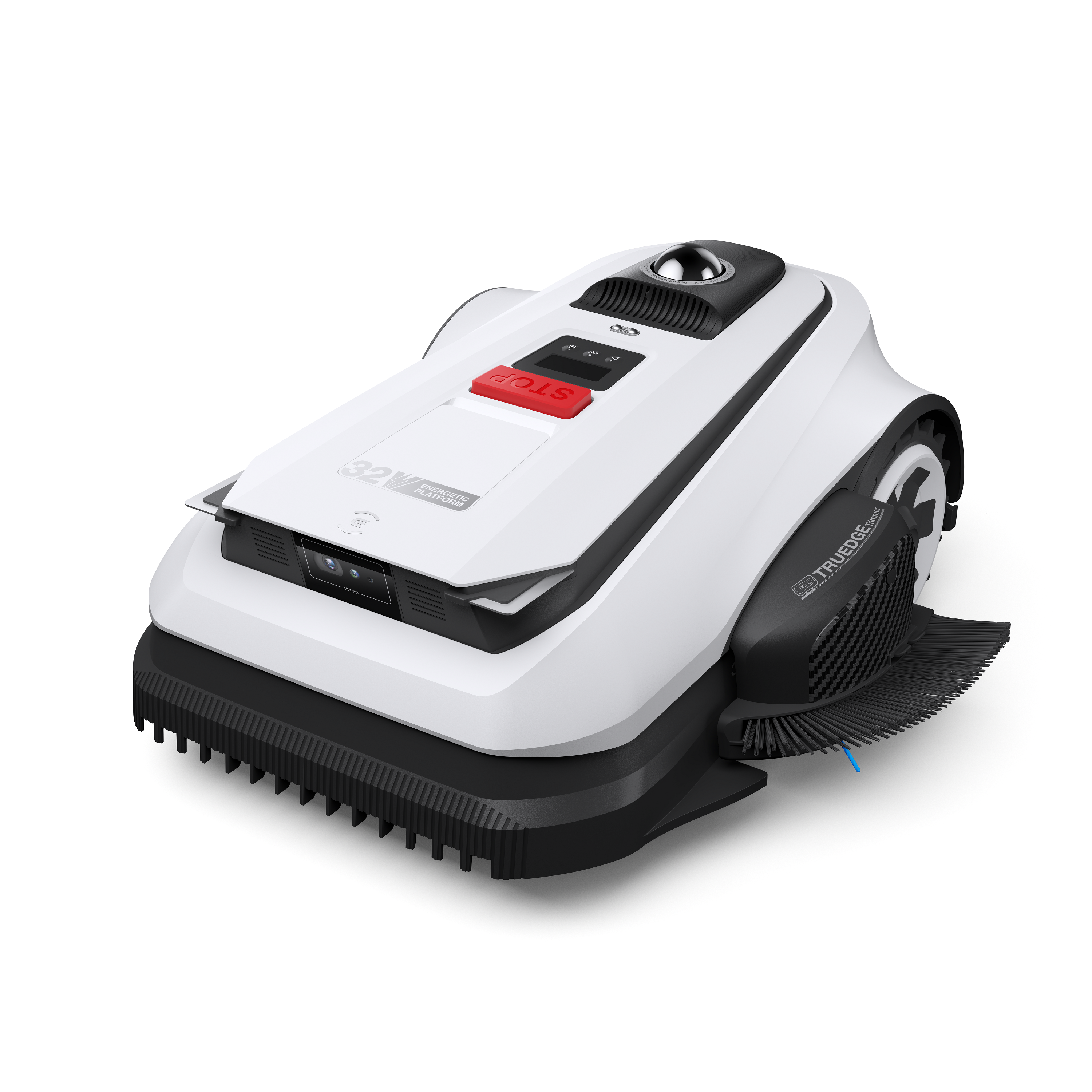
4. ECOVACS GOAT A3000 LiDAR PRO
The GOAT A3000 LiDAR PRO is built around a different problem: not just mowing the center of a large lawn, but getting close to borders without leaving a strip that still needs a string trimmer. It combines a 360-degree rotating LiDAR unit, a forward 3D ToF LiDAR sensor, and an AI camera. The integrated TruEdge trimmer is designed to reach close to walls, fences, and other edges that a conventional mower deck cannot cut cleanly.
ECOVACS lists the A3000 LiDAR PRO for up to three-quarters of an acre, with a 13-inch cutting width, an adjustable cutting height of about 1.2 to 3.5 inches, a 7.5Ah battery, and a fast-charging system. The manufacturer says it can mow up to 400 square meters per hour and detect more than 200 obstacle types. Those are manufacturer specifications, not independent measurements by TestedWise.
There is a slope-specification issue worth flagging. ECOVACS' current US product page includes a 15-degree figure in one feature section and a 50% (about 27-degree) claim elsewhere; its campaign material also uses the 50% figure. Because the same official product material is inconsistent, we would not buy this mower specifically for a steep bank without confirming the rating for the exact model and current manual with ECOVACS. If steep slopes are your main concern, the LUBA 3 below has a clearer published 80% rating.
Reviewed tested the earlier GOAT A3000 and named it its best overall robot mower. The publication says the A3000 LiDAR PRO is the next-generation replacement with the TruEdge trimmer added. That is useful context for the platform, but it is not a direct hands-on test of the exact LiDAR PRO Amazon listing linked here. The original test also noted that a charging-station roof was not included with the earlier model; check the current bundle contents before checkout.
- Recommended lawn area: up to 0.75 acre; 13-inch cutting width.
- Dual LiDAR + AI camera navigation, integrated TruEdge edge trimmer, and app-based mapping.
- Confirm the current slope specification and charging-station accessories for the exact LiDAR PRO bundle.
View the GOAT A3000 LiDAR PRO Amazon listing · ECOVACS A3000 LiDAR PRO specifications · Reviewed's robot mower test results

Best for steep slopes and complex larger lawns
5. Mammotion LUBA 3 AWD 3000
The LUBA 3 AWD 3000 is the most capable climbing option in this group on paper. Mammotion rates it for up to 0.75 acre and an 80% slope, equivalent to about 38.6 degrees. It uses four-wheel drive and a 360-degree LiDAR sensor, NetRTK positioning, and dual-camera AI vision. Mammotion calls this combination Tri-Fusion navigation. The system is intended to keep the mower oriented across uneven ground and areas where one positioning method alone may be less reliable.
For the 3000 model, Mammotion lists up to 30 mowing zones, a 12-blade dual-disc cutting system, and up to 215 minutes of runtime per charge under its stated conditions. Its iNavi service uses cellular connectivity to provide NetRTK without requiring the owner to install a physical RTK base station. Check cellular coverage at the property and confirm which services are included with the exact Amazon bundle. The linked listing is the 3000 standard version; the 3000H has a different cutting-height range and should not be treated as the same SKU.
The trade-off is size, cost, and setup effort. Reviewed's hands-on test of the LUBA 3 3000S found that assembly took several hours and that the machine was heavy to handle. The reviewer also warned that aggressive AWD tires can dig into turf during tight turns or when the mower becomes stuck on a slope. That matters: a high slope rating does not mean the mower can climb every wet, loose, rutted, or unstable bank without damaging the grass.
Choose the LUBA 3 when your yard genuinely needs AWD and has enough area to justify a premium machine. If your lawn is mostly flat, a smaller mower will usually be easier to install, less expensive, and less demanding to store. Do not pay for a steep-slope rating that your property will never use.
- Recommended lawn area: 0.75 acre for the 3000 model; 30-zone management.
- 360° LiDAR + NetRTK + dual-camera AI vision; no physical RTK base station required for the NetRTK service.
- 80% (38.6°) maximum slope claim; 41 lb product weight and more involved assembly are important ownership considerations.
View the LUBA 3 AWD 3000 Amazon listing · Mammotion LUBA 3 official specifications · WIRED's 2026 robot mower testing
Boundary wire vs. RTK vs. vision vs. LiDAR: what actually changes?
Navigation is the most important technical difference between robot lawn mowers. The right system depends on the shape of the yard and what blocks the mower's view of the sky or the grass edge. A more expensive sensor package is not automatically better for every property.
Boundary wire: a physical map that you install
A boundary-wire mower follows a low-voltage cable installed around the mowing area. You can also create wire loops around flower beds, ponds, trees, and other no-go areas. The installation takes time, and a broken cable can interrupt operation, but the mower does not need satellite correction or a camera to decide where the lawn ends. That can be an advantage under dense tree cover, beside buildings, or in a yard where GNSS reception is unreliable. The WR155 is the wired option in this comparison.
RTK or Network RTK: precise satellite positioning
RTK combines satellite positioning with correction data to improve location accuracy. Some systems use a local reference antenna that must be installed with a reasonably open view of the sky. Network RTK receives correction data over a cellular connection instead, which can remove the need for a local antenna where the service is available. It does not remove the need for usable satellite signals or cellular coverage. Tall buildings, dense canopy, narrow passages, and poor network reception can still affect performance. The Navimow i210 uses Network RTK fused with vision; check its coverage tool before buying.
Vision-only: no wire and no RTK antenna
A vision-based mower uses cameras to recognize the lawn, map boundaries, and identify obstacles. The setup can be simple because there is no cable to bury or RTK base to mount. The limitation is that a camera needs enough visual information to interpret the scene. Low-contrast lawn edges, deep shadows, tall grass, darkness, and visually confusing transitions can make mapping harder. The Eufy E15 is the vision-only choice here, and its independent test results suggest that grass type and yard conditions matter as much as the headline area rating.
LiDAR and sensor fusion: mapping with distance data
LiDAR measures distances using laser light and builds a spatial map from nearby objects. It can be useful under trees or around buildings because it does not depend on a clear satellite view in the same way as RTK. Some products combine LiDAR with cameras and RTK so the mower can use more than one source of position information. The ECOVACS GOAT A3000 uses dual LiDAR and an AI camera; the Mammotion LUBA 3 adds NetRTK and dual-camera vision to its 360-degree LiDAR system. These systems can reduce certain navigation weaknesses, but they also cost more and do not remove the need to inspect maps, set no-go zones, and supervise early mowing sessions.
In short: choose boundary wire if dependable physical limits matter more than installation time; RTK if you have suitable satellite and network coverage; vision if your lawn has clear, visible edges and you want simpler setup; and LiDAR or sensor fusion if the yard is large or visually complex enough to justify the extra cost.
Match the mower to your yard before comparing features
Measure grass, not the entire property
A quarter-acre lot is not necessarily a quarter-acre lawn. Subtract the house, driveway, patio, beds, play area, and any section the mower cannot safely reach. Measure each connected grass area and note narrow corridors between them. A mower's rated coverage is based on a defined operating scenario; several zones, tight turns, and obstacles can make a nominally suitable model feel undersized.
Check slopes in both directions
Manufacturers often publish slope as a percentage grade, while reviewers and homeowners may describe it in degrees. They are not the same measurement. A 30% grade is about 16.7 degrees; 45% is about 24 degrees; 50% is about 26.6 degrees; and 80% is about 38.7 degrees. Check the manual for the mower's maximum slope and whether the rating applies near the boundary, on wet grass, or only under specific conditions. A mower that can climb a slope in a controlled test may still slip or tear turf when turning on it.
Look at trees, buildings, and narrow paths
Take a walk around the property before choosing a navigation system. A yard with open sky and broad grass edges may suit RTK or vision. A lawn under a thick tree canopy may be better served by a physical boundary wire or a LiDAR-based system. Narrow gates and passages need particular attention: check the mower's width, the minimum passage it can navigate, and the clearance needed for it to turn around. A map that looks connected on a phone is not proof that the robot can physically travel between zones.
Decide how much edge work you still want to do
Most robot mowers cut with a blade disc set inside the outer body. That can leave a narrow strip of grass along walls, fences, and raised borders. If a clean edge is important, look for a dedicated edge-trimming feature and read how it works. The GOAT A3000 LiDAR PRO includes a string trimmer for edge work; other models may still need a conventional string trimmer or edging tool for the final finish.
Installation, maintenance, and the real cost of ownership
The purchase price is only part of the decision. A robot mower needs a charging station, an outdoor power supply, replacement blades, occasional cleaning, software updates, and a safe place to operate. Before ordering, check these practical details:
- Charging-station location: Choose a level, stable spot with enough clearance for the mower to enter and leave. Confirm that the power supply and cable can reach an outdoor outlet without creating a trip hazard.
- Outdoor electrical protection: Follow the manual's instructions for the power supply and outdoor receptacle. In the United States, outdoor outlets should have appropriate GFCI protection and weather-resistant covers; do not improvise electrical connections.
- Boundary-wire installation: For a wired model, measure the perimeter and every island before starting. Keep the wire within the manufacturer's distance from paths, walls, and drops. Plan for future landscaping changes.
- Mapping and no-go zones: Mark ponds, steep drops, garden beds, exposed roots, play equipment, and areas where the mower could become trapped. Review the first few mowing sessions instead of assuming the automatic map is perfect.
- Blades and deck: Inspect the cutting system regularly. Replace dull, bent, or damaged blades according to the manual, and power the mower off before cleaning or maintenance. Do not reach underneath while the blade disc can move.
- Wheels and sensors: Remove compacted grass and mud from wheels, sensors, and the underside. Dirty cameras or LiDAR windows can affect navigation, while packed grass can interfere with cutting.
- Seasonal storage: Follow the model-specific instructions for winter storage, battery charge level, and keeping the charging station dry. Do not assume an IP rating means the mower should be left outdoors through every winter condition.
Replacement blades are a recurring cost. Some brands use small pivoting blades that are inexpensive but need periodic replacement; dual-disc systems may use more blades and have a different replacement cost. Check the price and availability of genuine replacement blades before buying. Also compare warranty length, battery coverage, cellular-service terms, and whether the manufacturer sells parts directly in the United States.
Safety around children, pets, and garden features
Obstacle avoidance is a convenience feature, not a guarantee that a mower will detect every child, pet, toy, animal, or object. A robot mower still has exposed cutting blades underneath its deck. Follow the operator's manual, keep children and pets out of the mowing area while the mower is operating, and schedule mowing for times when the yard is clear. Do not rely on an AI camera as a substitute for supervision or a safe yard layout.
Before each scheduled run, remove toys, hoses, branches, and other objects that could damage the blades or become trapped under the mower. Set no-go zones around ponds, steps, steep drops, gravel, and delicate planting. Use the mower's PIN, app lock, lift sensor, and stop controls as directed. Switch the unit off before lifting, clearing a blockage, cleaning the deck, or changing blades. CPSC identifies a dedicated voluntary safety standard for robotic battery-powered electric lawn mowers, ANSI/OPEI 60335-2-107; buyers should still read the manual for the exact model they own.
Also consider wildlife. If the manufacturer offers a night-time lockout or schedule restriction, use it where appropriate, and avoid running a mower when you know animals may be in the work area. A quiet mower is not automatically a harmless one.
Buying mistakes to avoid
- Buying to the maximum area rating: Leave headroom if the lawn has several zones, narrow routes, or significant slopes.
- Confusing slope percentage with degrees: Compare the same unit and check whether the manufacturer is quoting a maximum grade or a typical operating limit.
- Assuming wire-free means signal-free: RTK still needs satellite and correction coverage; vision still needs visible lawn edges; LiDAR still needs a clear view of its surroundings.
- Expecting a robot to clear tall grass: Use a conventional mower for the first cut and let the robot maintain a regular height.
- Ignoring the last few inches at the edge: Check whether the mower has an actual edge trimmer or whether you will still need a string trimmer.
- Assuming obstacle detection makes it pet-safe: Keep people and animals out of the operating area and use the safety controls.
- Skipping service and accessory costs: Compare replacement blades, battery coverage, 4G/RTK terms, winter storage, and warranty support—not just the mower itself.
If your yard is small and simple, a conventional mower may still be the better purchase. Our PowerSmart EasyCut 18-inch gas mower guide explains the trade-offs of a basic push mower for a small, mostly flat lawn. A robot is most valuable when it can maintain the grass frequently and safely with little intervention; it is not automatically the cheapest or easiest way to cut every yard.
For the next part of the decision, see a traditional gas mower alternative.
For the next part of the decision, see cordless leaf blowers for yard cleanup.
Frequently asked questions
Do robot lawn mowers need a boundary wire?
Not all of them. Traditional models such as the WORX Landroid L WR155 use a physical boundary wire. Newer models may use RTK, cameras, LiDAR, or a combination of sensors to create virtual boundaries. Check the exact model: a mower that does not need a guide wire may still require a boundary wire.
Is RTK better than camera navigation?
Neither is universally better. RTK can provide precise positioning when satellite and correction coverage are good, while camera-based navigation can avoid a separate antenna and work well when the lawn edges are visually clear. A camera may struggle with poor lighting or confusing boundaries; RTK can be affected by blocked sky or weak network coverage. Some models combine both.
Can a robot lawn mower handle steep hills?
Some can, but compare the maximum grade carefully. The Navimow i210 AWD is rated for 45% (about 24 degrees), while Mammotion rates the LUBA 3 AWD 3000 for 80% (about 38.6 degrees). Those are manufacturer limits, not guarantees on wet, loose, rutted, or uneven grass. AWD helps traction, but it can also damage turf if the mower spins or turns aggressively.
Are robot lawn mowers safe around dogs and children?
They have safety sensors and obstacle-detection features, but those systems are not a substitute for keeping people and pets out of the mowing area. Follow the model's manual, use its safety lock and stop controls, and schedule mowing only when the lawn is clear.
Can a robot mower cut long or overgrown grass?
That is not what most are designed to do. Robot mowers work best when they trim a small amount frequently. If the grass is long, wet, or dense, use a conventional mower first and set the robot to maintain the lawn afterward.
How often do robot mower blades need replacing?
It depends on mowing frequency, grass, soil, and the number of small objects the blades encounter. Inspect the blades regularly and follow the manufacturer's replacement interval. Replace damaged or dull blades rather than waiting for the mower to leave a visibly poor cut.
Will a robot mower work under trees?
It depends on the navigation system. Satellite-based RTK can be less reliable where the sky is heavily blocked. Camera systems depend on lighting and visible lawn boundaries. LiDAR and physical boundary-wire systems do not rely on the same clear-sky conditions, which can make them worth considering for tree-covered yards. Test the exact layout and signal coverage before buying.
Bottom line: Start with your lawn, not the feature list. The Eufy E15 is the simplest choice for a small, flat yard; the Navimow i210 AWD adds traction and Network RTK for a small sloped property; the WORX WR155 remains a practical wired option under trees; the ECOVACS GOAT A3000 LiDAR PRO focuses on large-area mowing and edge finishing; and the Mammotion LUBA 3 AWD 3000 is built for demanding slopes. Measure the grass, check the navigation conditions, confirm the exact Amazon variant, and read the manual before you buy.