
Buying Guide · Tech & Gadgets
Best Wireless Over-Ear Headphones for Travel & Work: 5 Models Compared
Sony, Bose, Sennheiser, JBL and Apple take different approaches to noise cancelling, comfort, battery life and wired listening. The right choice depends on how you use headphones—not one headline specification.
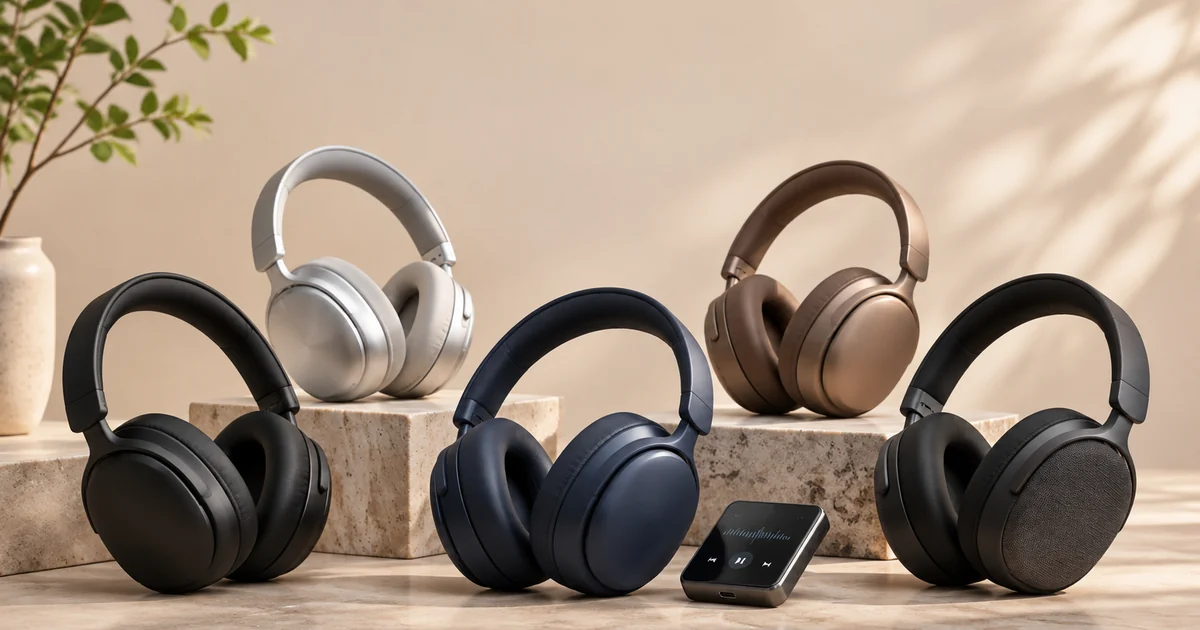
Quick picks by listening priority
For a balanced premium pair across devices: the Sony WH-1000XM6 combines adaptive noise cancelling, multipoint, LDAC and a detachable analog cable. Sony rates it for up to 30 hours with noise cancelling on. SoundGuys measured 37 hours and 14 minutes in its own standardized test, but that result belongs to SoundGuys’ test setup—not a promise of the same runtime for every listener.
For long-session comfort and travel: the Bose QuietComfort Ultra Headphones (2nd Gen) have generous padding, adaptive noise control and USB-C lossless audio. Bose advertises up to 30 hours, or 23 hours with Immersive Audio. RTINGS’ 2026 retest describes strong isolation and a very comfortable fit; it also notes that the microphone is unavailable over wired connections.
For battery longevity and repairability: the Sennheiser MOMENTUM 5 Wireless is rated for up to 57 hours with ANC on and has a user-replaceable battery. That combination is unusually practical if you expect to keep a pair for years. SoundGuys’ review praises the battery and connectivity, while noting that its ANC is good rather than class-leading.
For airplane entertainment and flexible sources: the JBL Tour One M3 Smart Tx adds a touchscreen transmitter that can connect to analog or USB audio sources, including many seatback entertainment systems. JBL rates the headphones for up to 40 hours with ANC on and 70 hours with it off; the transmitter itself has a separate battery rating.
For people already invested in Apple devices: the Apple AirPods Max 2 add H2-powered features, Adaptive Audio, Personalized Spatial Audio and lossless USB-C listening. The trade-offs are weight, a 20-hour ANC battery estimate and reduced feature access on non-Apple devices.
Five wireless over-ear headphones at a glance
| Model | Manufacturer battery estimate | Weight | Documented strengths | Check before buying |
|---|---|---|---|---|
| Sony WH-1000XM6 | Up to 30 h (ANC on); 40 h (ANC off) | 254 g | LDAC, LC3, multipoint, detachable analog cable, passive operation | No USB audio; shallow ear pads may not suit every ear shape |
| Bose QuietComfort Ultra Headphones (2nd Gen) | Up to 30 h; 23 h with Immersive Audio | Approx. 264 g (headphones only) | Comfort-focused fit, adaptive ANC, USB-C lossless, aptX Adaptive on compatible Snapdragon Sound devices | Wired use disables the microphone; confirm the exact battery mode and listing |
| Sennheiser MOMENTUM 5 Wireless | Up to 57 h (ANC on) | Approx. 290 g | User-replaceable battery, aptX Lossless, USB-C and 3.5 mm wired listening, two active Bluetooth connections | No IP rating; ANC is not the strongest in this group |
| JBL Tour One M3 Smart Tx | Up to 40 h (ANC on); 70 h (ANC off) | 278 g | Smart Tx transmitter, Auracast, USB-C and 3.5 mm inputs, LDAC and LC3 | Confirm whether the Amazon listing includes the Smart Tx transmitter |
| Apple AirPods Max 2 | Up to 20 h (ANC on) | 386.2 g | H2 features, strong ANC, Personalized Spatial Audio, lossless USB-C audio | Heavy; many conveniences and features depend on Apple devices |
Battery figures above are manufacturer estimates under their own conditions. They are not directly comparable as a ranking: volume, codec, spatial audio, call use, ANC mode, temperature and test content differ. Weight is the headphone-only manufacturer figure where available; cases and transmitters are excluded.
What each model does well—and where it compromises
1. Sony WH-1000XM6 — a flexible all-rounder
Sony lists Bluetooth 5.3, SBC, AAC, LDAC and LC3 support, multipoint connection and up to 30 hours of continuous music playback with noise cancelling enabled. The headphones weigh approximately 254 g and support passive wired operation through the detachable stereo-mini cable. That makes them a versatile option for someone moving between a phone, laptop and an analog source.
LDAC is not a universal upgrade button. The source device must support it, and Apple devices generally use AAC rather than LDAC. The WH-1000XM6 also does not provide USB audio listening; its USB-C port is for charging. Independent testing is positive about its ANC, sound and microphone, but RTINGS notes that the ear pads are relatively shallow, so people with larger ears should pay attention to fit.
- Consider it if: you want strong all-round ANC, app-based EQ and broad Android/laptop compatibility.
- Check first: ear-pad depth, your preferred codec and whether analog wired listening is enough for your setup.
Check the Sony WH-1000XM6 Amazon listing (ASIN B0F3PQHWTZ).
2. Bose QuietComfort Ultra Headphones (2nd Gen) — comfort and noise isolation
Bose’s second-generation Ultra headphones focus on noise control, plush padding and listening modes. The official specification page lists Bluetooth 5.4, a 30-hour battery figure and USB-C digital audio at up to 16-bit/44.1 or 48 kHz from compatible sources. Bose also supports Snapdragon Sound; aptX Adaptive is used when the connected Android device is Snapdragon Sound-certified. Do not assume every Android phone will expose that codec.
RTINGS’ retest describes the Bose pair as very comfortable and particularly effective at reducing travel noise. It also flags a practical limitation: the microphone does not work while the headphones are connected by wire. If you regularly switch between a laptop meeting and a wired in-flight entertainment system, remember that wired listening and wired calls are not the same thing.
Bose’s product page gives up to 30 hours, or 23 hours with Immersive Audio. The page’s detailed footnote also references an earlier 24/18-hour test protocol that does not explicitly identify a second-generation test unit. We therefore report Bose’s current headline estimate but avoid treating the footnote as a clean, directly comparable Gen 2 result.
- Consider it if: long-session comfort, travel noise reduction and USB-C lossless playback matter more than the lightest possible build.
- Check first: whether your calls are wireless, which Snapdragon Sound features your phone supports and how the ear cushions feel with glasses.
Check the Bose QuietComfort Ultra Headphones (2nd Gen) Amazon listing (ASIN B0FDKR293G).
3. Sennheiser MOMENTUM 5 Wireless — long runtime and a replaceable battery
Sennheiser rates the MOMENTUM 5 for up to 57 hours of Bluetooth playback with ANC enabled. Its most meaningful ownership feature is the user-replaceable rechargeable battery: the company describes a replacement process that can be completed with a small screwdriver. The headphones weigh approximately 290 g and support Bluetooth 5.4, SBC, AAC, aptX, aptX HD, aptX Adaptive and aptX Lossless. They also support USB-C and analog wired listening.
That broad codec list matters most to compatible Android devices. iPhones do not use aptX Lossless, so Apple owners should not pay extra solely for that codec. The product is not IP-rated, which is a reason to choose earbuds for workouts or wet-weather use rather than treating these as sports headphones.
SoundGuys tested the MOMENTUM 5 for two weeks and highlights its replaceable battery, connectivity and battery capacity. Its review describes the ANC as improved and useful, but not at the very top of the category. SoundGuys also notes that its battery test was not complete at the time of publication; the 57-hour figure in our comparison is therefore Sennheiser’s claim, not a SoundGuys lab result.
- Consider it if: long battery life, replaceability and broad Android codec support are high priorities.
- Check first: the fit around your ears, the lack of an IP rating and whether your source device supports the codec you intend to use.
Check the Sennheiser MOMENTUM 5 Wireless Amazon listing (ASIN B0H1YDZJQP).
4. JBL Tour One M3 Smart Tx — the most flexible travel-source setup
The Tour One M3 Smart Tx is more than a conventional Bluetooth headphone bundle. JBL includes a separate touchscreen transmitter that can accept USB-C digital audio or a 3.5 mm analog source, then send audio wirelessly to the headphones. That can be useful with airplane seatback entertainment systems, televisions or older audio sources that do not offer Bluetooth. JBL lists Bluetooth 5.3 with LE Audio, Auracast, 40 mm drivers and up to 40 hours of music playback with ANC on, or 70 hours with ANC off. The headphones weigh 278 g.
The Smart Tx is a separate device with its own battery rating—up to 18 hours according to JBL—so do not confuse its runtime with the headphone runtime. Also verify that the listing you buy is the Smart Tx bundle rather than a Tour One M3 version without the transmitter. The transmitter is the feature that makes this particular version distinctive.
SoundGuys’ lab review found strong ANC and a broad feature set, including the transmitter, USB audio and Auracast. Its reviewer thought the default sound needed some adjustment and noted that comfort may not suit everyone. What Hi-Fi? also praised the foldable design and wired lossless option, while judging the sound and ANC less convincingly than some rivals. These are reviewers’ findings, not TestedWise hands-on results.
- Consider it if: you travel often and want a way to use seatback or other wired audio sources without plugging a cable into the headphones.
- Check first: whether the transmitter is included, its separate battery needs and whether you like the sound after using the app EQ.
Check the JBL Tour One M3 Smart Tx Amazon listing (ASIN B0F4RT7HFT).
5. Apple AirPods Max 2 — for people who live in the Apple ecosystem
AirPods Max 2 use Apple’s H2 headphone chip and add Adaptive Audio, Conversation Awareness, Personalized Spatial Audio and Live Translation on compatible Apple devices. Apple lists Bluetooth 5.3, up to 20 hours of listening with ANC enabled and a weight of 386.2 g. USB-C supports lossless audio and ultra-low-latency audio with compatible setups.
The trade-off is substantial weight: at 386.2 g, AirPods Max 2 are much heavier than the other four headphones in this comparison. SoundGuys measured 21 hours and 31 seconds with ANC enabled at 75 dB SPL and found the noise cancelling very effective, but also called out the weight, battery life and Apple-only features as drawbacks. The Smart Case helps the headphones enter a low-power state, but it offers limited physical protection.
AirPods Max 2 can connect to non-Apple devices as Bluetooth headphones, but Apple’s system conveniences—automatic switching, Spatial Audio features and settings—are limited or unavailable outside compatible Apple hardware. SoundGuys also notes that the wireless codec list is SBC and AAC; lossless playback is through USB-C, not a high-resolution Bluetooth codec.
- Consider it if: you use an iPhone, Mac and iPad, and value Apple-specific switching and spatial features.
- Check first: the 386.2 g weight, case protection, 20-hour battery estimate and reduced non-Apple feature set.
Check the Apple AirPods Max 2 Amazon listing (ASIN B0GSS4SGZR).
How to compare headphone tests fairly
Battery is one of the easiest specifications to misuse. Manufacturer figures describe a particular combination of volume, codec and listening mode. Independent labs use their own test tracks, sound levels and ANC settings. For example, SoundGuys measured 37 hours and 14 minutes for the Sony WH-1000XM6, 55 hours and 37 minutes for the JBL Tour One M3, and 21 hours and 31 minutes for AirPods Max 2 with ANC enabled at its stated 75 dB SPL test level. Those are useful measurements from one publisher, but they are not the same as manufacturer claims and should not be mixed with RTINGS results as if every lab used an identical protocol.
Comfort is even less universal. Head width, ear size, glasses, hairstyle, clamping force and heat all change the experience. A reviewer can tell you what they found and explain their test method; only a fit trial can tell you whether a headband or ear cup will bother you after three hours.
Finally, ANC ratings should be read by frequency and environment. A headphone can be excellent at reducing low airplane rumble but less effective at nearby speech. Look for measurements and sample recordings rather than relying on a single “noise cancellation percentage.”
Phone, laptop and wired compatibility
iPhone users: AAC is the common Bluetooth route for all five. Apple-specific features make AirPods Max 2 more convenient in an Apple household, but Sony, Bose, Sennheiser and JBL also work over standard Bluetooth. Do not buy LDAC or aptX support expecting an iPhone to use those codecs.
Android users: Sony’s LDAC and Sennheiser’s aptX family can be useful if the phone supports the codec. Bose aptX Adaptive requires a compatible Snapdragon Sound device. JBL’s LDAC support is also source-dependent. Codec support must exist at both ends of the connection.
Windows and work laptops: check multipoint behavior, microphone mode and whether the headphones can stay connected to a phone and computer simultaneously. Multipoint is not the same as seamless ecosystem switching, and some features change when a headset is connected by cable.
Wired audio: Sony supports analog listening through its 3.5 mm cable and can operate passively. Bose supports analog and USB-C digital audio, but RTINGS notes that its mic is unavailable while wired. Sennheiser includes analog and USB-C listening. JBL supports analog/USB audio and adds the Smart Tx transmitter. AirPods Max 2 use USB-C for lossless wired listening. If you need a wired microphone for meetings, verify that exact use case before buying.
A practical buying checklist
- Fit: Do the ear cups fully surround your ears? Do the pads press on glasses or piercings? Can you return the headphones after a fit trial?
- Weight: Compare grams, but also check clamp force and headband pressure. The lightest pair is not automatically the most comfortable.
- ANC: Is your main problem airplane rumble, office speech, HVAC noise or general distraction?
- Battery: Use the ANC-on figure if ANC will stay on. Treat lab results and manufacturer estimates as separate evidence.
- Connectivity: Do you need multipoint, a specific codec, USB-C audio or a 3.5 mm cable?
- Calls: Check independent microphone samples. Confirm whether the mic works when wired.
- Travel: Is the case protective? Does the headset fold? Do you need an aircraft-seat transmitter?
- Ownership: Check replacement ear pads, battery repair options, warranty, seller and return terms.
If you are deciding between over-ear headphones and earbuds, the existing five-model wireless earbuds comparison explains the portability and fit trade-offs. For a more general decision framework, continue to How to Choose Over-Ear Headphones. Apple-specific comparisons are covered in our AirPods model guide.
Frequently asked questions
Are over-ear headphones better than earbuds for flying?
They can be more comfortable for long listening sessions and often provide larger batteries and strong ANC, but they take up more space. Earbuds are easier to pack and may be preferable if over-ear cups make your ears hot or press on glasses. The right choice depends on fit and how much you value portability.
Which headphones in this comparison have the longest stated battery life?
Sennheiser rates the MOMENTUM 5 Wireless for up to 57 hours with ANC on. JBL rates the Tour One M3 for up to 40 hours with ANC on and 70 hours with ANC off. These are different manufacturer test estimates, not a controlled comparison.
Can I use these headphones with both an iPhone and a Windows laptop?
All five can connect over Bluetooth to common devices, but simultaneous connections and automatic switching differ. Sony, Bose and Sennheiser list multipoint capabilities. Apple’s automatic switching is designed around compatible Apple devices. Check the exact model’s app and device instructions before relying on it for work.
Do I need LDAC or aptX Lossless?
No. These codecs are useful only if the phone, computer, headphones and playback settings support them. Fit, tuning, source quality and stable connection matter too. iPhones generally use AAC rather than LDAC or aptX Lossless.
Can I listen to lossless audio over USB-C?
Bose, Sennheiser, JBL and Apple document USB-C audio capabilities for their respective models. Sony WH-1000XM6 uses USB-C for charging and offers analog wired listening instead of USB audio. Check the supported bit depth, sample rate and app settings for the exact product.
Which model is best for airplane entertainment systems?
The JBL Tour One M3 Smart Tx has a dedicated transmitter designed to connect to analog or USB audio sources, which can be useful with many seatback systems. A standard 3.5 mm cable can also work with other models, but the JBL transmitter is a separate accessory with its own battery.
Are any of these headphones water-resistant?
Do not assume so. These are primarily consumer over-ear headphones, and some have no published IP rating. Sweat, rain and spills can damage cushions, microphones or charging ports. Check the exact manufacturer documentation and avoid using them in wet conditions unless the model is explicitly rated for it.
Bottom line: Sony is the balanced cross-platform choice, Bose emphasizes comfort and isolation, Sennheiser stands out for its replaceable battery and long stated runtime, JBL adds an unusually useful travel transmitter, and AirPods Max 2 make the most sense for Apple users who accept their weight and shorter battery estimate. Choose by your own routine and fit—not by a single winner badge.
Sources & further reading
- Sony — WH-1000XM6 official specifications
- Sony — WH-1000XM6 Help Guide specifications
- Bose — QuietComfort Ultra Headphones (2nd Gen) product specifications
- Bose Support — Snapdragon Sound and aptX Adaptive compatibility
- Sennheiser — MOMENTUM 5 Wireless official product and specifications
- Sennheiser — MOMENTUM 5 Wireless support specifications
- JBL — Tour One M3 Smart Tx official product page
- JBL — Tour One M3 Smart Tx official specification sheet
- Apple — AirPods Max 2 technical specifications
- RTINGS — Sony WH-1000XM6 review and retest
- RTINGS — Bose QuietComfort Ultra Headphones (2nd Gen) review and retest
- SoundGuys — Sony WH-1000XM6 review and battery test
- SoundGuys — Sennheiser MOMENTUM 5 Wireless review
- SoundGuys — JBL Tour One M3 review and battery test
- SoundGuys — Apple AirPods Max 2 review and battery test
- SoundGuys — 2026 headphone test methodology and model comparison
- What Hi-Fi? — JBL Tour One M3 Smart Tx review
- Sennheiser — MOMENTUM 5 Wireless official support specifications
Content reviewed: Nov 20, 2026